Cruise Cabin Prices Explained: What Changes Your Fare

A cruise with the same general duration can have a radically different price before you even choose a cabin. According to Newsweek's reporting of AAA estimates, seven-night European river cruises commonly cost $2,500–$5,000 per person in 2025, compared with $700–$2,000 per person for seven-day Caribbean cruises. The cabin category matters, but so does the product you're buying.
The useful question isn't what cabin prices average. It's what you'll pay per passenger-night for the accommodation, inclusions, and itinerary you want. That approach also exposes a costly blind spot: a fare advertised per person sharing a cabin may bear little resemblance to the price for someone traveling alone.
Table of Contents
- Typical Cabin Prices by Category at a Glance
- What Moves a Cruise Cabin Price and How to Compare Totals
- How Much More a Balcony Really Costs Per Person
- Solo Cabin Prices and the Single Supplement
- How Season, Itinerary and Ship Class Shift Fares
- Lock In Your Cabin Rate Before You Pay
Typical Cabin Prices by Category at a Glance
| Cabin type | Average per night, November 2025 | Seven-night Caribbean fare per person per night, 2024 |
|---|---|---|
| Inside | $142 | $85 |
| Ocean view | $168 | $130 |
| Balcony | $215 | $200 |
| Suite | $385 | $430 |
The November 2025 nightly averages, $142 inside, $168 ocean view, $215 balcony, and $385 suite, come from All Aboard Deals. The 2024 estimates for a typical seven-night Caribbean cruise, $85 inside, $130 ocean view, $200 balcony, and $430 suite per person per night, come from Super Global Calculator.
These columns aren't interchangeable. The first reports nightly category averages without establishing the same per-person basis as the second. Don't divide that column by an assumed occupancy or treat a difference between columns as evidence that prices rose or fell.
Read the price ladder, not a promised fare
Both sets show the same broad ordering: inside cabins cost least, ocean-view cabins sit above them, balconies require a more substantial commitment, and suites occupy a separate budget tier. They don't establish what your departure will cost.
For practical budgeting, assign each category a job:
- Inside: Keep accommodation spending down when you'll spend most waking hours elsewhere on the ship.
- Ocean view: Pay for daylight and an outside view without assuming you need private outdoor space.
- Balcony: Budget for somewhere private to sit outside, not merely a larger room.
- Suite: Examine the specific accommodation and included services rather than buying the label.
An ocean-view cabin can be the sensible middle ground if daylight matters but you rarely sit outdoors. An inside cabin can be better value if you're choosing between a window and the shore excursion you most want.
Budgeting rule: Use averages to choose which categories to investigate, then use live quotes to set your actual spending limit.
A monthly average also isn't a year-round ceiling. Keep a provisional range for each category, with separate room for trip expenses outside the fare. Your completed vacation budget may exceed the cabin-only range once those expenses are included.
What Moves a Cruise Cabin Price and How to Compare Totals
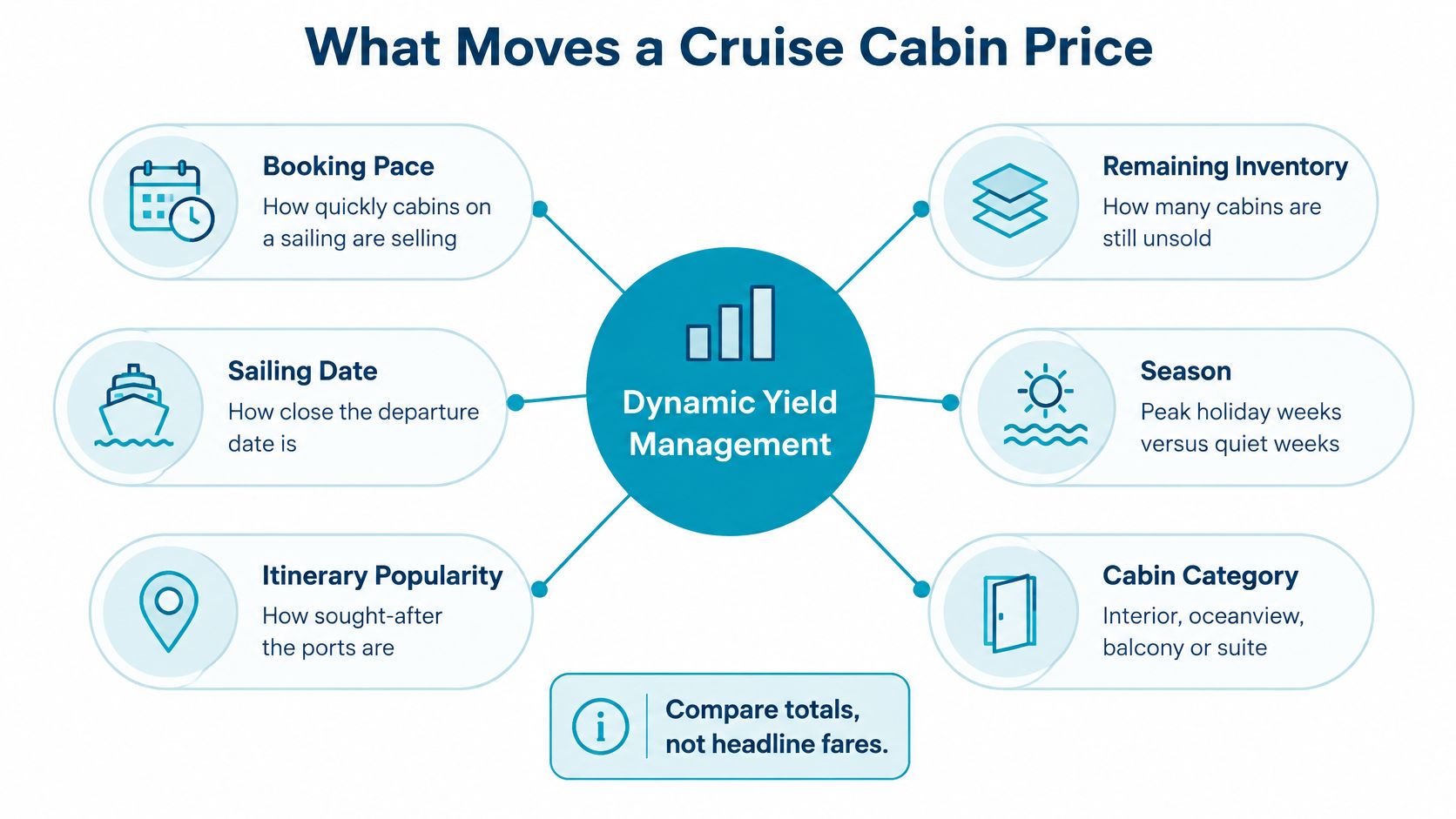
Cruise lines adjust fares through dynamic yield management. Actowiz Solutions' cruise pricing report identifies booking pace, remaining inventory, sailing date, seasonality, itinerary popularity, and cabin category as pricing drivers, and explains that categories can reprice independently.
That last point changes how you shop. An inside cabin can remain discounted while balconies on the same departure become more expensive because balcony inventory is selling faster.
The pricing drivers work together rather than as a universal booking calendar.
Read availability alongside the fare
Booking pace describes how quickly passengers are reserving cabins; remaining inventory describes what the cruise line still has to sell. Departure timing and season affect that sales picture, while itinerary appeal influences which accommodation passengers are willing to pay for.
Availability provides another clue. A category shifting from selectable cabins to guarantee-only or waitlist status can indicate tightening supply. It doesn't prove that every other category will increase.
If choosing your exact stateroom matters, treat that ability as part of the product. A guarantee booking and a selectable cabin aren't equivalent just because they share a category name. Read the assignment conditions before deciding the cheaper option wins.
Turn the advertised fare into a comparable total
Use a spreadsheet or a saved comparison with separate fields for fare, charges, extras, and usable benefits.
- Match the booking conditions. Compare the same ship, itinerary, departure date, occupancy, category, and inclusion set when judging competing offers. Otherwise, identify exactly what changed.
- Build the cash total. Include taxes, port charges, mandatory fees, and any gratuities not already included. Add the Wi-Fi, drinks, excursions, and insurance you intend to buy.
- Value promotions realistically. Count onboard credit only against eligible spending you would otherwise make. A smaller deposit changes when you pay, not necessarily how much you pay.
- Normalize the result. Divide the all-in total by the number of passengers and cruise nights.
All-in cost per passenger-night = total planned cruise spending ÷ passengers ÷ nights.
Keep the scope consistent. If airfare and a pre-cruise hotel appear in one option, include them in the others or show them in a separate trip-cost comparison. Our guide to the average cost of a cruise for two can help you organize a shared budget without confusing the cabin total with the per-person amount.
Our real-time pricing includes bonus offers, onboard credits, group space, rates, and exclusive online discounts. Check the conditions attached to each offer rather than assuming every displayed benefit applies to every fare.
Travel insurance also needs its own quote because its price depends on the cruise's cost and length. Don't copy an insurance allowance from a shorter or cheaper itinerary.
Our comparison tool lets you compare up to six sailings side by side, including rates, itineraries, ship profiles, and more. Use that view to eliminate mismatched options, then compare the remaining totals on the same basis.
How Much More a Balcony Really Costs Per Person
| Cruise line | Balcony average per person | Interior average per person | Balcony premium | Typical itinerary |
|---|---|---|---|---|
| Royal Caribbean | USD 1,008 | USD 635 | About 58% | About 6 nights |
| Princess | USD 1,343 | USD 728 | About 84% | About 10 nights |
Travel Daily Media's cross-line analysis reports Royal Caribbean averages of approximately USD 1,008 for balconies versus USD 635 for interiors on roughly six-night itineraries, and Princess averages of USD 1,343 versus USD 728 on roughly ten-night itineraries, with balcony premiums of about 58% and 84%, respectively.
Those aren't interchangeable quotes for your trip. They show why an upgrade deserves its own calculation rather than an automatic tick in the booking engine.
A balcony costs more for reasons beyond floor area. The cruise line has limited balcony inventory, passengers are buying private outdoor space, and scenic itineraries can make that space especially desirable.
Price the upgrade against actual use
Start with the total cabin upgrade, not a per-person promotional difference. Divide that amount by cruise nights, then by the occupants sharing the cost.
The same Travel Daily Media analysis illustrates the occupancy effect: a USD 400 cabin upgrade over seven nights costs approximately USD 28.57 per passenger-night when shared by two people, or USD 57.14 per night for a solo traveler. Sharing doesn't make the upgrade cheaper overall, but it changes the cost each traveler must justify.
Buy the balcony for time you expect to spend there, not simply because it's the next category up.
A balcony is easier to justify when both occupants expect to use it during scenic cruising, quiet mornings, or downtime between activities. It's harder to justify when you'll mostly be ashore and return to the cabin to sleep.
Length alone doesn't make the upgrade worthwhile. A longer sailing spreads a fixed premium across more nights, but the quoted premium itself may also be higher.
Apply the same test to suites. List the services and space included in the specific suite, subtract only expenses those inclusions replace, and evaluate the remaining upgrade cost. A suite with benefits you won't use isn't automatically better value than a comfortable balcony.
Solo Cabin Prices and the Single Supplement
A cheaper-looking inside cabin can cost a solo traveler more than a purpose-built studio. The advertised fare may assume shared occupancy, while the studio is priced for someone traveling alone.
Private space can still be worth paying for, but the comparison needs to start with the solo total.
CruiseBooking's 2026 pricing guidance reports single supplements of roughly 150–200% of the published per-person fare, while noting that dedicated studios can reduce or avoid the surcharge. Percentage terminology needs care: confirm whether a quote describes the total solo fare as a percentage of the shared fare or an additional percentage added to it before doing any arithmetic.
Find the studio break-even point
Request the complete price for a solo occupant in each relevant category:
- Inside: Record the solo cabin fare, not the shared-occupancy starting price.
- Ocean view: Check whether daylight comes at an acceptable incremental cost.
- Balcony: Judge the private outdoor space against your personal nightly budget.
- Studio: Confirm both the total and any differences in accommodation or inclusions.
Keep taxes, port fees, and gratuities separate from the occupancy adjustment. They don't necessarily scale in the same way, so multiplying an entire shared-occupancy quote can produce the wrong answer.
The studio wins on price when its complete solo total is lower than the standard cabin's complete solo total for the same sailing. Divide each by cruise nights to compare the cost of traveling alone without a second passenger diluting the result.
For another perspective on choosing a solo cruise, watch the video below.
Don't assume studios will remain available while you decide. Solo inventory is limited and can disappear earlier than standard double-occupancy accommodation, so check it early even if you're still considering a larger cabin.
How Season, Itinerary and Ship Class Shift Fares
Timing can change your options before you compromise on accommodation. CabinSaver's analysis of 806 Norwegian Cruise Line sailings in 2025 found the lowest median fares in November, approximately $70–$175 per night across studio, inside, ocean-view, and balcony categories.
That's a finding about a specific cruise line and dataset, not proof that November is cheapest everywhere. Use it as a reason to test neighboring months rather than as a rule for every destination.
Change one trip variable at a time
Start with your preferred category and compare departure months. If you also change ships, destinations, and accommodation at once, you won't know which compromise produced the saving.
- Month: Compare quieter periods with holiday departures while checking weather and the activities available ashore.
- Route length: Use the nightly figure alongside the full amount you'll pay. A manageable nightly rate can still produce an unaffordable trip total.
- Departure port: Check the fare and your journey to the ship. A cheaper cruise can lose its advantage when flights or hotel arrangements become more complicated.
- Ship class and brand tier: Compare the onboard product as well as the accommodation. Mainstream ocean, premium, luxury, and small-ship options don't necessarily include the same services.
For a destination-specific timing decision, consider Alaska cruises in September. Weigh the sailing's price against the conditions and experiences you want, rather than treating the cheapest available date as automatically best.
A cheaper departure is useful only if you still want the trip it offers.
Separate a lower fare from a different vacation
A smaller ship, older vessel, or different brand may suit you well. But label that change clearly instead of presenting it as an identical product at a discount.
Save comparable quotes as you shop, including the date checked and the fare conditions. If your preferred category becomes expensive, test a neighboring departure before abandoning it.
The practical shortlist is straightforward: settle the month, route length, embarkation port, and ship class, then compare sailings that match those priorities. You'll make a clearer decision than you would by sorting an unrestricted search by its lowest advertised fare.
Lock In Your Cabin Rate Before You Pay
Choose the lowest all-in cost per passenger-night among the sailings that meet your requirements, not the lowest number anywhere in the search results. A bargain that removes your preferred itinerary or essential accommodation feature isn't the same purchase.
Before entering payment details, make sure the quote reflects the travelers, cabin, inclusions, and benefits you intend to book. Save the itemized total so you can distinguish a genuine fare change from a different offer.
Check the payment conditions
- Confirm the deposit: With our bookings, your rate is locked in once your deposit is paid. Check the amount due and the remaining payment schedule.
- Read cancellation terms: Once you're within the final-payment period, our cruise cancellation penalties are strict and aren't waived even for medical reasons.
- Resolve unclear charges: We offer a free cruise quote and can help with pricing questions before you commit.
Use our guidance on when to book a cruise to assess timing alongside the payment obligations, rather than watching the fare in isolation.
Know what happens if a lower price appears
If you find a lower price compared with the cruise line after booking but before final payment, advertised anywhere in U.S. dollars, we'll contact the cruise line to re-fare to the best promotion. Additional restrictions may apply, so don't assume a price adjustment is automatic.
Choose your qualifying sailing, verify the completed total, and request a quote while you still have the booking details open. That gives you a specific price and set of conditions to evaluate before paying.
Best Cruise Rates offers free cruise quotes, real-time pricing, and assistance with cabin selection and pricing questions. Visit Best Cruise Rates with your preferred sailing and occupancy details, and ask for an itemized quote you can compare on an all-in per-passenger-night basis.
Ready to book your next cruise?
Compare 40+ cruise lines or call our specialists at 1-888-604-0279.