How to Find Last Minute Cruises Without Overpaying

The most common advice about last-minute cruises is that prices collapse in the final weeks and patience pays. That advice is wrong often enough to cost real money. Fares on unsold cabins do drop sometimes, but they also sit flat, sell out, or climb as the cheap cabin categories disappear, and the saving you chased can vanish into a flight booked two weeks out.
Treat how to find last minute cruises as two questions instead of one. What does this sailing cost me in total, door to door, and what happens to that money if I cancel? Answer both and the choice gets simple. Skip them and you're betting on a price chart you can't see.
Table of Contents
- Search Windows and What Each One Pays
- How to Search and Compare Sailings Step by Step
- What the Trip Really Costs, From Fare to Port
- Cancellation Rules That Can Wipe Out Savings
- Decide Whether to Book This Sailing Today
Search Windows and What Each One Pays
Start looking 60 to 90 days before departure and price the same sailing at two or three checkpoints before you commit. That's the working answer, and it comes from the numbers rather than from the folklore. Last-minute booking is a search for remaining value, not proof that prices fall.
The most useful public analysis here is a 2024 study in Tourism Management Perspectives, summarized in this advance booking and cruise pricing study. It found that 84% of cruise bookings happen within 20 weeks of departure, with most crowded into the 3 to 10 week window. Bookings made 31 to 60 days out were, on average, only 0.9% cheaper than bookings inside the final 30 days, and that comparison isn't stable: booking 31 to 60 days ahead beat the final 30 days in 28.6% of the study's model estimates before the pandemic and in 39.3% of estimates after it.
Flexibility does the rest of the work. Compare multiple embarkation ports, dates, cabin grades and itineraries, because a lower base fare can be offset by reduced cabin choice or fewer promotions bundled into the price.
The wider market tightens the same screw. The Points Guy's reporting on cruise inventory put booking pace for 2024 sailings at 25% to 30% above 2019 levels, and noted that cruise lines historically had about 60% to 65% of the coming year booked by January, against an estimated 75% at the time of that analysis. Ships fill earlier, which leaves fewer cabins for anyone shopping three weeks out.
| Window before departure | What the pricing data shows | Search action |
|---|---|---|
| 90 to 61 days | Many sailings are already well booked; the average booking curve reached about 230 days in 2023 | Build a shortlist of three to five sailings |
| 60 to 31 days | Bookings averaged only 0.9% cheaper than the final 30 days, a result that flipped in 28.6% of estimates before the pandemic and 39.3% after | Compare the same sailing at several checkpoints |
| 30 to 21 days | Most bookings fall between 3 and 10 weeks out, so popular cabins sell first | Recheck the shortlist every 48 to 72 hours |
| 20 days or less | Final payment and penalty windows apply, and promotions are inconsistent | Confirm refund terms before paying |
Two checkpoint dates, two fares you'd accept, one decision. Write them down before you open a search tab.
How to Search and Compare Sailings Step by Step
Pick three sources before you price a single fare: the cruise line's own offers, a comparison tool, and a person who books cruises for a living. Run the same sailing through all three and record the totals in one place so they're comparable line for line. This guide to where to book a cruise covers the sourcing question in more depth, and our comparison tool will hold up to six sailings side by side on rate, itinerary and ship profile. The tool saves time; the discipline below is what saves money.
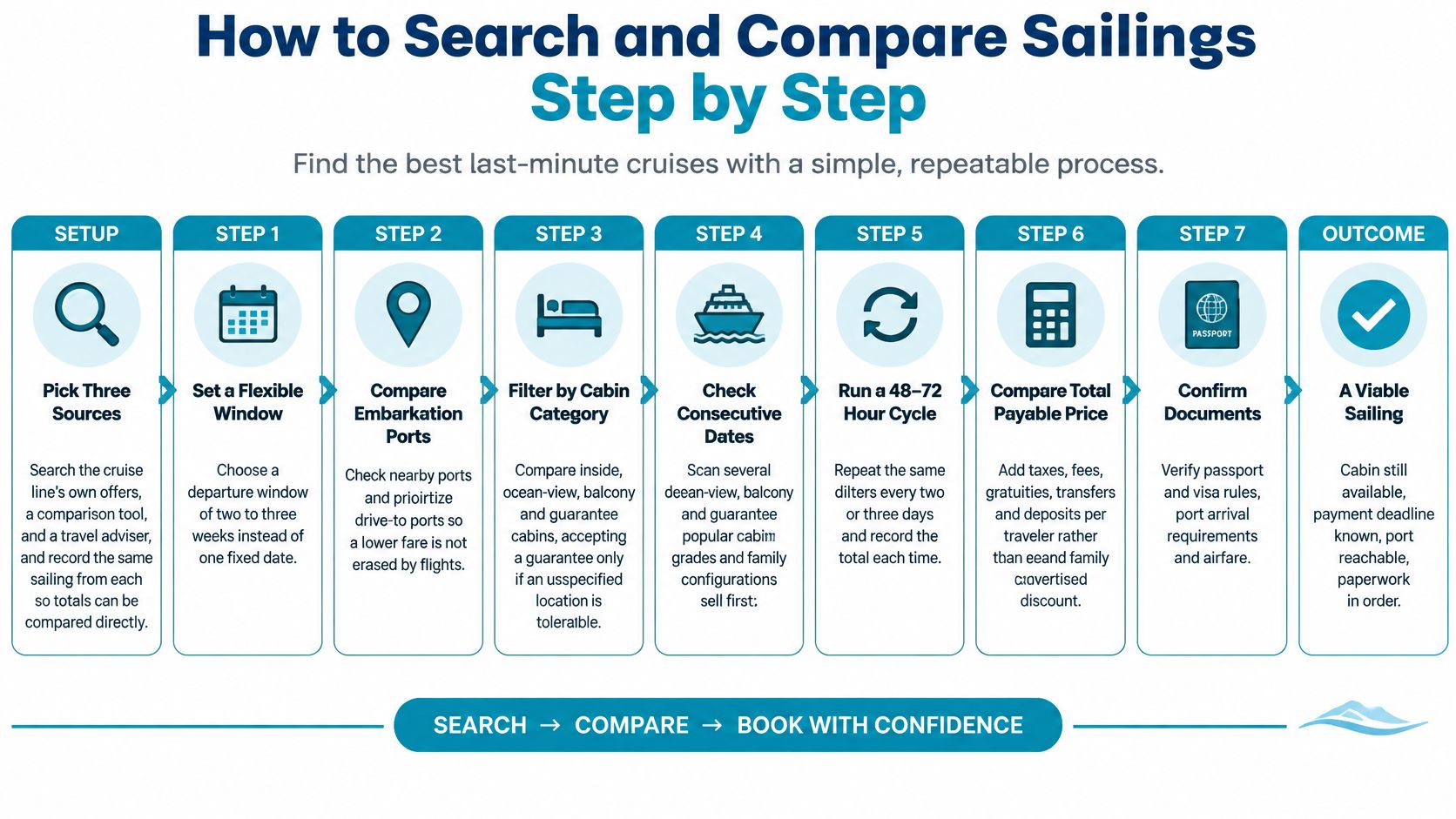
- Set a window of two to three weeks, not a date. A single fixed Saturday hides the sailing that leaves two days earlier and costs less. Scan every departure inside the window before you judge a route.
- Compare ports and start with the drive-to ones. A lower fare in a city you have to fly to usually isn't lower once flights, bags and a transfer are added. The usual mistake is comparing three base fares and picking the smallest without pricing the trip to each port.
- Filter by cabin category and be honest about guarantees. Inside, ocean-view, balcony and guarantee. A guarantee buys a category, not a location, so take it only if an unspecified cabin is tolerable. Skip it for a family who need two rooms near each other, and skip it for anyone who gets sick in the wrong part of the ship.
- Walk several consecutive departure dates. Availability is sold by lower berth and shifts by ship, itinerary, cabin type and occupancy. A sold-out Saturday often sits beside an open Tuesday on the same vessel, and family configurations go first.
- Run a 48 to 72 hour cycle. Repeat identical filters every two or three days and log the total each time. A genuine price drop and the quiet withdrawal of an onboard credit look identical in a headline fare, and only your recorded totals separate them.
- Compare the total payable, per traveler. Add taxes, fees, gratuities, transfers and any required deposit, then judge on all-in cost and included value. Percentage discounts are marketing numbers; the amount that leaves your account isn't.
- Confirm documents the day you shortlist. Passport validity, visa rules, arrival requirements at the port and the flight that must land before the ship sails. Paperwork that takes three weeks is a dead end on a fourteen-day booking.
A sailing is viable when four things are true at once: the cabin you can live with is still open, the payment deadline is written down, travel time to the port fits your schedule, and the paperwork clears. Anything short of all four means you're still shopping.
What the Trip Really Costs, From Fare to Port
A $300 cabin saving looks like a win until the flight you book three weeks out costs $500 more than the same route did in spring. That's the trade-off the Hourglass Expeditions cruise cost guide sets out, where a $300 cruise discount disappears after a $500 increase in airfare and leaves the traveler $200 behind. The cabin fare is the smallest number in that story.
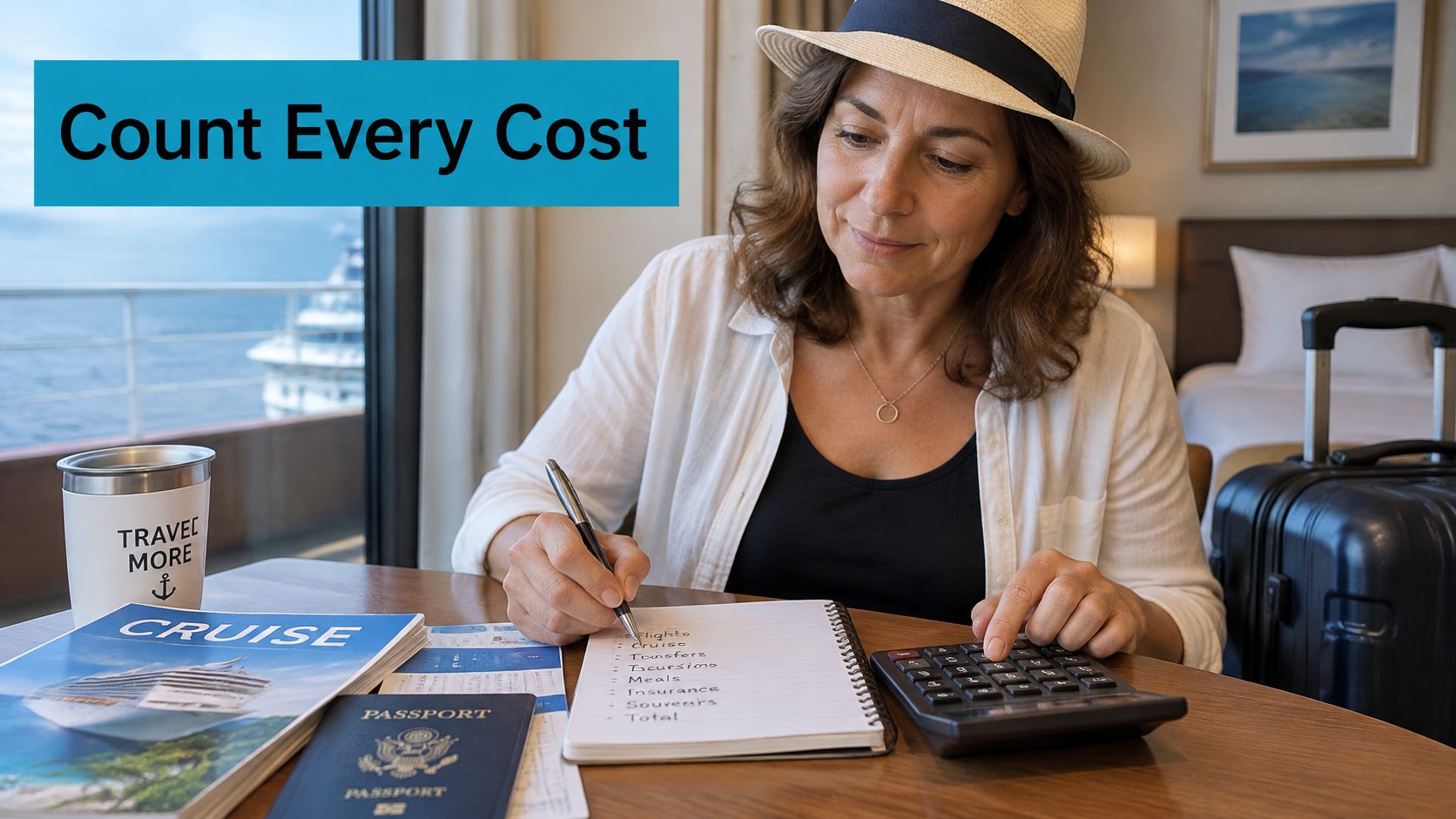
Price every line before you compare cabins
- Fare plus taxes and port fees: the headline number before the mandatory extras, and the one inflated in most marketing.
- Gratuities: a daily amount per person that runs into real money across a week. Set it from the page on how much are gratuities on a cruise instead of assuming it's trivial.
- Drinks, Wi-Fi and specialty dining: a package often beats paying per item, but only count what you'd use.
- Shore excursions and port transfers: priced per person, per port, and easy to leave out of a comparison.
- Airfare, checked bags and an airport hotel: the lines most likely to move against you in the final month.
- Insurance and the deposit: the two costs that decide how much you lose if plans change.
Test the trip to the port
Prioritize ports you can drive to. When flying is unavoidable, arrive at least one day before embarkation, price transfers, baggage and alternate airports, and don't lock in anything nonrefundable until the cancellation terms are confirmed. Miami, Port Canaveral and Fort Lauderdale carry heavy demand, and Port Canaveral recorded 8.6 million passenger movements in fiscal 2025, according to that same cruise cost guidance, so parking and transfers fill up in peak weeks.
The failure that has no fix is a missed embarkation. You can't solve it by meeting the ship at the next port, and the cabin is paid for either way.
Work the worksheet on your top two sailings
| Line | Example (USD) |
|---|---|
| Cabin saving | 300 |
| Added airfare | -500 |
| Transfers and parking | 140 |
| Hotel and extra night | 180 |
| Insurance premium | 95 |
| Net result before extras | -200 |
The figures on the right are a hypothetical worked example, so replace them with your own quotes. In this version, the three extras push the result from minus $200 to roughly minus $615, and that's before a single onboard charge. Do this for your top two sailings and keep the one with the best total you can reach.
Cancellation Rules That Can Wipe Out Savings
The cheapest fare of the final month is also the least forgiving. Cruise lines generally want full payment at booking when departure is close, and cancellation charges climb steeply from there. The Royal Caribbean booking and cancellation policy illustrates the shape of it, with charges rising toward 100% of the fare as sailing approaches, and nonrefundable deposits staying nonrefundable.
| Cruise line | Days before departure | Cancellation charge or rule |
|---|---|---|
| Royal Caribbean (1 to 4 nights) | 74 to 61 days | 50% charge |
| Royal Caribbean (1 to 4 nights) | 60 to 31 days | 75% charge |
| Royal Caribbean (1 to 4 nights) | 30 days or less | 100% charge |
| Disney Cruise Line | 89 to 45 days | Deposit charge |
| Disney Cruise Line | 44 to 30 days | 50% charge |
| Disney Cruise Line | 29 to 15 days | 75% charge |
| Disney Cruise Line | 14 days or less | 100% charge |
| Holland America Line | 120 days (final payment) | Final payment due |
| Holland America Line | 60 days or less | No refund |
Work the risk on a real number. A $2,000 fare on a 1 to 4 night Royal Caribbean sailing, cancelled 45 days out, lands in the 75% band and costs $1,500 to walk away from. That exposure is the reason to buy cruise insurance before final payment rather than after, and to confirm the policy covers cancellation, interruption, medical evacuation and missed embarkation. Once you're inside the final payment period, penalties are strict and don't get waived for medical reasons.
Get the exact schedule in writing for your fare, sailing length, residence market and cabin category, and ask whether the deposit is refundable or converts to future cruise credit.
Risk-adjusted price: fare plus nonrecoverable deposit, insurance premium, change fees, and any stranded airfare or hotel costs.
A low fare isn't a bargain if one disruption produces a loss bigger than the saving.
Decide Whether to Book This Sailing Today
The verdict splits by traveler, and it's rarely close.
- Wait when your destination and dates can move, the ports are flexible, and the all-in total is still falling at each checkpoint. Promotions on selected sailings are real, but they aren't universal, and the pricing pattern behind them is inconsistent.
- Book now when you need a specific ship, a specific cabin type, a school-holiday week or an international flight connection. Those sailings sell out, and waiting costs more than it saves.
- Walk away when a cheap headline fare sits on an itinerary nobody wants, a cabin with a restricted view, or transport that costs more than the cabin discount.
Booking research reported in 2025 found prices for 2026 cruises already running about 4% higher despite strong demand, according to the Maritime Executive's global cruise outlook. That's the market you're negotiating with, and it doesn't reward hesitation on the good cabins.
One decision rule covers it. If your top sailing passes the break-even worksheet and the cancellation date is clear, book it today. If it fails either test, hold it to the next checkpoint and keep the date.
Best Cruise Rates gives you real-time pricing and availability across more than 40 cruise lines, so you can price the same sailing at each checkpoint and see the total rather than a teaser fare. Our comparison tool holds up to six sailings side by side on rate, itinerary and ship profile, and our advisers will walk you through the cancellation schedule and deposit terms before you commit a dollar. Start with a free quote at Best Cruise Rates and put your two checkpoint dates on the calendar.
Ready to book your next cruise?
Compare 40+ cruise lines or call our specialists at 1-888-604-0279.