Alaska Cruises in September: Weather, Prices and Ports
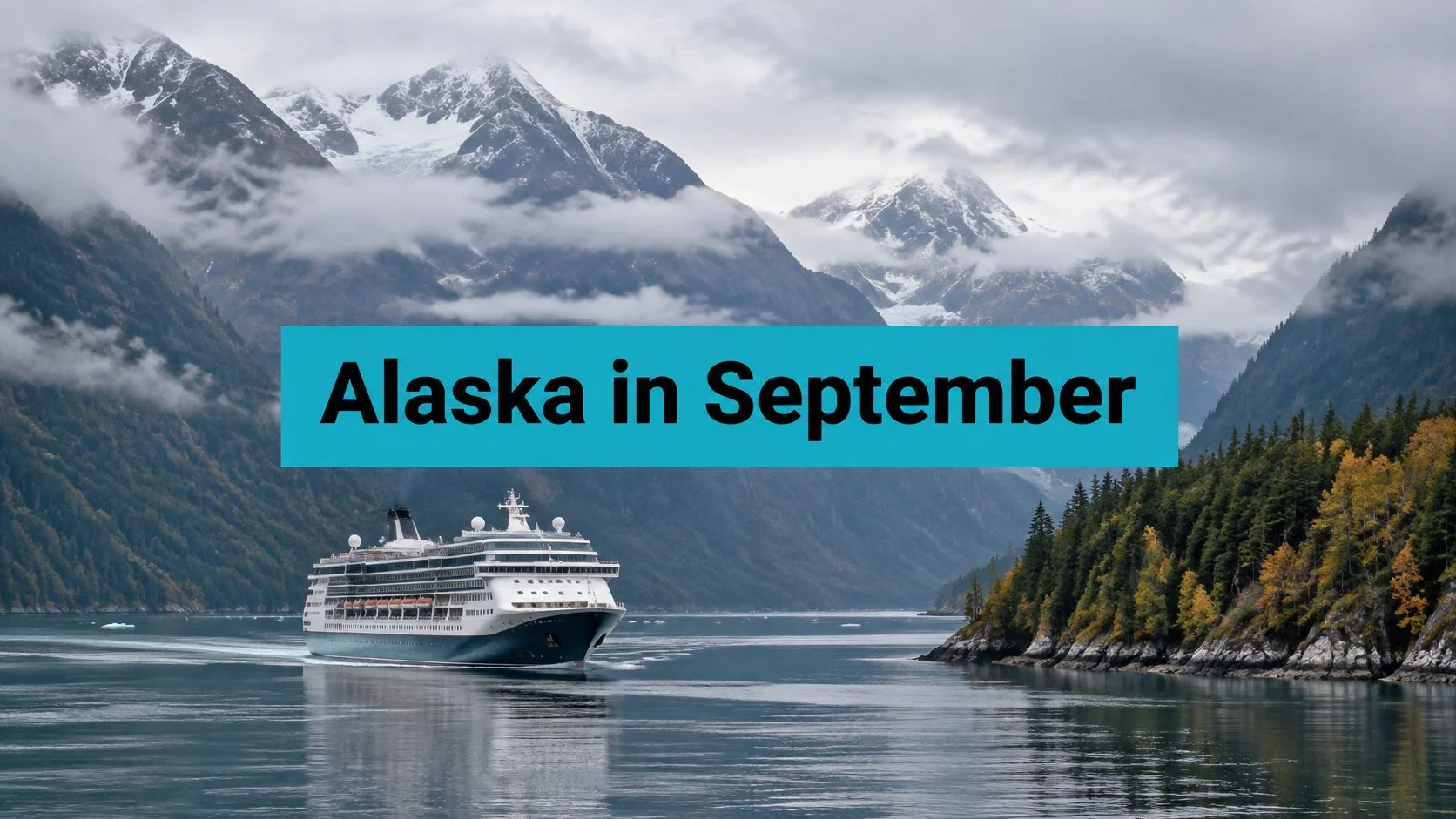
The cheapest Alaska cruise can be the wrong bargain if the scenery you're paying to see disappears behind low cloud. September brings genuine savings, but it also brings a wetter, darker version of the Inside Passage. Choose Alaska cruises in September for value and a less crowded trip, not for reliable sunshine, and judge the itinerary port by port rather than treating Alaska as a single weather forecast.
Table of Contents
- Is September the Right Month for Alaska?
- Weather and Rain by Port in September
- Highlights Across Early, Mid and Late September
- How to Pack and Book for Wet, Cool Days
- Crowds, Savings and What You Give Up
- Pick Your September Sailing Before You Book
Is September the Right Month for Alaska?
September suits travelers who'll trade warmer weather and longer days for lower prices and thinner crowds. It's a poor choice if rain would spoil your vacation or if your ideal cruise revolves around sunny afternoons on deck.
September sits at the late end of Alaska's regular May-through-September cruise season, and Alaska.org's weather and climate guide describes the late-season trade-off: some hotels, tours and cruises may cost approximately 10% to 25% less than peak summer, alongside the representative Inside Passage conditions below.
September at a glance in the Inside Passage
| Measure | September value | What it means for you |
|---|---|---|
| Average high | About 55°F | Layers needed on deck and in port |
| Average low | About 43°F | Cold evenings on the ship's outer decks |
| Daylight | About 12.4 hours | Shorter sightseeing windows |
| Rainy days | About 20 | Plan for wet days, not occasional showers |
| Clear days | About 6 | Glacier and mountain views aren't guaranteed |
| Price and crowd effect | Some prices about 10% to 25% lower than peak summer; generally fewer crowds | Potential savings on hotels, tours and cruises, not a guaranteed discount on every booking |
Treat those figures as planning averages, not a forecast for your sailing. A rainy day doesn't necessarily mean uninterrupted downpours, and a clear day isn't the only time you can enjoy a glacier. The concern is whether your plans still work when mountains disappear into cloud or an exposed afternoon becomes uncomfortable.
The basic choice is straightforward.
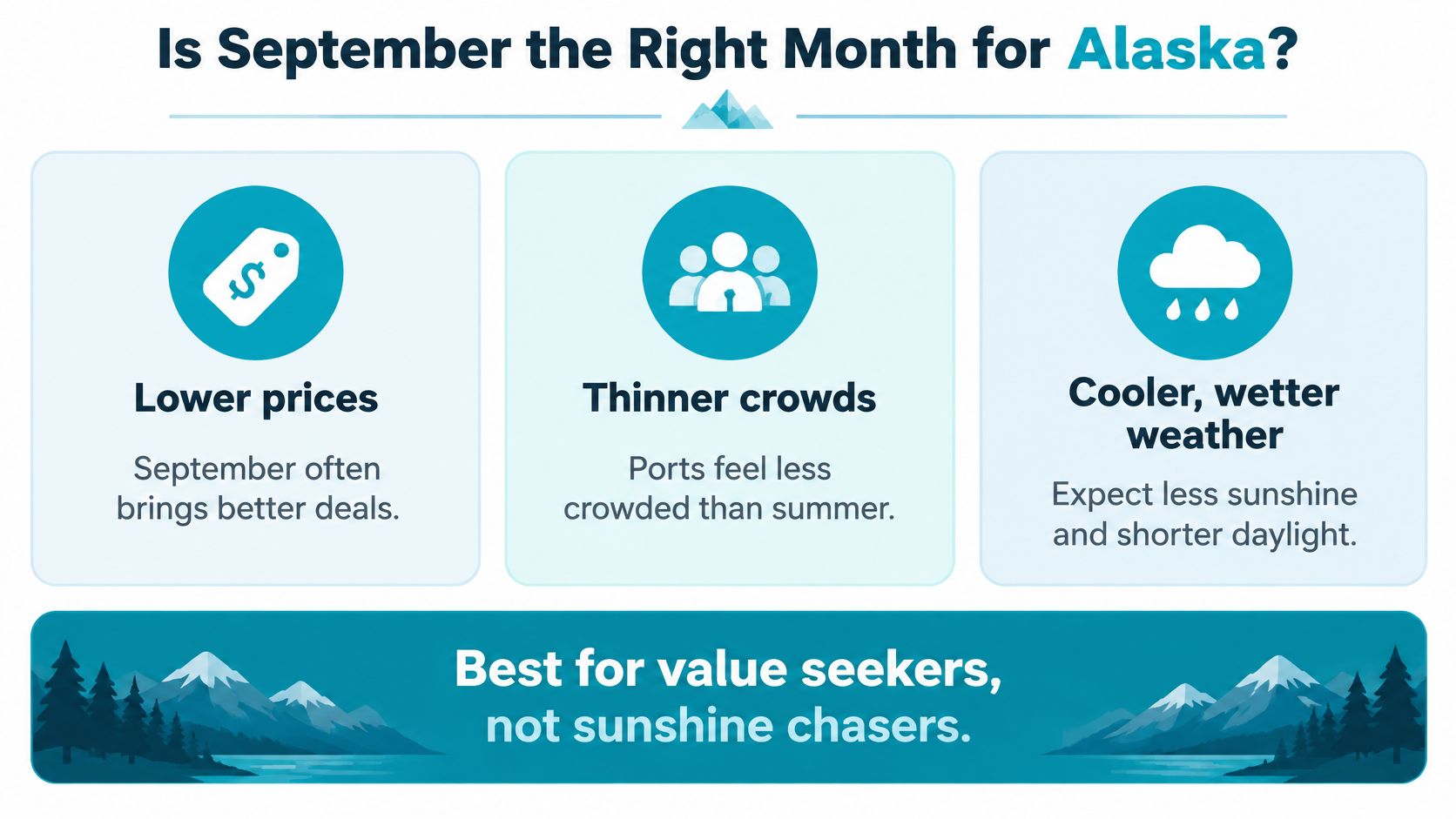
Buy the experience, not just the discount
Don't compare September and summer using the cruise fare alone. Compare the cabin category, port calls, included benefits, flights and the excursions you want. A lower fare is useful only when the sailing still delivers your priorities.
Use a cruise booking timing guide to organize the purchase, but decide your weather tolerance before chasing an offer. Waiting for a better price won't fix a mismatch between your expectations and the season.
Practical rule: If rain and shorter days would ruin the trip, choose June or July instead. If you're comfortable exploring in waterproofs and value a quieter experience, September deserves serious consideration.
Choose it deliberately. You shouldn't need an unusually sunny week to feel that you booked the right vacation.
Weather and Rain by Port in September
Treat September weather as a port-by-port problem, not one Alaska forecast. Ketchikan and Skagway can share an itinerary and still demand opposite plans: one argues for covered, flexible stops; the other is the better bet for an open-air day.
The Travel Chronicle's September cruise weather guide lists September precipitation normals near 9.15 inches in Juneau, 14.30 inches in Ketchikan, 9.90 inches in Seward and 3.9 inches in Skagway, with typical daytime highs in the mid-to-upper 50s°F across the region and mid-month daylight around 12 hours 50 minutes to 13 hours in major Southeast ports.
September weather by Alaska port
| Port | Average September high | September precipitation | What to plan for |
|---|---|---|---|
| Juneau | Mid-to-upper 50s°F regional range | About 9.2 in | Flexible glacier and whale timing with sheltered backups |
| Ketchikan | Mid-to-upper 50s°F regional range | About 14.3 in | Put indoor and sheltered activities first |
| Skagway | Mid-to-upper 50s°F regional range | About 3.9 in | Strongest outdoor-excursion candidate among these Southeast ports |
| Seward | Mid-to-upper 50s°F regional range | About 9.9 in | Protect the transfer day and keep a land-based fallback |
Those highs are a regional planning range, not proof that every port will feel the same. Sitka still belongs in the same cautious plan even without a quoted monthly total here: build the day from the local forecast instead of assuming it behaves like Juneau or Skagway.
Match the outing to the port
Juneau needs a backup you would enjoy. If the main event depends on glacier visibility, pick a museum, hatchery, tram-adjacent plan or another sheltered stop before boarding. For a boat excursion, ask how much seating is enclosed and how much viewing requires standing on an exposed deck.
Ketchikan is where shelter should drive the choice. Choose cultural visits, indoor stops or a guided outing with regular chances to get out of the rain. A long exposed walk should not be the only plan because it looks short on a map.
Skagway is the cleaner outdoor bet. Its lower monthly precipitation makes it the sensible port for a walking-heavy day or an open-air excursion. Mountain views can still vanish, so an enclosed rail coach remains a useful compromise rather than a compromise at all.
Seward is about protecting the whole day. A marine outing here often connects to embarkation, disembarkation or a train transfer, so check what a cancellation does to the rest of the schedule. Leave slack between the boat, the port and the next leg.
Sitka is a forecast call. Hold one outdoor option and one sheltered option, then decide close to the port call. Borrowing Skagway's drier pattern would be the wrong move.
Read beyond the rain icon
Maritime exposure and mountain effects explain why neighboring ports behave differently. They can also create low cloud and weak visibility without a dramatic storm warning.
Check visibility and cloud cover, not only precipitation. A manageable drizzle may still allow a waterfront walk, while low cloud can erase the point of a flightseeing ticket. Use the monthly numbers to choose a resilient itinerary, then use the local forecast to choose that day's activity.
Highlights Across Early, Mid and Late September
Start with your main reason for going, then choose the part of the month that supports it. A scenery-first traveler and someone looking for a peaceful, low-key voyage shouldn't automatically book the same departure.
Early September for scenery-first travelers
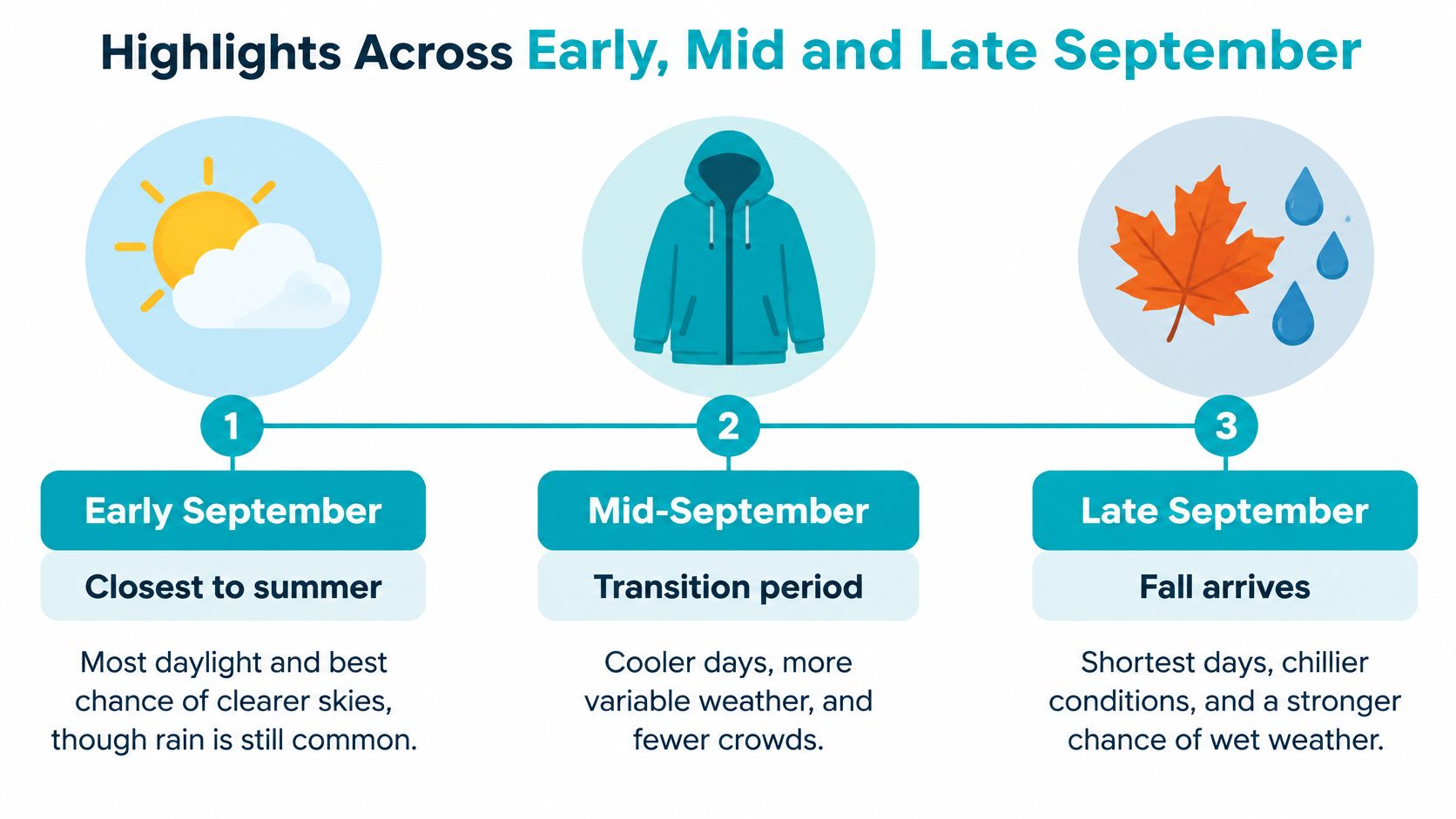
Early September is often the better fit for a first Alaska cruise within this month. It sits closest to summer, with more daylight than later departures and the chance of lingering summer-like conditions. Rain still belongs in the plan, so don't make every shore day depend on clear skies.
Say glacier scenery is your priority. Choose a sailing whose glacier experience is central to the itinerary, then treat a weather-sensitive optional excursion as an addition rather than your only opportunity. If a flightseeing trip gets cancelled, the glacier viewing built into the cruise itself still carries the day.
Mid-September for darker evenings
Mid-month suits travelers who want the seasonal transition and would enjoy an attempt at northern-lights viewing. Treat an aurora sighting as a bonus, not the reason the cruise must succeed: darkness helps, but cloud cover and solar activity still decide whether there's anything to see.
Ask how the ship communicates viewing opportunities and identify a suitable outdoor observation area before you sail. Don't sacrifice the following day's main excursion to an all-night vigil when the forecast shows thick cloud.
This timeline captures the change in emphasis through the month.
Late September for flexible travelers
Choose late September when atmosphere and quiet matter more than having the widest selection. Expect chillier conditions and tighter daylight planning, and decide in advance you're comfortable with that trade.
Before committing, confirm the actual operating dates of your preferred wildlife, rail and land excursions. Ask what species a wildlife tour targets and what its operator expects on your sailing date, rather than accepting a generic seasonal description. An excursion that stops running mid-month is a cost you won't see in the fare.
Pick the departure that supports your main interest. Don't book the last available sailing and assume every experience advertised for Alaska will still be available.
How to Pack and Book for Wet, Cool Days
Pack for staying outside comfortably, not merely getting from the ship to a coach. Start with a moisture-wicking base layer, add an insulated mid-layer, and finish with waterproof outerwear and waterproof footwear. You should be able to remove warmth without removing rain protection.
Port-specific temperatures reinforce that approach: the CruiseKick Alaska cruise guide gives average September highs of approximately 56°F in Juneau, 59°F in Ketchikan and 57°F in Skagway. Those are useful clothing guides, but don't mistake a comfortable air temperature for a comfortable exposed boat ride.
Use this checklist to organize the essentials.
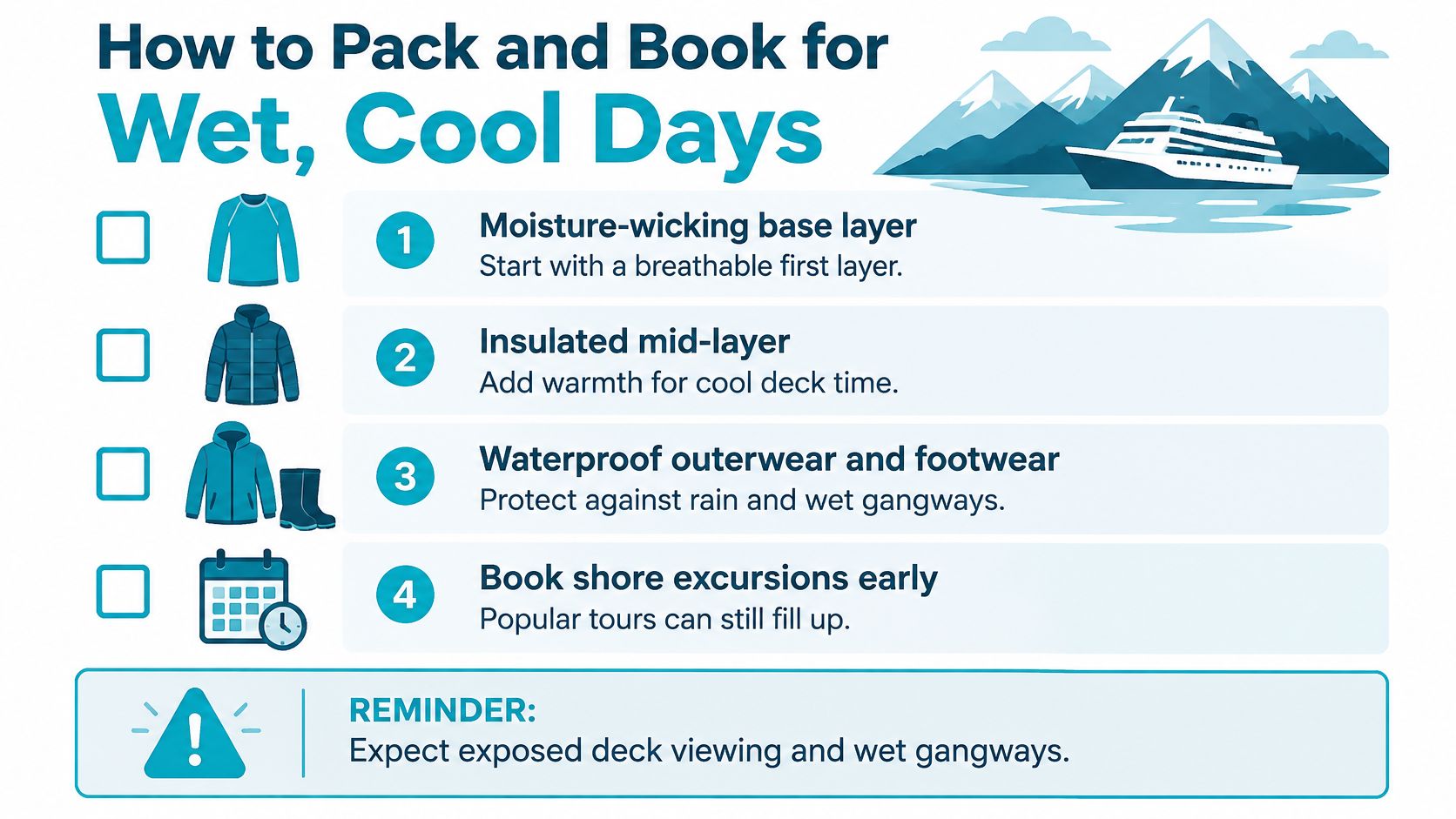
Build a workable daily routine
Keep your rain layer accessible. Put your waterproof jacket, gloves and hat in a daypack rather than leaving them in the cabin. Add a dry bag or protective pouch for electronics so you can keep using your camera without exposing everything else.
Assign sheltered options before buying excursions. Give Juneau and Ketchikan a realistic alternative such as a museum, cultural visit or covered outing. Check opening hours and transport, because a backup that you can't reach during the port call isn't useful.
Read cancellation and return terms separately. For glacier and wildlife tours, establish what happens if the operator cancels, what happens if you cancel, and how return-to-ship timing is handled. A weather refund and protection against missing departure are different questions.
Prefer usable port time over an impressive port list. Examine arrival and departure times before squeezing in a distant excursion. A longer call offers more room to adapt, but another port day isn't automatically a replacement opportunity for the same tour.
Review the forecast before departure and again onboard. Move independent outdoor activities to the driest available window when reservations and transport allow. Don't assume you can shift a booked excursion between ports or dates without the operator's agreement.
Test the kit before leaving home
Wear your footwear on a wet walk before packing it. Check that your jacket's hood stays in place, that the cuffs close properly and that your insulating layer fits underneath without restricting movement.
A generic Alaska checklist can tell you to bring a coat. A useful September plan tells you where you'll need shelter, which bookings can change and what you'll do when an outdoor plan doesn't work.
Crowds, Savings and What You Give Up
September isn't an empty-port escape. A regional cruise-demand analysis cited in The Points Guy's Alaska timing guide recorded approximately 258,000 passenger visits in Juneau during September 2024. Expect working docks, excursion boarding and other ships, not deserted waterfronts.
Keep that scale in mind when imagining your arrival.
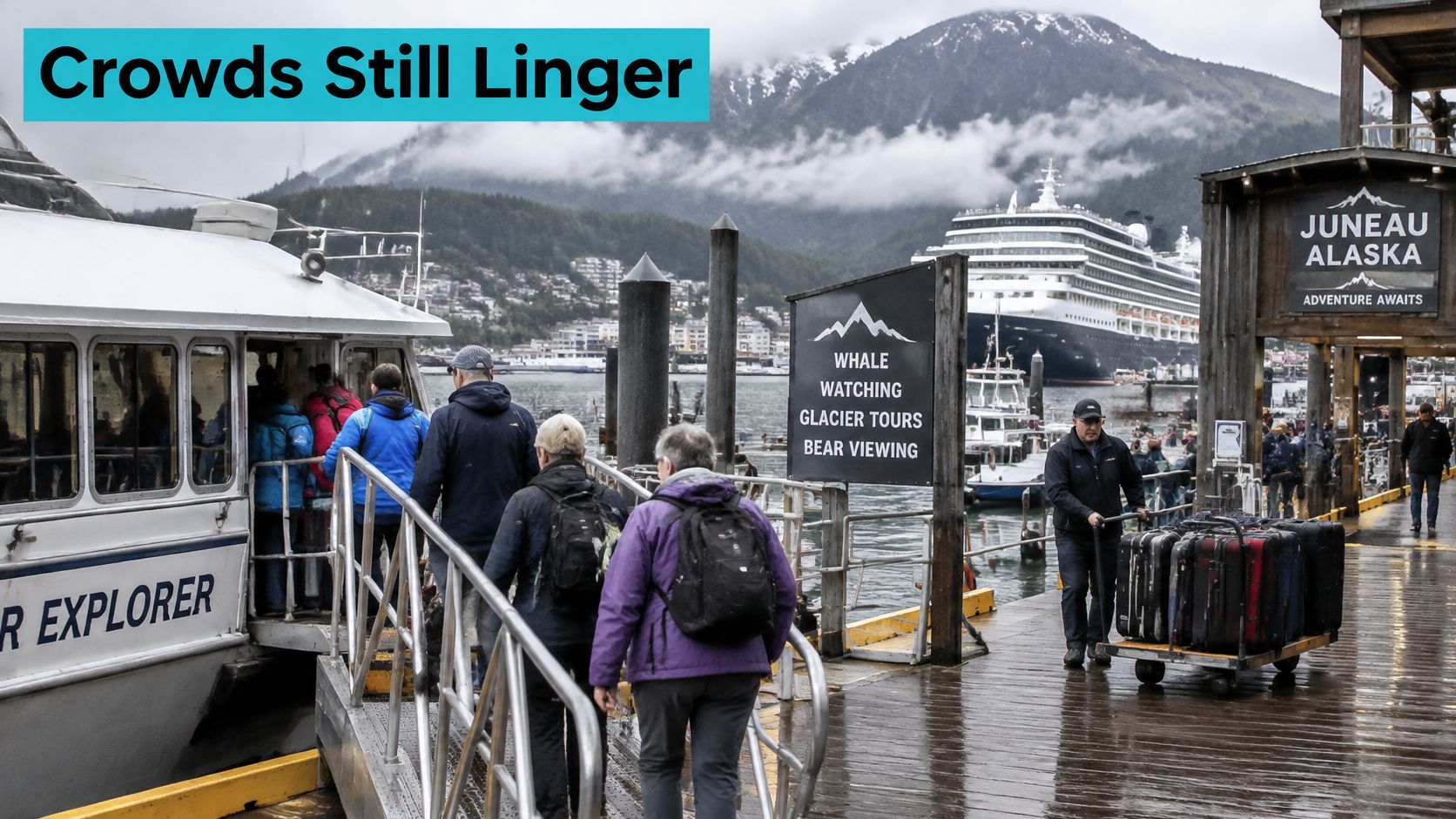
Alaska's overall cruise traffic reached approximately 1,650,000 visitors in 2023, compared with 951,000 in 2006, an increase of more than 70%, according to the National Park Service's account of changing visitor patterns; it also describes Glacier Bay's operating window extending from a historical early-September finish to ships commonly appearing from late April through mid-October. September is an established part of the operating season, not an improvised final opportunity.
Put the savings beside the compromises
A shoulder-season fare deserves the same scrutiny as any other booking. The relevant comparison isn't the cheapest September cabin against a premium summer cabin. It's a comparable holiday with the same priorities.
| What you gain | What you give up or must check |
|---|---|
| Potentially lower cruise and land costs | Whether flights, transfers and desired excursions preserve the saving |
| A less intense peak-season atmosphere | No promise of empty docks or uncrowded popular tours |
| A chance to spend savings on a better cabin or outing | Whether that upgrade helps you enjoy this particular itinerary |
| More appeal for travelers with flexible schedules | Narrower sailing and excursion choices toward season's end |
Many ships begin repositioning near the end of the month, so don't confuse a lower price with an equivalent selection. A fare can be attractive while the sailing lacks the port, ship or tour that made you want Alaska in the first place.
Use these sailing visuals as context, then judge the departure by its written itinerary and operating details.
Calculate the cost of the compromise
Your comparison should include money you may spend to make the trip work: suitable rain gear, sheltered alternatives and transport for independent plans. Also consider what you can't replace with money, such as a missed scenic opportunity on a once-in-a-lifetime itinerary.
Use this guide to getting better cruise deals to evaluate the offer, then write down your nonnegotiables before paying. If quiet is the priority, favor a later departure only after confirming that the experiences you care about operate on its exact dates.
Value test: A cheaper sailing is a good deal when you'd still choose its itinerary without the discount.
The gain is a potentially less expensive, less hectic holiday. The cost is less certainty and, toward the end of the season, less choice. September is good value for the right traveler, not a universally better bargain.
Pick Your September Sailing Before You Book
Book September when its compromises suit you, not because someone calls it Alaska's best-kept secret. Your travel style matters more than a general verdict about the month.
Which traveler should book a September Alaska cruise
| Traveler | Fit | Why |
|---|---|---|
| Budget-focused couple wanting fewer crowds | Strong fit | Potential discounts and quieter ports can offset cooler weather |
| Photographer chasing glaciers and clear skies | Mixed | Choose early September and flexible excursions |
| Family needing sunshine and warm pool time | Weak fit | Cool, wet days limit comfortable outdoor deck time |
| Northern lights hopeful | Good fit mid-month | Darkness grows, but visibility still requires favorable clouds and solar activity |
| Traveler wanting the full range of options | Mixed | Itinerary and excursion choice narrows late in the month |
A strong fit doesn't mean every September sailing will suit you. A budget-focused couple might prefer a comfortable inside cabin and spend on shore activities, while a photographer may care more about observation access and the timing of scenic cruising than the lowest fare.
Families should judge the ship as carefully as the destination. If children need active indoor alternatives, examine the actual facilities and age-appropriate programming rather than assuming outdoor pools will fill the downtime.
Compare the itinerary before the cabin upgrade
Start with your must-have experience. If it's glacier viewing, inspect the scenic-cruising itinerary; if it's a particular rail journey or wildlife outing, confirm availability before treating the port name as proof that you can do it.
Then inspect the ship. Look for comfortable indoor viewing spaces, practical access to outdoor decks and places where your group can spend a wet sea day happily. Don't pay extra for a feature you won't use while overlooking one that would materially improve the trip.
Use the cruise itinerary search to build a shortlist. Our booking engine lets you search by destination, cruise line, ship, embarkation port and date range, and the compare tool lets you review up to six sailings side by side for rates, itineraries, ship profiles and more.
Make the final choice against a difficult day
Before reserving, ask whether you'd enjoy the sailing if your most weather-sensitive excursion were canceled. If the answer is no, change the itinerary, the timing or the expectations before committing.
Bring that concern into your planning conversation. Our cruise specialists help with new bookings, pricing questions and planning guidance, so explain which experience matters most rather than asking only for the cheapest departure.
My recommendation is early September for a first visit, later September for travelers who actively prefer the late-season trade-off. Choose the ship and route that remain enjoyable when the weather doesn't cooperate.
Visit Best Cruise Rates to compare September Alaska sailings and request a free cruise quote. Tell us your preferred dates, must-see ports and weather-sensitive excursions so we can help you choose a sailing that fits your ideal trip.
Ready to book your next cruise?
Compare 40+ cruise lines or call our specialists at 1-888-604-0279.