Average Cost of Cruise for 2: A Realistic Budget

A seven-night mainstream cruise costs about $3,600 to $4,100 for two before extras, with taxes, gratuities, and onboard spending added on top. That is the planning range for the cruise itself, not the cost of leaving home and getting back.
The sale price on the screen is usually the fare only. Cabin category changes that fare for both travelers at once, and the departure city can move airfare and a pre-cruise hotel by more than the difference between two promotional fares. Alaska, Hawaii, the Mediterranean, and other long-haul trips make that gap obvious. A Florida couple and a couple connecting through two airports can book the same ship and still land on different totals.
The useful average cost of cruise for 2 is a three-part budget: the fare, the fees and choices on board, and the cost of reaching the ship. Averages below are operating averages or published examples, not a quote for your dates. Treat older segment figures as direction only.
Table of Contents
- Average Cost of a Cruise for Two at a Glance
- How Cruise Line Choice Changes the Total
- Flights, Hotels and Departure City Costs
- Fees, Extras and a Two-Traveler Budget
- Budget Mistakes That Skew the Total
- Confirm Your Total Before You Book
Average Cost of a Cruise for Two at a Glance
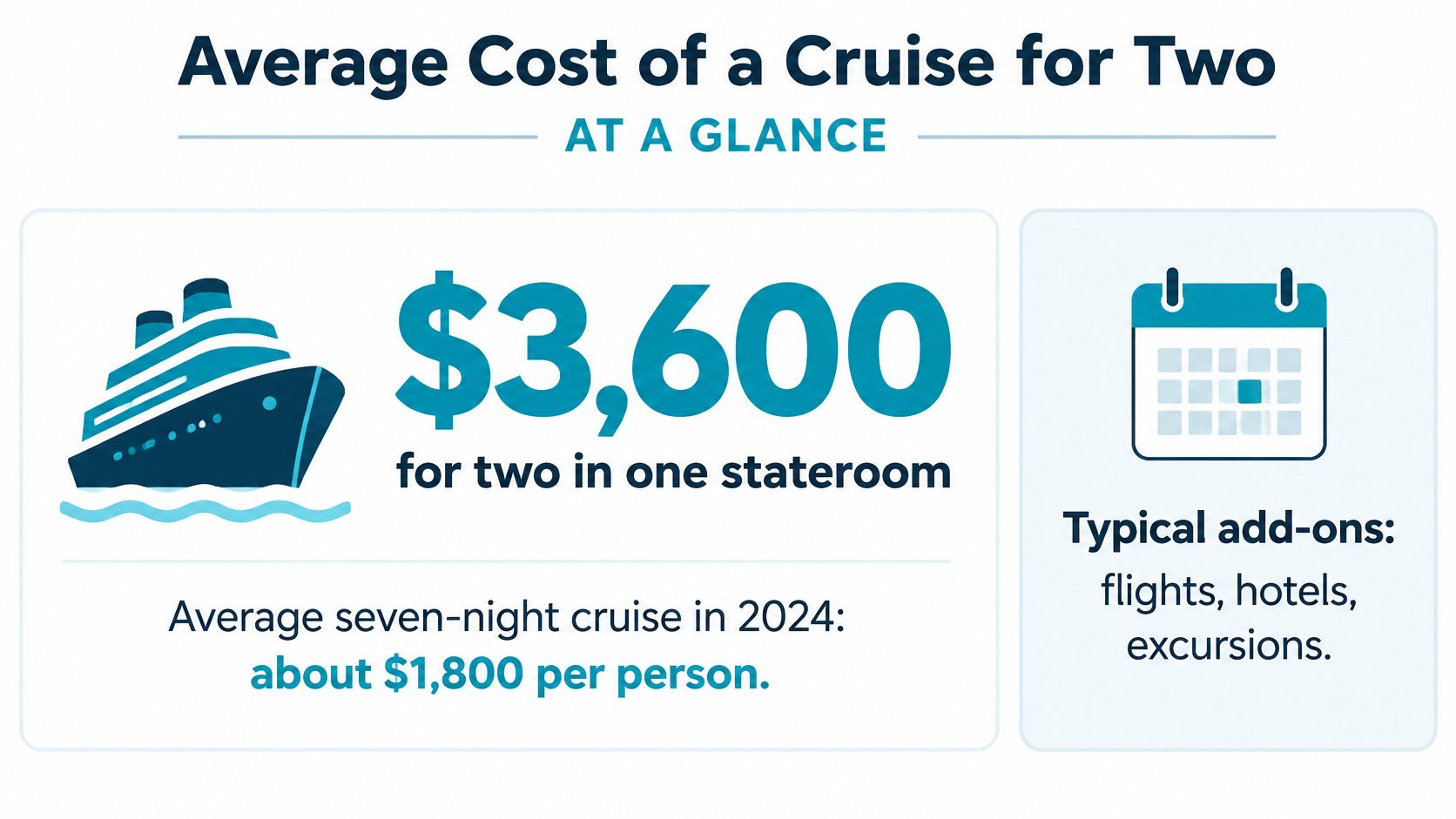
In 2024, a seven-night cruise averaged about $1,800 per person, or $3,600 per stateroom for two, according to Thrillist's cruise-cost overview. That figure is a useful starting point, but the cabin category can shift the fare by thousands of dollars.
| Benchmark | Basis | Total for two |
|---|---|---|
| Thrillist 2024 average, seven nights | per stateroom, as reported | about $3,600 |
| Typical mainstream base fare, seven nights | fare only, no fees or extras | about $3,000 |
| Industry 2025 benchmark, seven nights | fares plus onboard spending, before flights and insurance | about $4,104 |
| Caribbean example, interior to junior suite | fare difference per person, doubled | about $3,200 |
Why the cabin, not the sale banner, sets the spread
A 2026 Caribbean line-by-line example lists per-person base fares of $899 for an interior and $2,499 for a junior suite. The difference is $1,600 per person, or about $3,200 for two, before onboard purchases.
The fare is charged per person and rises with the cabin category. Taxes, port expenses, and daily gratuities remain broadly similar across those cabins, so they make up a larger share of an interior's cost. In the same Caribbean example, taxes and port expenses add $185 per person, while gratuities add about $130 per person in a standard cabin. Those charges matter, but they do not account for the suite's much higher fare.
Practical rule: Compare sailings by total voyage cost per passenger, not by the promotional fare alone.
For a mainstream seven-night sailing, the 2024 reported average offers a starting point of about $3,600 for two before extras. The Caribbean example shows how choosing a junior suite over an interior can add about $3,200 in fare alone. Set the cabin category before treating a “from” price as your budget.
How Cruise Line Choice Changes the Total
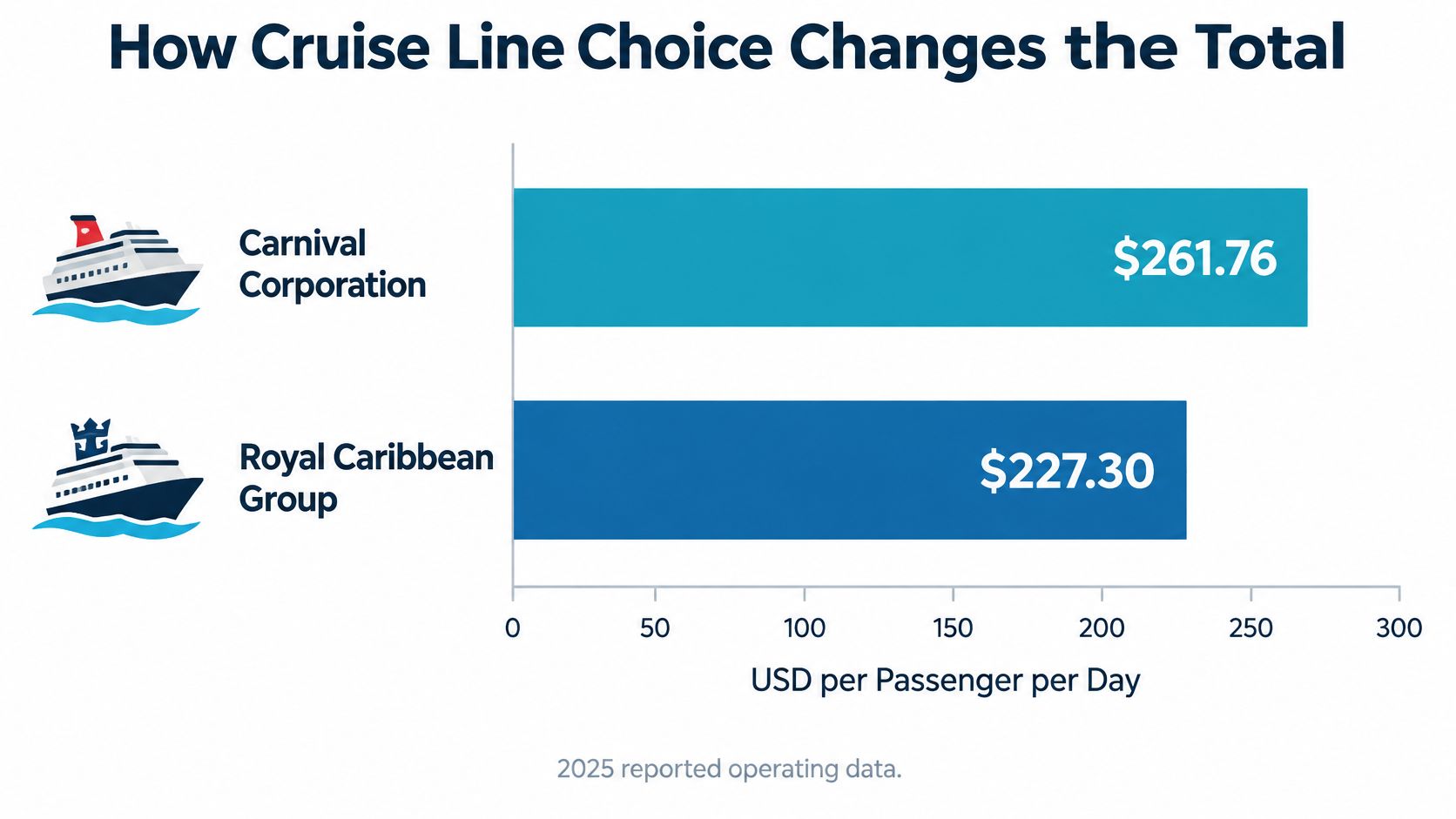
Brand choice moves a couple's total about as much as the cabin does, and the 2025 operating figures show it in daily dollars. These are not retail quotes. Cruise Chaos, drawing on 2025 operating data for Carnival Corporation, Royal Caribbean Group, and Norwegian Cruise Line Holdings, puts a reasonable seven-night planning benchmark for two at approximately $4,100 before flights, parking, travel insurance, and optional excursions.
Across the three groups, average fare revenue was $197.42 per passenger per day and onboard revenue was $95.75, a combined $293.17 per passenger per day. Onboard purchases were nearly one-third of that combined daily revenue. Seven nights at the combined rate is about $2,052 per traveler, or approximately $4,104 for two.
| Cruise group (2025 data) | Spend per passenger per day | Seven nights for two |
|---|---|---|
| Carnival Corporation | $261.76 | about $3,665 |
| Royal Caribbean Group | $306.47 | about $4,291 |
| Norwegian Cruise Line Holdings | $388.78 | about $5,443 |
| Combined three-group average | $293.17 | about $4,104 |
Lowest daily spend to highest
Carnival Corporation averaged $261.76 per passenger per day including onboard spending. Fourteen passenger-nights (seven nights for two people) is about $3,665.
Royal Caribbean Group averaged $306.47. The same fourteen passenger-nights come to about $4,291.
Norwegian Cruise Line Holdings averaged $388.78. That is about $5,443 for two over seven nights, the high end of these three groups.
Each figure mixes mainstream, premium, and luxury brands inside the corporate group, and the companies reported different average voyage lengths. A couple on one ship, one cabin, and one week will not land on the corporate average. Expect a wider range once you pick a single line, season, and itinerary.
Choose the cruise group first, then price cabins inside it. The brand moves the total as much as the room does.
After the line is set, compare cruise cabin types on that line rather than hopping between a mass-market interior and a premium suite as if they were the same product. Our cruise line partnerships cover Royal Caribbean, Carnival Cruise Line, Celebrity Cruises, Princess Cruises, MSC Cruises, Norwegian Cruise Line, Disney Cruise Line, and others, so the group comparison can be checked against a live fare instead of an average.
Flights, Hotels and Departure City Costs

The embarkation port can outweigh the cruise fare. No reliable published airfare belongs in a general couple's budget, because the home airport, the port, and the season set the ticket. Ask for a written quote from your own airport before you treat two sailings as equal.
Same ship, two home cities
Say two travelers in a northern city and two in a Florida city book the same seven-night Caribbean sailing, the same cabin, and the same week. The cruise fare matches. The northern couple is buying a longer flight, often a connection, and a higher chance of a weather delay that forces a hotel night. The Florida couple may drive, or take a short hop, and sleep at home the night before. Alaska, Hawaii, the Mediterranean, and other international turns stretch that gap further, because the flight and the hotel sit outside every headline fare.
Air bought through the cruise line and air bought on your own are different products. Cruise-line air is generally available about 3 weeks before departure, which is late if you want to hold a specific seat or a Saturday stay. Custom air itineraries carry a minimum charge of approximately $35 to $100 per person, and further charges can apply. Get both quotes in writing. Don't assume a flat add-on.
The pre-cruise hotel
A hotel night is a second line, not a default. You need it when the flight lands late, the port is an hour or more from the airport, or a missed connection would mean missing the ship. You can skip it when you live near the port or the flight arrives with a full day to spare. Again, no single hotel rate fits every port. Request the quote for the pier you will use.
Price the departure city against the cruise fare before you pick a sailing date. If the flights cost more than the cabin difference you were debating, change the port or the week, not the spreadsheet after you have paid.
Check embarkation options early. A drive-to port and a fly-to port are not the same vacation, even when the brochure shows the same ship.
Fees, Extras and a Two-Traveler Budget
For two travelers, the fare is only one part of the total. A typical seven-night mainstream fare is about $1,500 per person, or $3,000 for two; estimates also put common onboard extras at roughly $680 per person, or $1,360 for two (cruise cost estimates). Airfare, a pre-cruise hotel, and gratuities can push the final cost well above the fare alone. Discounts usually apply to the base fare, while taxes, port charges, service charges, and travel to the port remain separate costs.
| Cost item | Mandatory or optional |
|---|---|
| Taxes and port expenses | Mandatory |
| Daily gratuities | Usually added automatically |
| Onboard spending: drinks, dining, Wi-Fi, excursions | Optional |
| Travel insurance | Optional; price varies with cruise cost and length |
| Airfare to the embarkation port | Depends on home city; get a quote |
| Pre-cruise hotel | Optional |
What is fixed
Taxes and port expenses apply to each sailing. Daily gratuities are usually posted per person per night, though some lines let guests adjust them later. Check how cruise gratuities are charged before assuming tips are included in the fare.
What you choose
Drinks, specialty dining, Wi-Fi, excursions, and spa visits are optional costs. The estimates above make $1,360 for two a moderate onboard-spending benchmark, not a minimum. Included dining and a small number of paid tours can bring spending down; a drinks package for both travelers can raise it. Shore meals and shopping are separate from onboard expenses.
Travel insurance is optional, and its price depends on the cruise cost and length. Best Cruise Rates offers travel insurance through BestCruiseRates.com and Allianz Global Assistance before final payment.
Write one total before you book
- Choose the cruise length and cabin category, then note the per-person base fare.
- Double the fare for two travelers. A $1,500 fare becomes about $3,000.
- Add taxes and port expenses for both travelers using the sailing's quote.
- Add gratuities for both travelers, adjusting for the number of nights.
- Set an onboard budget. $1,360 for two is a moderate planning benchmark, not a minimum.
- Add quoted airfare, transfers, and any pre-cruise hotel based on your departure city.
- Add insurance if you want it, then set a separate buffer for extra meals ashore.
Keep mandatory fees, optional spending, and departure costs in separate lines. The fare is a starting point, not the trip total.
Budget Mistakes That Skew the Total
The expensive mistake is comparing a promotional fare with another line's full price. A percent-off banner usually cuts the base fare. The rival's higher number may already include taxes or a package. Put both sailings in the same columns, fare, fees, gratuities, and the extras you will buy, or the "deal" is a different product.
Next is the per-person trap. Some averages are already the stateroom total for two. Some are one traveler. Doubling a stateroom figure, or failing to double a per-person fare, invents or erases an entire second guest. Read the unit before you multiply.
Third, couples assume gratuities are inside the fare. On most mainstream lines they are added per person per day unless a package says otherwise. Leaving them out makes a cheap interior look cheaper than it is, and it makes a bundled fare look overpriced.
Fourth, onboard spending never makes the brochure and still shows up on the folio. Drinks, Wi-Fi, and specialty restaurants are optional, but a budget that lists only the fare is a partial budget. Price the package or set a cash limit before you sail.
Fifth, port-city meals, taxis, and shopping are not the cruise price. The Cruise Lines International Association report states that passengers on a typical seven-day cruise generated about $750 per person in spending in port cities, roughly $1,500 for a couple. That is destination-side activity, not money paid to the line, so don't add it blindly to the fare. Do plan it with local prices if you intend to eat and shop ashore. The same overview's 2012 segment figures, including $171 per day for contemporary cruises, only show that luxury and destination cruises cost more per day than contemporary ships. They are not current prices.
If a total leaves out fees, extras, or airfare, label it partial before you compare it with another sailing.
A partial number can still be useful. It just can't pick the winner.
Confirm Your Total Before You Book
Get a written total for two before you pay a deposit. Your rate is locked in once that deposit is paid, so the number you accept is the number you are defending later.
Four actions, then the deposit
Ask for a quote. We offer a free cruise quote when you contact us. You search by destination, line, ship, embarkation port, and dates, and you can put up to six sailings side by side for rates and itineraries. A planner handles cruise-line issues at no cost to you.
Demand every line. Ask for the base fare, taxes and port expenses, gratuities, and any drinks, dining, or Wi-Fi package you plan to buy. If a lower fare shows up after you book but before final payment, in U.S. dollars and advertised anywhere, we contact the cruise line to re-fare to that promotion. Restrictions apply. Ask whether a lower price hits the base fare or the full total. The way to get better cruise deals is to compare complete quotes, not banners.
Decide on insurance before final payment. Match the policy to this trip's cost and length. Buying after final payment is a different conversation, and you may lose the option.
Match the quote to your written budget. Include airfare and any pre-cruise hotel from your airport. Confirm the cabin category and the departure port in the same pass. If the quoted cruise total fits and the flights don't, change the port or the week before you pay.
Copy this and fill it in:
- Total for two: fare, taxes, gratuities, and chosen packages, in one figure.
- Cabin chosen: interior, ocean view, balcony, or suite, named on the quote.
- Fees counted: taxes, port expenses, and daily gratuities are lines, not surprises.
- Extras chosen: a dollar limit or a named package, not "we'll see."
- Departure costs priced: flights and any hotel, quoted from your home airport.
- Insurance decided: yes or no, with the premium if yes.
- Deposit date set: only after the lines above are filled.
A couple that books from the fare alone is guessing. A couple that books from this list knows which part of the average cost of cruise for 2 they can still change, and which part the deposit will freeze.
Best Cruise Rates gives you a free cruise quote and planning help across more than 40 cruise lines, so the fare, fees, and cabin for two show up as one written total before you pay a deposit. You can compare sailings side by side and ask a specialist to walk the taxes, gratuities, and any package against the budget you just built. Visit Best Cruise Rates and request that quote before you lock a rate.
Ready to book your next cruise?
Compare 40+ cruise lines or call our specialists at 1-888-604-0279.