Cruise Ship Itinerary: How to Read and Compare Them
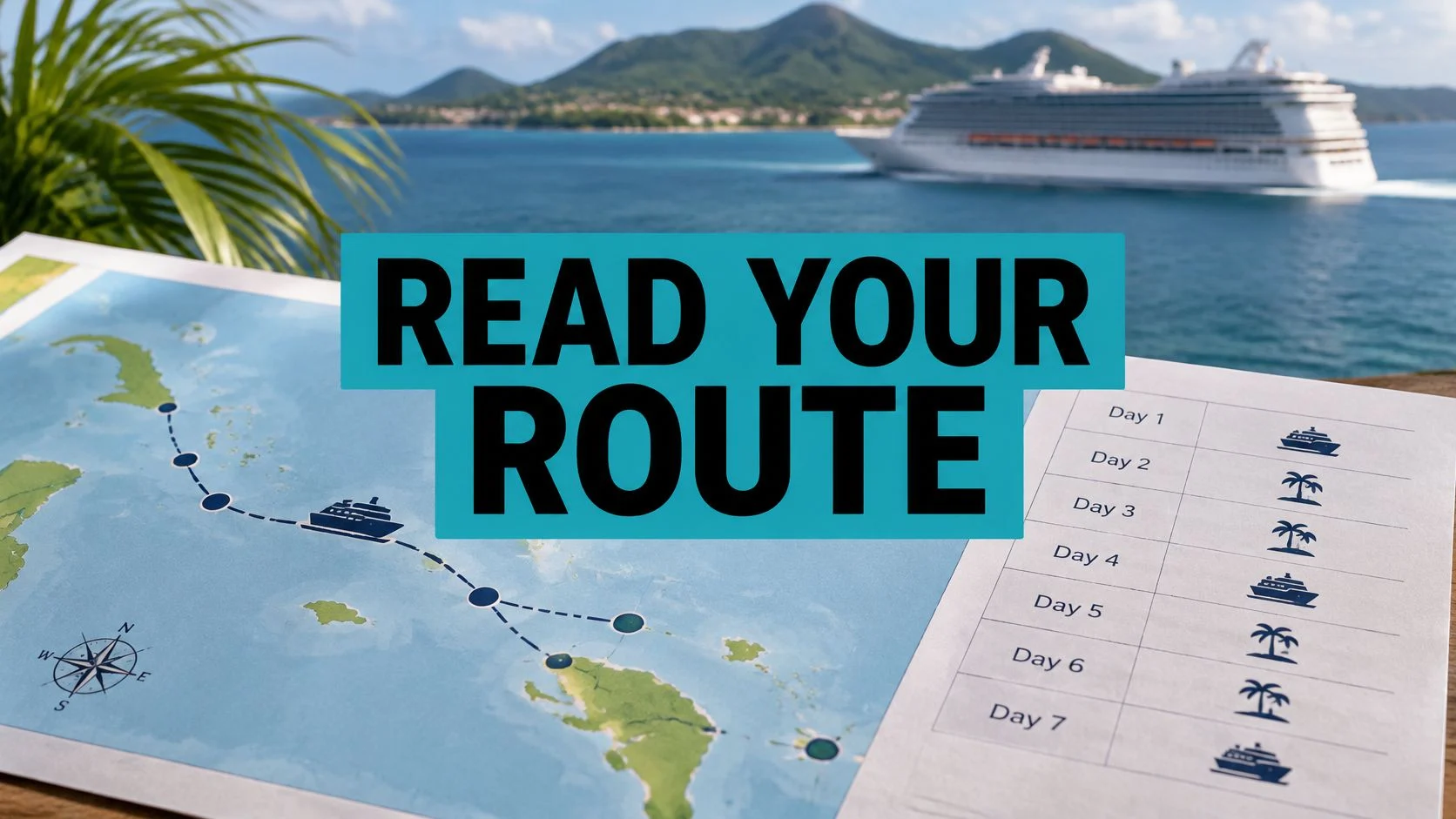
You're comparing two seven-night sailings that both list Cozumel, and the one with more port names looks like the better trip. A cruise ship itinerary isn't a postcard list. It's a timed schedule: a day, a date, a port or a sea day, and an arrival and departure window that the ship has to hit. The hours printed on the line are the ship's window, not the hours you can spend in town.
Table of Contents
- What Each Line of a Cruise Ship Itinerary Tells You
- How Much Time You Really Get in Each Port
- Matching the Route to Your Kind of Trip
- Port Order, Berth Limits and Crowding
- How to Check an Itinerary Before You Commit
- Compare Two Sailings and Book
What Each Line of a Cruise Ship Itinerary Tells You
Say one line reads Day 3, Cozumel, Mexico, arrive 8:00 AM, depart 5:00 PM. That single row packs a day number, a calendar date, a place, and two clock times. Some rows say at sea instead of naming a port. Read every line in the same order, or you'll match the wrong flight to the wrong morning.
Start with the day number and date. Day 1 is usually the boarding day, and the last day is when you walk off. Match those dates to your flights before you look at beaches. Then read the port and its times. Arrival is when the ship is scheduled alongside or at anchor. Departure is when it must be gone. Last, notice whether the day is a port day or a sea day. That mix is the pace of the whole week.
| Itinerary entry | What it means | Planning check |
|---|---|---|
| Day number and date | Which day of the sailing you are reading | Match the date to your flight and boarding day |
| Port with arrival and departure times | When the ship docks and when it must leave | Subtract gangway and all-aboard time to estimate time ashore |
| At sea | No port call that day | Count sea days against your priority list |
| Tender port | Ship anchors offshore and ferries guests ashore | Add tender time each way to every trip ashore |
| Overnight stay | Ship stays in port into the evening or next day | Notice the extra evening ashore and whether it suits you |
Arrival is not time ashore
Those clock times are the ship's window, not yours. Crew open the gangway after the ship is cleared, and all-aboard is called before the printed departure so the ship can cast off on time. A call that looks like nine hours on the page can leave you closer to six usable hours once both ends come out.
The same line means different things at a dock and at a tender port. At a dock you walk down a gangway onto the pier. At a tender port the ship anchors and boats ferry you in, so every trip ashore starts and ends with a wait. An overnight stay keeps the ship in port past dinner, which suits a late museum or a second evening ashore and is wasted if you only wanted a beach morning.
Practical rule: Count port days and sea days across the whole sailing before you fall for any single stop.
If you wanted a new town every morning and the week is four sea days, the route doesn't match the trip you pictured.
How Much Time You Really Get in Each Port
The published window is the start of the planning math, not the length of the visit. Take that Cozumel line, 8:00 AM to 5:00 PM. On paper that's nine hours. Knock off about 45 minutes to clear the gangway, a 30-minute walk from the terminal into the pier area, and a 60-minute buffer so you're back before all-aboard. You're left with roughly six usable hours. That's the number to write next to the port, not nine.
A docked call lets you step off and start that clock. A tendered call doesn't. You wait for a boat, ride it, and do the same on the way back, and a choppy morning slows the whole queue. Add the round trip to every separate trip ashore. If you come back for lunch on the ship, you've spent the tender time twice.
Ask what you can actually do there
Most itinerary pages name the port and a few sights. They rarely say whether you can get from the ship to that sight in the hours you have. Steep streets, a long transfer, a closed restroom, or a late tender can make a famous stop a poor one, and that isn't only a wheelchair question.
CLIA's 2024 State of the Cruise Industry Report reported that 45% of cruise travelers booked an accessible shore excursion in the previous year, and that more than 100 designated accessible excursions are available globally. An excursion labeled accessible still doesn't promise a step-free path from the gangway into town, a vehicle with space, or a way to go on your own. Ask for equipment before you sail if you need it.
For each stop, write down five answers:
- Tender or dock: If it's a tender, the usable clock starts when you reach the quay, not when the ship anchors.
- Terminal distance: A pier on the edge of town can eat the first hour in a shuttle.
- Transport that runs: Note the bus, taxi, or walk, and whether it runs on a Sunday call.
- Restrooms and surfaces: Uneven streets and a missing accessible restroom end a stop early.
- Backup if the tender slips: A delayed first boat can wipe a booked tour. Know the shorter plan.
If you want a second evening without that squeeze, look at cruises with overnight port stays and compare those calls by usable hours, not by the times printed on the day line.
Matching the Route to Your Kind of Trip
Region decides what "a normal week" even looks like. In 2024, the Caribbean, Bahamas, and Bermuda accounted for 43% of all cruise passengers, the largest share of any itinerary region, with the Mediterranean second and Alaska among the leading individual markets, according to the 2025 State of the Cruise Industry Report. That same report's 2025 counts put more than 16 million passengers in the Caribbean, more than 9 million in Europe, and just over 1.7 million in Alaska. Because so much capacity sits on warm-weather loops, two sailings with nearly the same name often share the same islands and differ mainly in order and homeport. A short Florida week, a longer southern loop, and a Panama Canal extension can all be sold as Caribbean.
| Itinerary type | Typical ports | Best for | Watch for |
|---|---|---|---|
| Caribbean loop | Bahamas, Caribbean islands, Mexico, Bermuda | Warm-weather beaches and short breaks | Many similar island calls and overlapping port lists |
| Mediterranean | Italy, Greece, Spain, France, Croatia | Culture, history and port-hopping | Berth changes and visitor limits in busy cities |
| Alaska | Juneau, Ketchikan, Skagway, Glacier Bay | Scenery and wildlife | Seasonal sailings and weather-dependent scenic cruising |
| Expedition | Remote coasts, polar and island destinations | Wildlife, polar and niche interests | Smaller ships, weather-dependent routing and guide-led landings |
A beach loop trades variety of coastline for repetition. A Mediterranean week trades beach time for cities, and those cities are where berth changes show up. Alaska is seasonal, and the scenic day can move with weather even when the towns stay on the schedule. Expedition is a different product. Passengers on expedition itineraries increased 71% from 2019 to 2023, and the 2024 CLIA industry report identified expedition and exploration as the fastest-growing cruise sectors. Smaller ships, guides, and weather-dependent landings are the norm, not a version of a seven-night island loop.
A western Caribbean week is a good place to practice this filter, because the island list looks familiar until you check order and time ashore. Our pages on western Caribbean cruise destinations spell out those repeated combinations.
Pick the one thing you want to remember, beaches, a city, scenery, or wildlife, and drop any route that doesn't put that thing on a day with real hours.
Port Order, Berth Limits and Crowding
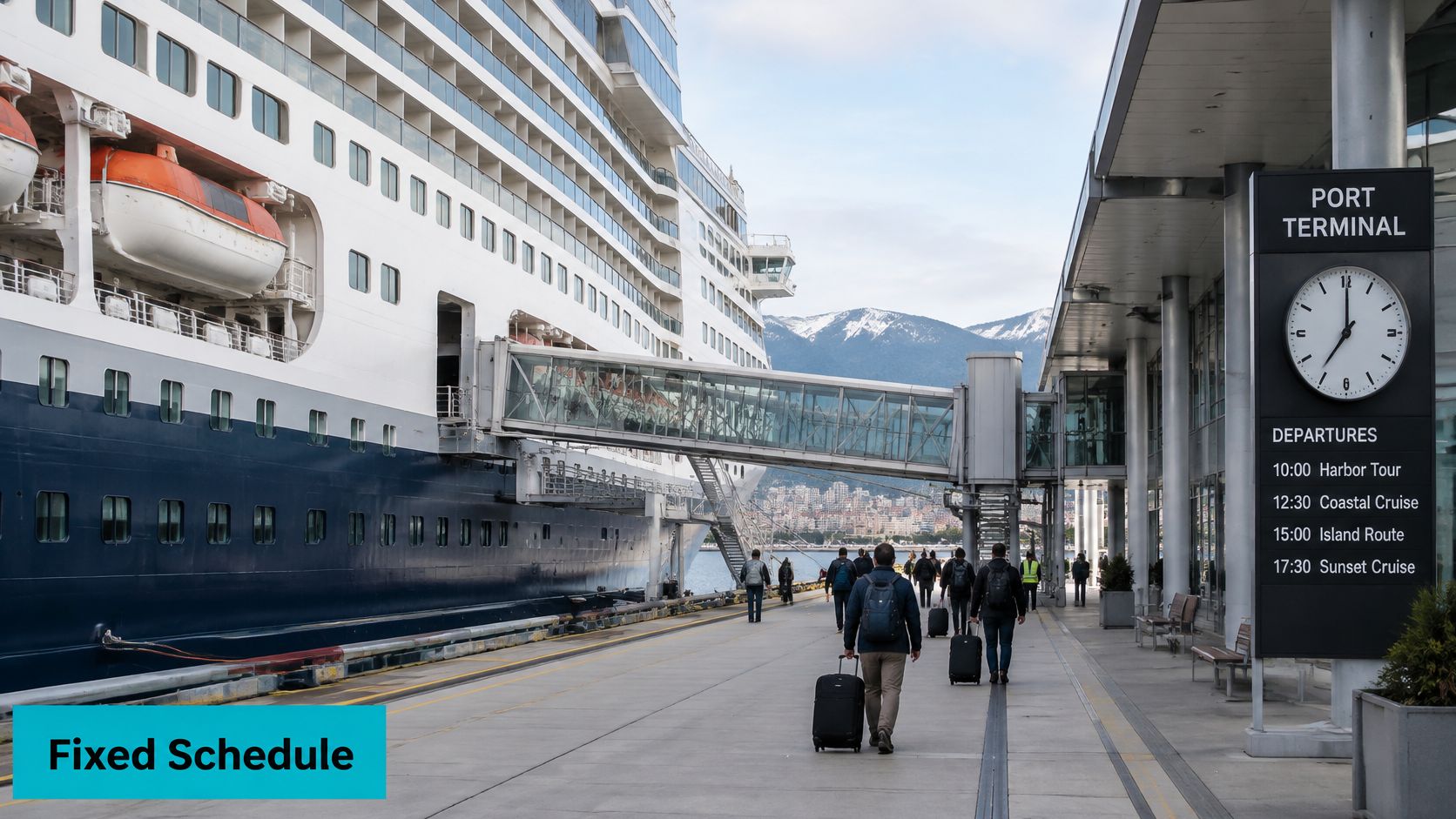
Treat the itinerary like a train timetable. Each port is a berth the ship has to reach inside a window someone else also wants. UNCTAD reports that a cruise port call is commonly initiated two to three years in advance so the port and the line can set berth, services, and timetable, including when several ships could call in parallel. A route that looks perfect on a map fails if that window already belongs to another large ship, if pilots are short, or if the terminal can't move that many people.
Seven famous cities or three full days
Put a fourteen-day route with seven famous cities next to a slower route with three ports. The seven-port version can hand you a few crowded hours in each place, with little slack if one morning slips. The three-port version can give each stop a full usable day. Sea days are the slack in the timetable. They absorb weather and traffic so the next fixed berth is still reachable. Two high-demand ports back to back leave almost no recovery. Miss the first call, and the second one gets shorter or dropped.
Ports are also cutting capacity, which changes what a printed city name delivers. Wanderlust reports that Barcelona is reducing cruise berths from seven to five in 2026, and that Amsterdam plans to limit cruise visits to 100 a year by 2026 and to remove ships from the city center by 2035. Some Mediterranean destinations are adding visitor limits or fees. The Port of Venice scheduled 242 cruise ship calls in 2024 and forecast 540,000 cruise passengers. A line that says "Venice" or "Barcelona" doesn't tell you whether you'll berth near the center, at a remote terminal, or on a day when several ships share the same streets.
Before you trust the port count, run a crowding check on each priority stop:
- Ships that day: More than one large ship usually means shared tenders, shared taxis, and a full old town by late morning.
- Likely passengers: A single mega-ship can put several thousand people into a small center at once.
- Terminal versus the city you booked: If the berth sits outside town, part of your usable hours is a bus ride.
- Timed access or fees: A reservation window can shrink a "full day" into a booked slot.
Port count measures how many names are on the page. It doesn't measure how long you stand in each place, or whether that place can hold the ship.
Breadth suits a traveler collecting cities. Depth suits someone who wants one neighborhood, a long lunch, or a beach that isn't the ship's own. If a private beach is the point of the day, compare those calls on cruise ship private islands the same way, by hours you can use and by how many ships share the island.
How to Check an Itinerary Before You Commit
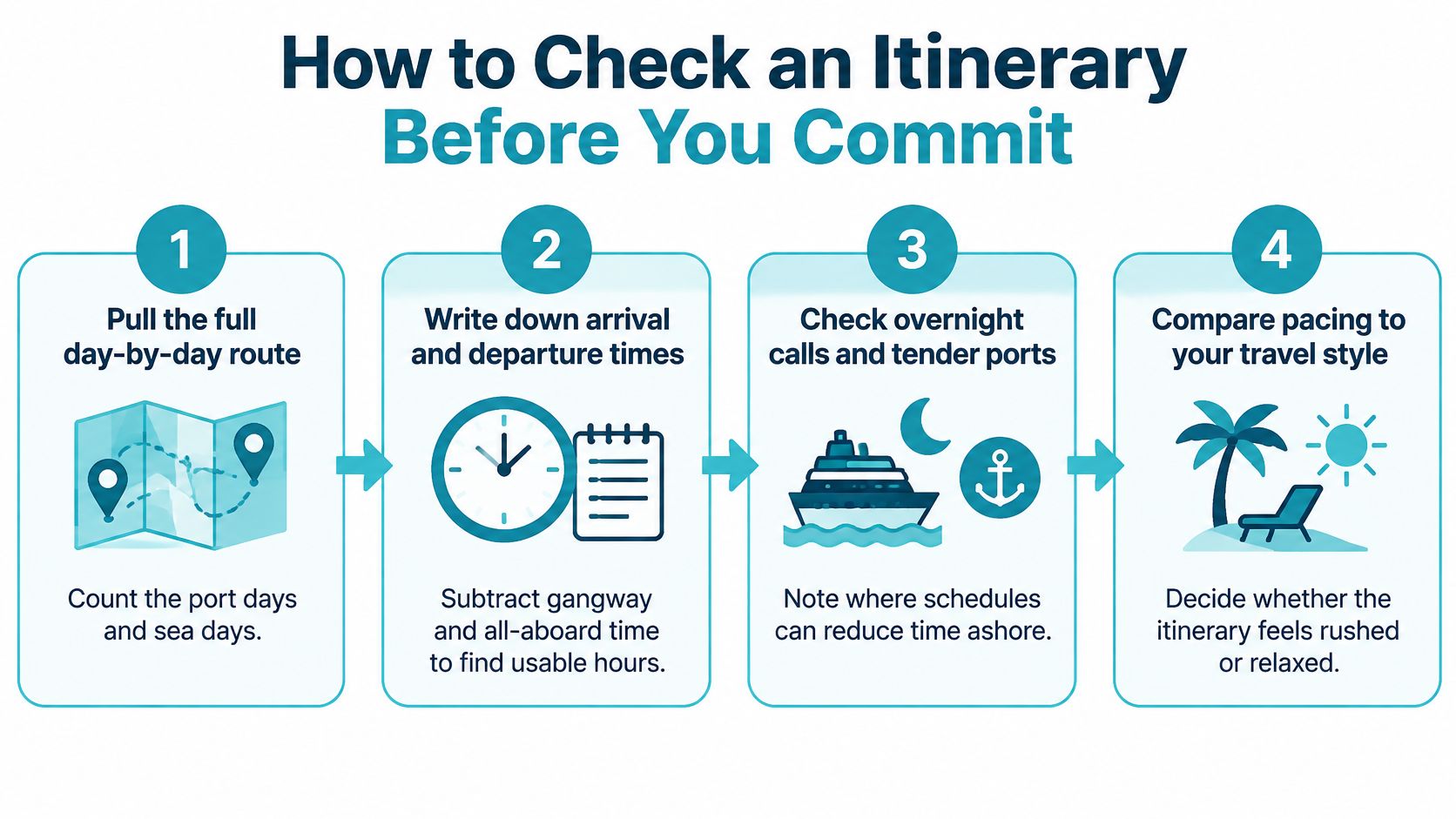
Score two candidate sailings on the same sheet. A longer list of ports will keep winning if you only count names.
- Pull the full day-by-day route. Count port days and sea days, including scenic cruising that never opens a gangway. You're checking pace, not collecting destinations.
- Write arrival and departure for every port, then subtract. Take off gangway time at the start and the all-aboard buffer at the end. The remainder is usable hours. If most calls land under six, the week will feel rushed no matter how pretty the map is.
- Mark docked, tendered, or anchored. A tender adds a boat ride each way, and rough water can pause the service. One tender is manageable. Three in a row rewrite the week.
- Read the port order, not just the set of ports. Two busy cities on consecutive days raise the chance of crowded streets or a shifted berth. Note every pair of high-demand calls that sit back to back.
- Look at how the sea days fall. A long ocean stretch suits a trip built around the ship. Short hops between ports suit someone who wants a new town daily and doesn't mind packing a day bag every morning.
- Compare the route with the published length. A seven-night sailing includes an embarkation day and a disembarkation day. Those two dates often give you little or no port time, so the "week ashore" may be five calls.
- Flag overnights and odd hours. A late arrival kills a morning tour. An early sailaway kills dinner in town. An overnight does the opposite, if you want that evening.
- Match the route to one priority. A specific city, one shore excursion, or a wildlife window should sit on a day with usable hours. If that day is a tender with a 2:00 PM departure, the priority isn't really on the cruise.
- Score a second sailing on the same rows. Same criteria, same sheet. Otherwise the sailing with the prettier brochure wins by default.
| Criterion | What good looks like |
|---|---|
| Usable hours in each port | Most ports give six or more usable hours |
| Sea days | Balanced to your pace |
| Tendered stops | Few or none if mobility is limited |
| Consecutive high-demand ports | Not back-to-back where possible |
| Crowding exposure | Few ships scheduled at priority ports |
| Verdict | One line per sailing |
Finish with one line per sailing, in your own words. Something like "eight usable hours in Cozumel, two sea days, tender in Roatan" is enough to compare next week without rereading both brochures.
Compare Two Sailings and Book
Read those two verdict lines before you reread the port lists. When the sailing with more published ports also has thinner hours and heavier crowding, let usable hours and crowding exposure decide. The extra city name doesn't give you the day back.
Choose the route whose usable hours sit on your single priority, whether that's a beach, a city, scenery, or wildlife. Then check the rate and the ship for that exact departure, not for a similar week a month later.
We let you search by destination, cruise line, ship, embarkation port, and date range, and the compare tool puts up to six sailings side by side for rates, itinerary, and ship profiles. Route and price stay on one page, so you aren't rebuilding the scorecard in a spreadsheet.
Write the one-line verdict for both sailings, keep the one whose hours match what you came for, and book that departure.
Best Cruise Rates lists port names with arrival and departure times so you can run the usable-hours check before you pay, across mainstream, luxury, small-ship, and river options from more than 40 cruise lines. Cruise specialists help with planning and with an existing booking at no extra cost. When you're ready to put two verdict lines next to real fares, visit Best Cruise Rates.
Ready to book your next cruise?
Compare 40+ cruise lines or call our specialists at 1-888-604-0279.