When to Book a Cruise for Better Fares and Cabins

What if the cheapest day to book your cruise comes after the cabin you need has already sold out? That's the gap in advice that treats every traveler as a bargain hunter with unlimited flexibility.
Deciding when to book a cruise starts with what you can't change: your departure date, cabin requirements, destination, or budget. Then you need a second date, your last sensible opportunity to review the reservation before final payment changes your financial exposure. There's no universal best day, but there is a practical booking window for your trip.
Table of Contents
- Booking Windows for Each Traveler Situation
- How Wave Season Sets Your Booking Date
- Why Cabin Type and Waiting Set Your Lowest Fare
- Season and Destination Timing for Lower Fares
- Match Final Payment Deadlines to Your Booking Date
- Pick Your Booking Date and Set a Review Date
Booking Windows for Each Traveler Situation
Recommended booking window by traveler situation
| Traveler situation | Suggested window | Why it matters |
|---|---|---|
| Fixed holiday or peak-season date | 6-12 months before sailing | Popular dates can lose availability before late discounts appear |
| Specific cabin, suite or accessible room | 6-12 months before sailing | Suitable categories may be scarce close to departure |
| Family needing adjoining cabins | 6-12 months before sailing | Matching cabin configurations thin out as the sailing fills |
| Balanced price and choice in shoulder season | 4-8 months before sailing | A useful balance between fare and cabin selection |
| Flexible dates, willing to accept fewer cabins | 2-4 months before sailing | A possible opportunity when demand is low |
| Early certainty for a chosen itinerary | About 12 months before sailing | Many lines publish itineraries roughly this far ahead |
These are planning windows, not promises of the lowest fare. AAA's cruise booking guide identifies 4-8 months as a general shoulder-season balance and 2-4 months as a possible low-demand opportunity; it also says many lines publish itineraries roughly 12 months ahead, with some opening 18-20 months before departure.
Your least flexible requirement should set the booking window. If you can change ships but must travel during a school break, treat yourself as a fixed-date traveler. If your dates are open but you need an accessible room, cabin availability should guide your decision instead.
Read the table by constraint, not by price
Start with the holiday and peak-date rows if your vacation leave is already fixed. You're choosing from departures that fit your calendar, so waiting doesn't necessarily create a useful alternative.
Next, consider the room itself. A family needing connecting cabins isn't shopping for any available cabin pair. Check whether the rooms connect through an interior door, rather than sitting beside each other on the deck plan.
For flexible travelers, the later windows are more useful. Shoulder season means the period outside a destination's busiest travel weeks, though the actual dates differ by destination. Compare departures on either side of your preferred date rather than assuming the cheapest sailing will be on your original weekend.
Practical rule: Choose the row that describes what you cannot compromise on, not the row with the latest possible booking date.
If a particular itinerary is essential, start checking when its schedule opens. An early reservation buys certainty only if the fare terms also suit you. Find your row, mark that window on your calendar, and write your nonnegotiable requirement beside it.
How Wave Season Sets Your Booking Date
Say you want a cruise during a school break and begin shopping as the holiday advertisements appear. You see onboard credit, bundled extras, and reduced deposits, but those offers don't answer the most important question: is your preferred sailing available under terms you're comfortable accepting?
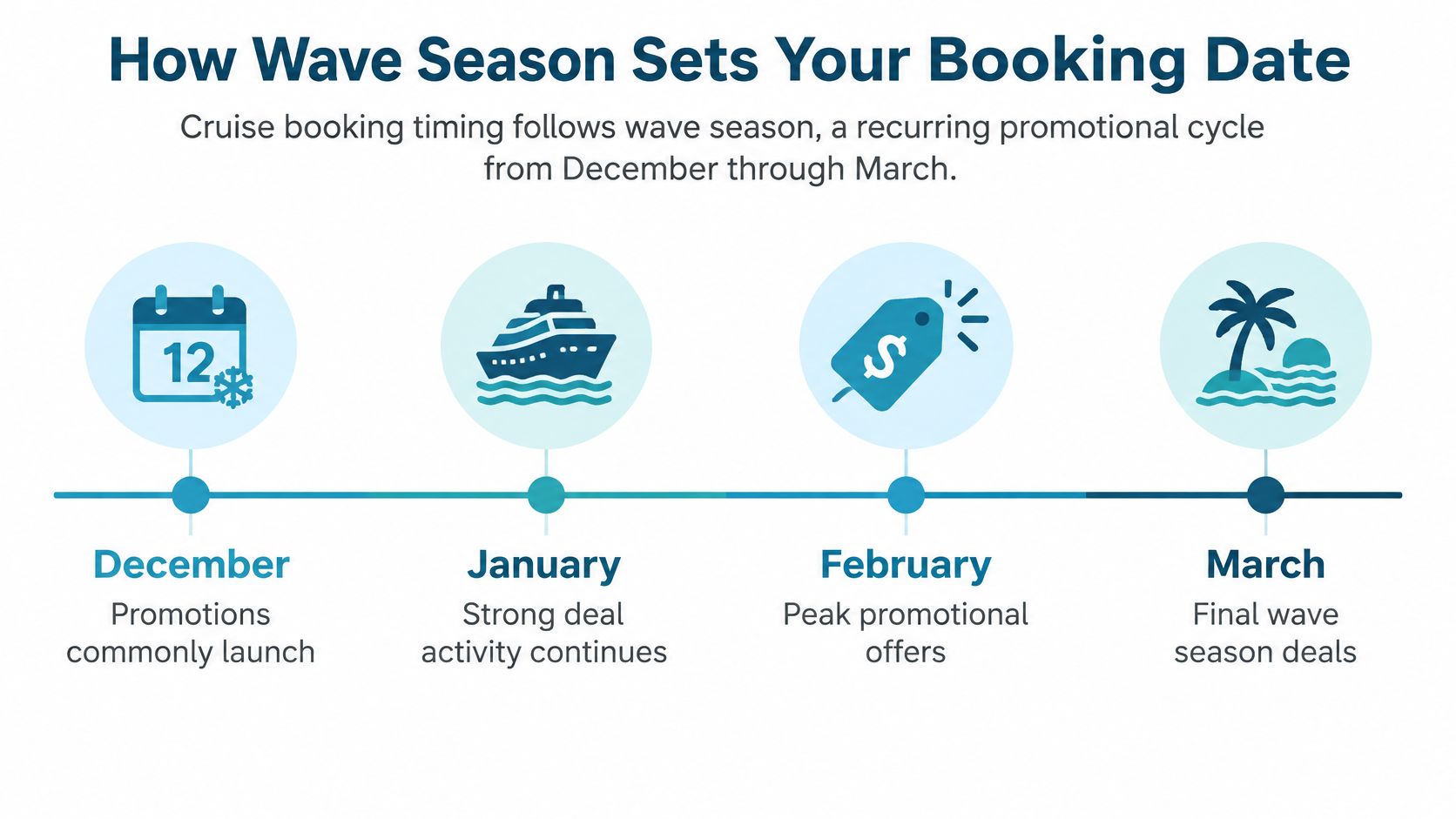
Wave season is the cruise industry's recurring promotional period, broadly December through March, with promotions commonly launching in early December and peaking in January and February, according to Fora's wave-season guide. That guidance places most wave-season bookings on sailings six months to two years later, making it especially useful for advance planners.
The calendar helps you organize your shopping, not predict a guaranteed price drop.
Follow the offers without chasing every promotion
In December, build a shortlist. Save the ship, itinerary, cabin category, total fare, deposit terms, and included benefits for each option. An advertisement is much easier to assess when you have a comparable quote beside it.
During January and February, compare new promotions against that baseline. Don't judge an offer solely by the size of an advertised discount. A package with benefits you won't use may be less useful than a simpler fare with better cancellation terms.
By March, decide whether you're still comparing acceptable alternatives or postponing a choice you already know you want. There's no requirement to wait until the promotional season ends. If the cabin and fare meet your needs, a reservation can be more useful than another round of browsing.
Use a monitor-or-reserve test
For the school-break traveler, the key question is whether a suitable cabin remains available. For a retiree with open dates, comparing neighboring departures may reveal a better overall fit without requiring a different destination.
- Reserve when choice matters: Commit when the sailing, cabin, and terms satisfy a requirement you can't easily replace.
- Keep monitoring when alternatives remain: Continue comparing if you'd happily change dates, ships, or cabin locations.
- Record the actual offer: Save the full quote, including exclusions and deposit conditions, rather than just the promotional headline.
Wave season is a comparison opportunity, not a booking command. Use its offers to evaluate a trip you understand, rather than letting a countdown timer choose the trip for you.
Why Cabin Type and Waiting Set Your Lowest Fare
When each cabin type most often reaches its lowest fare
| Cabin type | Usually lowest fare | Trade-off |
|---|---|---|
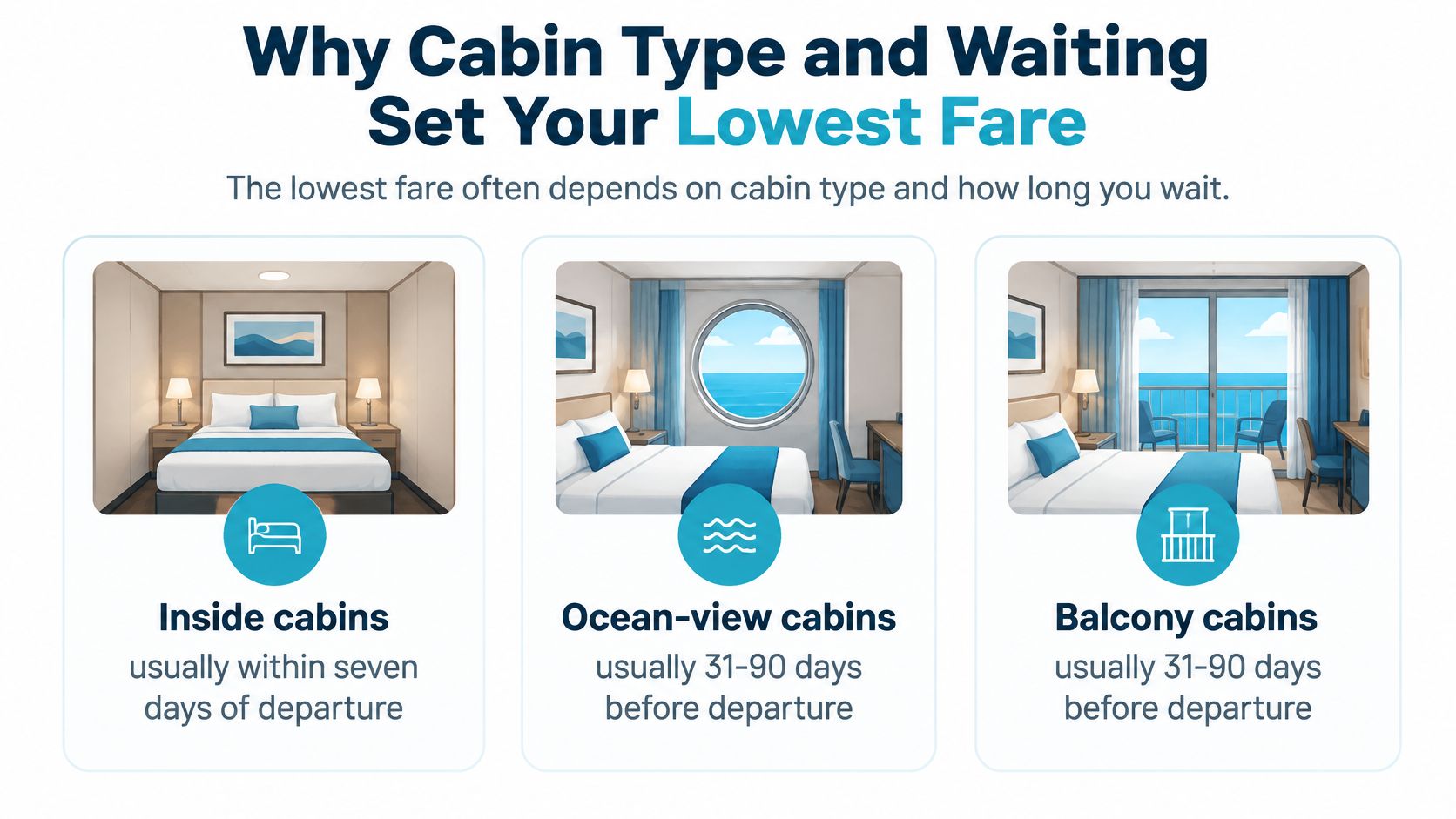
| Inside cabin | Within 7 days of departure | Can be cheapest late, but only if unsold; choice is limited |
| Ocean-view cabin | 31-90 days before departure | A monitoring window for flexible shoppers who don't want to wait until departure week |
| Balcony cabin | 31-90 days before departure | Reserve earlier if a specific location or category matters |
An independent 2025 fare analysis summarized in Cruise Trade News's booking-pattern commentary found inside cabins often cheapest within seven days, ocean-view and balcony cabins more commonly lowest 31-90 days out, and fares notably higher 365 or more days before departure.
Those findings describe fare patterns, not a promise that your preferred cabin will remain unsold. They also distinguish two different goals: finding the lowest available price and securing a room that makes the trip work.
What waiting means for each cabin shopper
An inside-cabin traveler who lives near the embarkation port can sometimes accept whatever suitable room remains. That person doesn't need to coordinate flights, protect a particular view, or secure adjoining accommodation. Waiting may fit the trip because missing that departure wouldn't create a major problem.
A balcony shopper has a different decision. A lower fare isn't necessarily equivalent if the remaining cabin has an obstructed view or sits somewhere the traveler would rather avoid. Compare the category description and deck plan, not just the word balcony.
For ocean-view cabins, ask whether you want natural light or a particular outlook. If either would satisfy you, you have more room to compare alternatives. If a specific window arrangement or location matters, treat that preference as an inventory requirement.
The useful question is what you're willing to lose in exchange for a possible discount. If the answer is nothing, waiting is unlikely to suit your priorities.
Does waiting actually save money?
A University of Arkansas analysis of approximately 400,000 Florida cruise bookings found that 87% of tickets sold during the final 20 weeks of the sales period, yet cruise companies increased prices by approximately 20% across the final 25 booking weeks. Sales peaking late didn't mean fares consistently fell late.
The analysis describes different purchasing behavior among early and late buyers. Early purchasers were generally less price-sensitive and more likely to select higher-priced products, while later purchasers were more responsive to price. That's why a busy late-booking period shouldn't be read as evidence of a universal clearance sale.
A last-minute fare is useful only if the cabin, itinerary, and cost of reaching the ship still make the trip worthwhile.
Compare the complete travel cost before celebrating a cruise-fare reduction. An inexpensive cabin can be a poor bargain if the remaining flights are inconvenient or expensive. Likewise, a fare for a cabin assigned later may not satisfy someone who needs to choose an exact location.
Separate essential features from preferences
Write down which cabin characteristics are essential and which are merely desirable. An accessible layout, required occupancy, or connecting configuration belongs in the first group. A preferred deck may belong in the second, unless there's a specific reason it matters to you.
Then choose your approach:
- Book for certainty when the room must meet a narrow set of requirements.
- Monitor comparable categories when you can accept several cabin locations or departure dates.
- Consider departure-week offers only when you can comfortably skip the sailing if nothing suitable remains.
The lowest advertised fare and the best booking decision aren't always the same thing. Pay for certainty deliberately, rather than discovering too late that you needed it.
Season and Destination Timing for Lower Fares
Seasonal fare patterns and operational risk by period
| Season or period | Typical fare pattern | Operational risk |
|---|---|---|
| Caribbean, September to early November | Early-autumn departures are often priced lower | Overlaps hurricane season; port or timing changes possible |
| Atlantic and Gulf, June 1 to November 30 | Lower demand can mean cheaper Caribbean and Gulf departures | Atlantic hurricane season; itinerary changes possible |
| Eastern Pacific, May 15 to November 30 | Compare individual departures; no uniform discount should be assumed | Eastern Pacific hurricane season |
| Christmas, New Year's and school holidays | Prioritize availability rather than assuming a late discount | Constrained cabin and departure choices |
A cheaper sailing date earns its discount by asking more of the traveler. Compare the fare drop with the cost of a changed port, a delayed embarkation, or a tighter flight connection before you treat an early-autumn or holiday-adjacent departure as a deal.
A peaceful departure scene doesn't tell you how much itinerary flexibility a trip may require.

Price the disruption, not just the cabin
A tropical system can lead a cruise line to substitute ports, change arrival times, or miss a scheduled call. Flights and hotel connections can also become part of the problem. The right comparison is therefore between the fare saving and your ability to absorb changes.
Say your main reason for traveling is a particular island. A cheaper departure is less attractive if you'd feel the vacation had failed without that stop. Someone who mainly wants time aboard the ship may be more comfortable accepting a revised route.
Build flexibility into the surrounding arrangements. Choose refundable or changeable hotel reservations where available, avoid tight same-day air-to-ship connections, and plan an overnight stay in the embarkation city before boarding. Read the actual change terms rather than assuming flexible means fully refundable. If flights are part of the plan, set them before the final payment deadline so the schedule is settled while the booking is still easier to adjust.
Risk check: Would you still want the cruise if the line replaced your favorite port? If not, the cheapest seasonal fare may be the wrong choice.
For a weather-sensitive traveler, departures outside the relevant hurricane window remove that particular seasonal concern, though they don't guarantee calm conditions. For a price-sensitive traveler, sailing during the window can be reasonable when substitute ports and disrupted connections are manageable.
Use the season to set the booking deadline you can live with. If a lower fare comes with ports you would hate to lose, book earlier for choice or choose different dates. If the saving is worth some uncertainty, decide before final payment which terms, transportation arrangements, and contingency budget you need.
Match Final Payment Deadlines to Your Booking Date
A final-payment deadline works like a fence around your money: before it, changing course costs little; after it, stepping back carries a penalty that grows as departure approaches.
Final payment deadlines by cruise line and length
| Cruise line | Cruise length | Final payment deadline |
|---|---|---|
| Carnival | Five days or less | 76 days before departure |
| Carnival | Six days or more | 91 days before departure |
Every cruise line sets its own deadline by sailing length, so confirm the exact date on your reservation rather than assuming a standard window. As one example, the Carnival cancellation policy lists final-payment points of 76 days for cruises of five days or less and 91 days for cruises of six days or more, with cancellation penalties increasing afterward. Rules differ by line, sailing length, fare type, and market.
Booking early doesn't automatically mean booking flexibly. Your deposit conditions can restrict you well before the balance comes due, so the first date on which cancellation costs money may be the day you reserve.
Check the deposit before accepting the fare
A refundable deposit preserves room to change plans, subject to its conditions. A nonrefundable deposit puts money at risk from the moment you book, and a distant departure date doesn't change that.
Ask for the deposit amount, refund conditions, change charges, and cancellation schedule in writing. Cruise specialists at Best Cruise Rates help with new bookings, pricing questions, and planning guidance, including the terms attached to the sailing you're considering.
Separate the cruise contract from everything around it. Airline tickets, hotels, and independent arrangements can carry their own restrictions, and canceling the cruise doesn't automatically cancel those commitments without cost. If you want custom air arranged through the cruise line, it must be set up before final payment, so book it early to protect flight availability.
Set a decision date before the payment date
Put a review appointment on your calendar before the balance is due. Leave enough time to get answers and act, rather than treating the payment deadline as the day to start reconsidering.
At that review, check:
- Travel readiness: Confirm leave, passenger details, and the documents needed for the itinerary.
- Total exposure: Review cruise penalties alongside airfare and hotel restrictions.
- Fare options: Ask whether an available promotion applies to your existing booking and what you'd give up by changing.
- Payment instructions: Confirm the amount due and the deadline shown on your invoice.
Two consequences sit just past that deadline. Once you're inside the final-payment period, cancellation penalties are strict and aren't waived even for medical reasons, so a hoped-for exception is a poor backup plan. Pre-cruise registration and ticket release also generally happen after final payment, which means the deadline is when the trip becomes administratively real, not only financially committed.
The right booking date is the one that lets you accept the reservation's actual financial commitments with confidence, after you've read the deposit terms, checked the surrounding arrangements, and marked the true deadline on your calendar.
Pick Your Booking Date and Set a Review Date
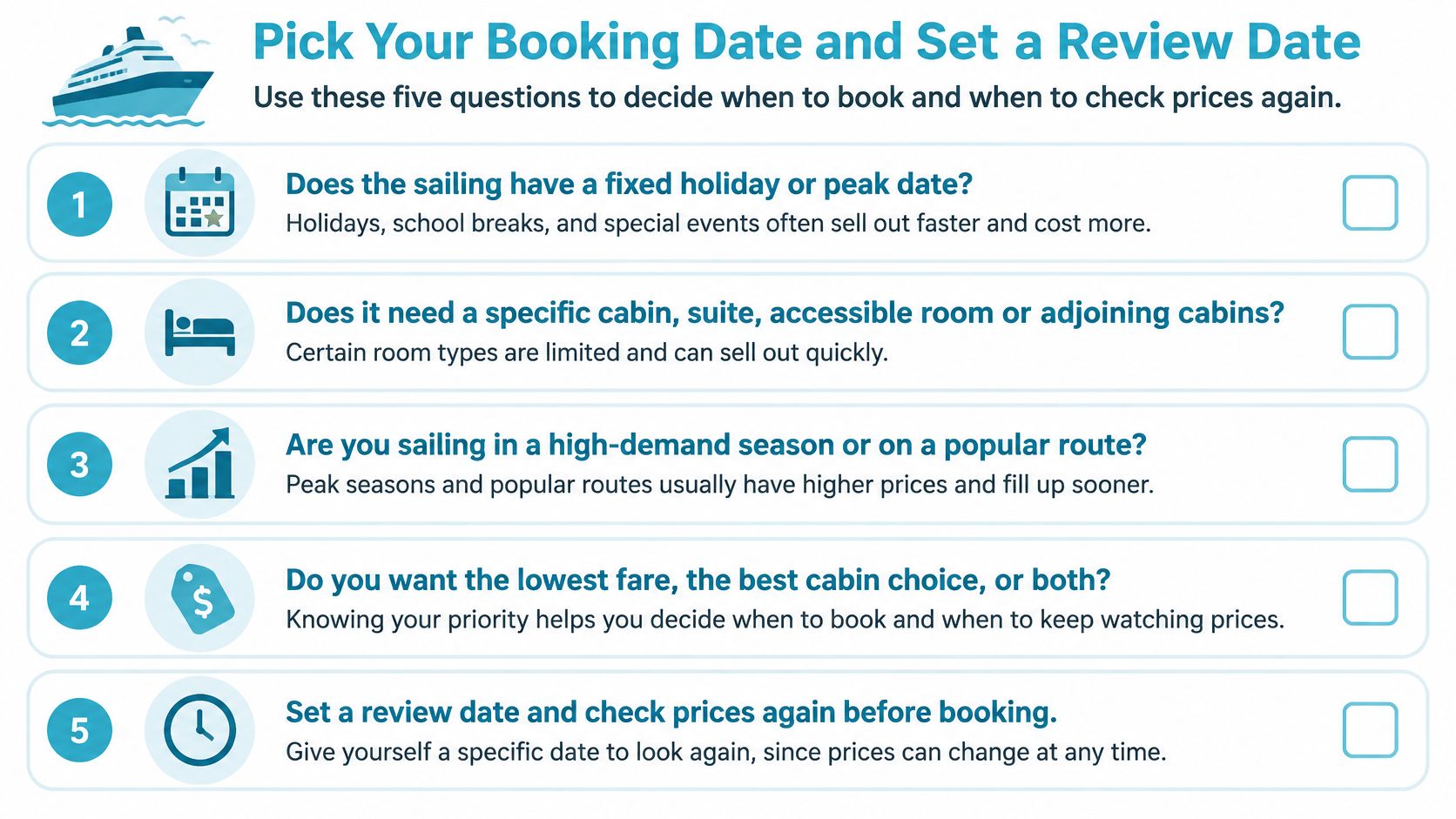
Use your trip's constraints to make a decision, rather than continuing to search indefinitely. Run through these questions in order, with the itinerary and written fare terms open beside you.
- Is the departure date fixed? Identify whether a holiday, school calendar, or work commitment prevents you from moving the trip.
- Does the cabin need specific features? Record accessibility requirements, occupancy, connecting doors, suite needs, or an essential location.
- Can you change both the date and cabin? Genuine flexibility means you'd accept alternatives, not merely browse them.
- Would seasonal disruption undermine the vacation? Consider whether substitute ports or changed travel connections would be acceptable.
- What is the exact final-payment deadline? Use the reservation's terms, not a general assumption about the cruise line.
This visual checklist can help you keep your priorities visible while comparing sailings.
Turn your answers into a booking instruction
If your departure and cabin requirements are fixed, your instruction is straightforward: reserve a suitable option when its fare and conditions are acceptable. Don't hold an essential room requirement hostage to the possibility of a promotion.
If you can change both, choose a monitoring period and define what would make you commit. That could be an acceptable total trip cost, a cabin category you like, or a departure with practical transportation. Also decide when you'll stop searching or abandon the trip.
If the itinerary carries seasonal concerns, settle the surrounding arrangements before paying. Make sure the hotel and transportation conditions match the amount of uncertainty you're willing to accept.
Compare equivalent offers and document the decision
Our online booking engine provides real-time pricing and availability, detailed itineraries, and cruise comparison tools. Use those details to compare equivalent cabin categories and complete itineraries, rather than selecting solely by the lowest headline fare.
Request a written quote before paying the deposit. Check passenger names, cabin category, included benefits, deposit conditions, cancellation terms, and the balance due date. Save that quote with your confirmation so you can evaluate any later offer against what you booked.
A review date is useful even when you don't expect to change anything. It gives you a deliberate opportunity to check readiness and financial commitments before the remaining balance becomes due.
Choose your booking date, mark your review date, and confirm your final-payment deadline in writing. Those calendar entries turn a vague search for a bargain into a decision you can manage.
Visit Best Cruise Rates to compare sailings and contact us for a free cruise quote matched to your dates and cabin requirements. Our cruise specialists can help you check booking terms and identify the final-payment deadline before you commit.
Ready to book your next cruise?
Compare 40+ cruise lines or call our specialists at 1-888-604-0279.