How to Get Best Cruise Deals: A 2027 Booking Guide

"Hold out for a last-minute fare" is the most repeated piece of cruise advice going, and it's the one that costs travelers the most money. Wait long enough and you aren't choosing between two prices. You're choosing between the cabin that's left and the cabin you wanted.
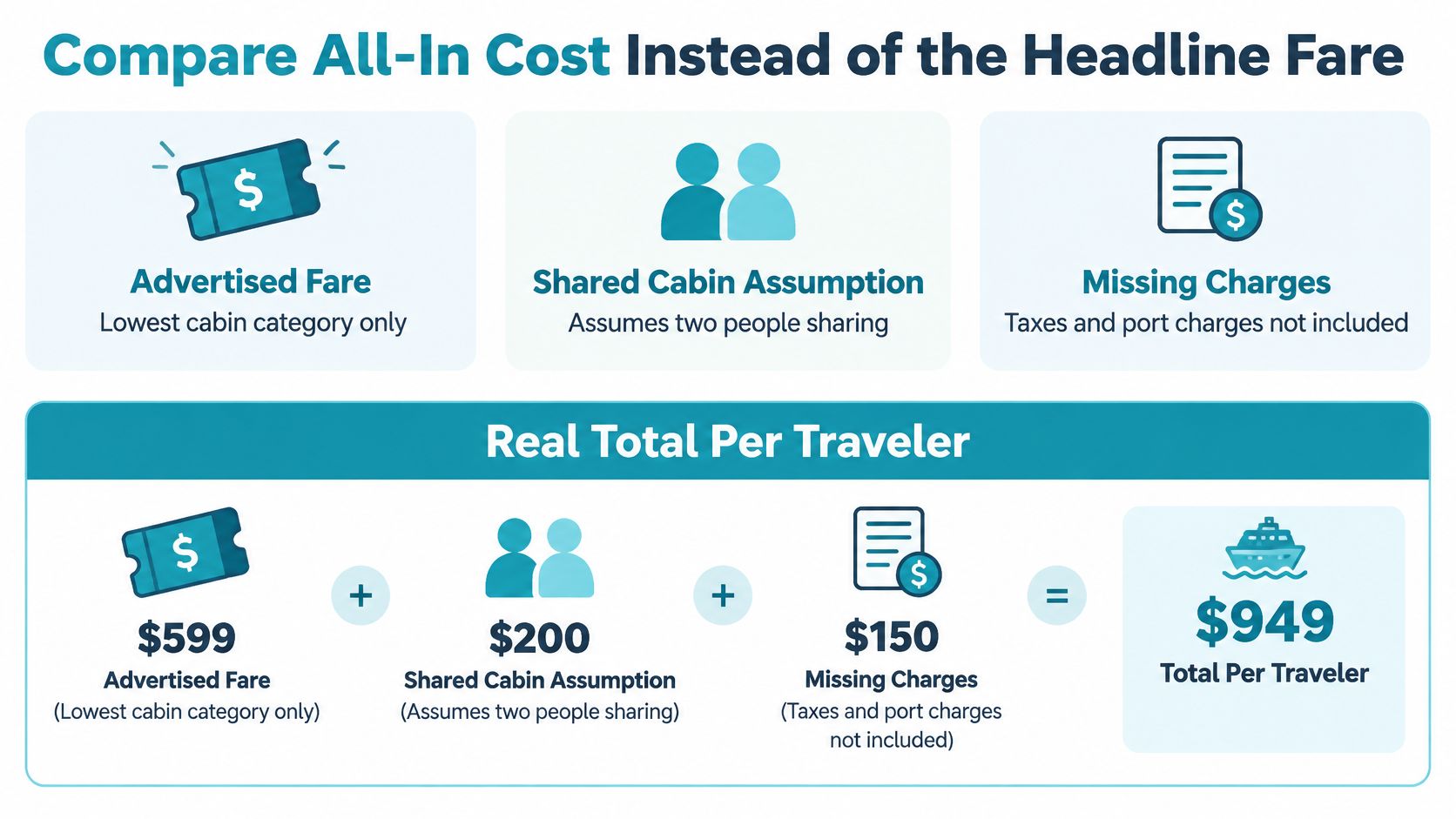
The fare on the banner isn't a price either. It's an opening bid: lowest cabin category, two people sharing, taxes and port charges billed separately, drinks and Wi-Fi on top. A deal only becomes real when you convert it to all-in cost per traveler, per night, and then ask the second question most buying guides skip: what happens to this price after you pay?
That second question decides as much as the fare does. Cruise pricing moves with demand right up to sailing day, and the rules that govern your booking change the moment the final-payment date passes.
Table of Contents
- Compare All-In Cost Instead of the Headline Fare
- Use Flexible Dates and Ports to Lower the Fare
- Booking Windows That Change Your Price
- How to Act When a Fare Drops After You Book
- Using a Travel Advisor to Reprice Your Booking
- Confirm the Deal Before You Pay
Compare All-In Cost Instead of the Headline Fare
Two quotes for the same ship in the same week can sit hundreds of dollars apart, and the lower number regularly loses once the arithmetic is finished. The lead-in fare is a marketing figure: lowest cabin category, two people sharing, taxes and port charges billed separately. Judge a deal on that number and you will often pick the sailing that costs the most by the time you board.
The Travel Statistics Bureau's cruise cost research prices the extras that turn that figure into a real total: drink packages at roughly $65 to $100 per person per day before service charges, Wi-Fi at $20 to $49 per device per day, specialty restaurants at $35 to $70 per person, and common excursions at $100 to $300. Build the full cost per traveler around them: fare, taxes, port fees, gratuities, transfers to the port, any pre-cruise hotel night, travel insurance, and only the extras you would buy.
Plug the ranges into your model before you compare anything.
| Add-on | Typical cost estimate | Why it changes the deal |
|---|---|---|
| Drink package | $65-$100 per person per day before service charges | Can turn a low fare into the costliest option for regular drinkers |
| Wi-Fi | $20-$49 per device per day | Adds up quickly for families with several devices |
| Specialty restaurant | $35-$70 per person per meal | Matters on sailings where the main dining room isn't enough for you |
| Shore excursion | $100-$300 per booking | Often the largest single add-on on port days |
| Port fees and taxes | Set by itinerary and ship; $180 per traveler in the worked example below | Makes two quotes incomparable until both include them |
| Gratuities | Automatic per person per day; $18 a day in the worked example | Check whether your quote includes them or bills them on board |
Where a bundled fare wins
Take one traveler on a seven-night sailing, with illustrative figures. Sailing A lists a $1,200 lead-in fare, plus $180 in taxes and port fees and $126 in gratuities at $18 a day: $1,506 before you have bought anything. A drink package at $80 a day adds $560 and takes it to $2,066. Wi-Fi for one device at $30 a day adds $210, for a total of $2,276, or $325 a night.
Sailing B charges $1,650 with drinks and Wi-Fi included. The same $180 in taxes and $126 in gratuities brings it to $1,956, or $279 a night. The bundled fare runs $450 higher on the base price, yet comes out $110 cheaper once drinks are counted and $320 cheaper once Wi-Fi is too. Drinks alone close that $450 gap in about five and a half days at $80 a day, so the break-even sits near six days; count the Wi-Fi alongside them and the crossover lands closer to four. On a seven-night sailing, the bundle wins for anyone who drinks daily.
Multiply by party size, and rerun the model whenever the drink price or the gratuity rules change.
Dividing by nights is the step most fare comparisons skip, and it flips decisions. Pricing research identifies itinerary length, cabin type, cruise line, departure port, ship capacity, ship rating and departure month as the drivers of fare levels, and a hedonic-pricing study of advance booking strategies associates each additional cruising day with an approximately 11% price increase. A longer sailing that looks pricier per booking can still be the cheaper vacation per day.
Value the freebies at zero unless you'd buy them. Onboard credit is worth its face value only to a traveler who was going to spend that money anyway.
Run the model twice, with and without the bundled drinks, Wi-Fi, onboard credit and promotional discount, and keep the written quote or screenshot each time. Compare identical cabin locations, the same currency and the same cancellation terms, or the difference you're measuring is noise.
Use Flexible Dates and Ports to Lower the Fare
Fares on the same ship and the same itinerary move by hundreds of dollars between departure weeks, and the reason is demand, not distance. Cruise lines price to fill cabins, so school holidays, warm-weather peaks and major vacation periods carry the premium while the weeks either side need incentives. Independent travel reporting points to shoulder-season departures as the cheaper option in major regions, with spring or fall Mediterranean cruises pricing under July and August sailings, and late-season September Alaska cruises under midsummer trips, as Yahoo Travel's cruise timing guide sets out.

Run a two-week window and two ports
- Widen the date to a two or three week range instead of one departure day. Fare movement inside a single month is often larger than the gap between two different cruise lines.
- Compare nearby ports. Two or three embarkation ports within driving distance of each other give you a real advantage, once you count the cost of getting to each one.
- Check the day of the week. A 2025 analysis of 714,000 cruise fare movements found Saturday had a 10.8% chance of a significant price drop, the highest rate among the days studied, according to Travel Industry Wire.
- Count the transport and the onboard spend. A five-day sailing isn't automatically worse value than a seven-day one, and it isn't automatically better either. Shorter trips cut gratuities, drinks and Wi-Fi, but the flight costs the same.
The search goes faster when the tool is built for it. Best Cruise Rates' booking engine lets you search by destination, cruise line, ship, embarkation port and date range, and its compare tool holds up to six sailings side by side for rates, itineraries and ship profiles, which is the only practical way to run a date-and-port grid without losing track of quotes.
A cruise already carries a structural discount against a land vacation, which is one reason the comparison gets sloppy. Truist Securities' May 2024 demand and pricing survey estimated fares were typically about 25% to 30% below comparable land-based vacations, against a historical discount of roughly 15% to 20%, as Travel Market Report reported. That discount tells you cruising is cheap relative to a resort. It doesn't tell you which of two sailings is the better buy.
Here's the routine worth running tonight. Pick two date windows and two ports, price all four combinations on the all-in model, and keep the two that clear your threshold.
Booking Windows That Change Your Price
Lead time decides two things: which cabins you can still choose from and what the fare does after you pay. The planning horizon has stretched, and the table shows where bookings now sit.
| Booking window | What the data shows | What to do |
|---|---|---|
| 9-18 months before | More than 40% of travel advisors report client windows stretching to 9-18 months, and 11% of cruise travelers book at least a year ahead (CLIA, 2025) | Secure popular dates, family cabins and suites |
| 360+ days before | 36% of European cruise bookings made more than 360 days ahead (Travel Market Report, 2024) | Early buyers often pick higher-priced itineraries, so compare categories |
| 270-359 days before | 16% of European cruise bookings made 270-359 days ahead (Travel Market Report, 2024) | A good window for comparing fares across categories |
| Final 20 weeks | 87% of tickets sold in this window in a study of about 400,000 Florida-market bookings | Track fares; late buyers tended to pay less but risk losing cabins |
| About one month before sailing | Peak sales point in the same Florida-market study | Expect sold-out categories, so plan around them if one cabin is essential |
North America has pushed out first. In its 2025 report, CLIA found 11% of cruise travelers book their sailing at least one year before departure, and more than 40% of travel advisors reported booking windows extending to 9 to 18 months in advance, per the CLIA 2025 State of the Cruise Industry Report. Europe runs earlier still. Travel Market Report's 2024 cruise trend coverage found 36% of European cruise bookings were made more than 360 days before sailing, with another 16% made 270 to 359 days ahead.
The late window is crowded, not cheap
The final stretch before departure carries most of the volume. In the Walton College analysis, late purchasers were generally more price-sensitive and more likely to obtain lower-priced cruises, while early purchasers tended to select higher-priced itineraries. Volume concentrated that late also means categories sell through, so the cheaper fare often comes attached to a cabin you didn't want.
What matters is whether your trip can survive the category left at the end.
Book early when the cabin is the point. If you need a specific suite, a family cabin or a holiday week, the later fare isn't available to you at any price.
If your dates and cabin are negotiable, track the same sailing through the final 20 weeks and buy when the all-in cost per night clears your threshold. If they aren't negotiable, buy the cabin while it exists. At Best Cruise Rates your rate locks once the deposit is paid, so committing early to a cabin you need carries less fare risk than waiting for a drop that may never come. The relationship between lead time and price also varies by cruise line, origin port and sailing, so a rule learned on one itinerary won't transfer cleanly to the next.
How to Act When a Fare Drops After You Book
A lower public fare does not create an entitlement to a refund or an adjustment. That's the part missing from most deal advice. Cruise lines and agencies apply different rules depending on fare type, cabin category, occupancy, market, payment status and whether you've reached final payment, and the answer to "can you match this?" changes with each of those.
The six steps, in order
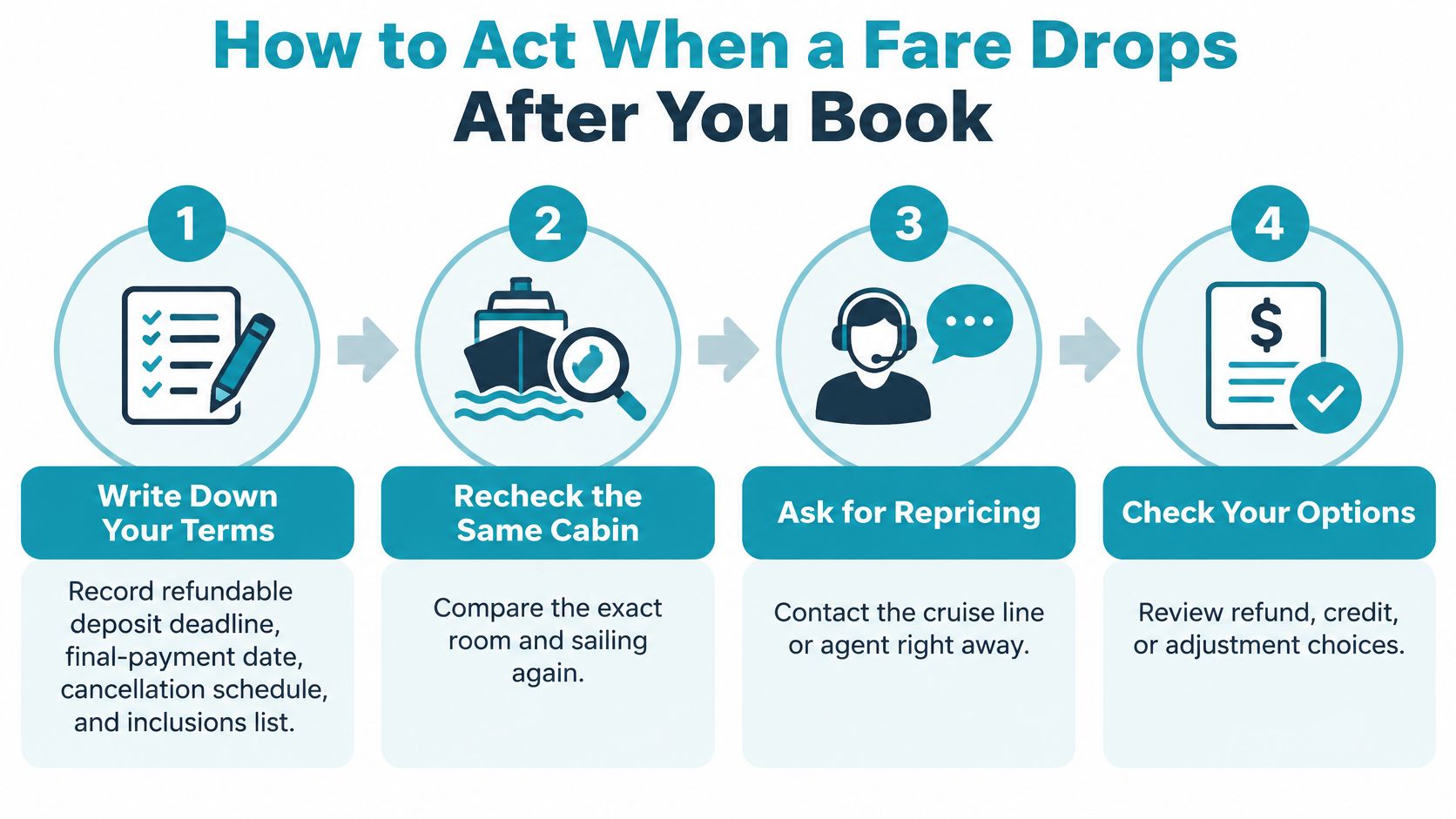
- Write down four things at the quote. The refundable deposit deadline, the final-payment date, the cancellation schedule and the inclusions list. These decide your options later, and none of them is recoverable from memory three months on.
- Recheck the identical sailing. Same ship, same date, same cabin category, same inclusions. A cheaper interior cabin isn't a price drop on your balcony, it's a different product.
- Ask for an adjustment before final payment. Repricing the existing booking is usually safer than canceling and rebooking, because cancellation can forfeit the deposit and the cabin.
- Expect less after final payment. At that stage a lower fare may come back as onboard credit, an upgrade, or nothing at all.
- Price the exit before you take it. Compare any cancellation penalty plus lost benefits, such as a nonrefundable deposit or flights booked around the sailing, against the new fare.
- Rebook only when the new all-in price clears the threshold you set at the quote, not when the headline number looks smaller.
The penalty schedule explains why timing decides the answer. Royal Caribbean's published policy, as set out by U.S. Cruise's cancellation schedule, moves from no charge at 90 or more days before many 5-14 night cruises to 25% at 89-75 days, 50% at 74-61 days, 75% at 60-31 days, and 100% within 30 days.
| Days before sailing | Cancellation charge |
|---|---|
| 90 or more days | No charge |
| 89-75 days | 25% |
| 74-61 days | 50% |
| 60-31 days | 75% |
| 30 days or fewer | 100% |
Read those numbers against any "last-minute deal" you're chasing. Inside 30 days, canceling to capture a lower fare means paying the full cruise fare to save part of it, which isn't a saving.
Waiting has a price, and it's paid in choice. A later fare can be lower and still be the worse outcome if it costs you the cabin, the flights that made the date work, or the ability to reprice safely before final payment.
International travelers should add flights and hotels to every version of this calculation. A nominal cruise saving of a few hundred dollars disappears fast when the only remaining seats are the expensive ones.
Using a Travel Advisor to Reprice Your Booking
The moment an advisor earns their place isn't while you're browsing. It's when you're holding a booking, you've spotted a lower advertised price, and someone needs to spend forty minutes on the phone with the cruise line on your behalf. That call is where most self-booked repricing attempts die, and it's the service you're already paying for inside the fare whether you use it or not.
Best Cruise Rates runs a best-price approach built for exactly that situation. If you find a lower price compared to the cruise line after booking but before final payment, in U.S. dollars and advertised anywhere, the company will contact the cruise line to re-fare your booking to the best promotion, and additional restrictions may apply. The quote itself is free for anyone who asks, and a travel planner handles the cruise line on all issues and concerns at no cost to you.
What the guarantee doesn't cover
Read the restrictions as carefully as the benefit, because the edges are where travelers get surprised.
- Timing. The protection applies after booking and before final payment. Once you've paid in full, a lower advertised fare is a conversation, not a guarantee.
- Currency and source. The lower price has to be advertised in U.S. dollars. A fare quoted in another currency, or buried behind a membership wall, may not qualify.
- Fare type and promotion. Re-faring moves you to an applicable promotion, and promotions carry their own deposit, cancellation and inclusion terms. A cheaper fare that strips out your drinks package isn't cheaper.
- Post-payment situations. After final payment, the options narrow to what the cruise line will offer, which is often onboard credit, an upgrade, or nothing.
Ask for the restrictions in writing before you rely on the guarantee, and confirm the covered fare types, currencies and deadlines against the published terms.
The sensible division of labor is straightforward. Use self-service search and comparison when you're still deciding what to book, and use an advisor when you need a quote, a reprice, or help with a reservation that already exists. That second category is where the time savings are real, because it's the part of cruise booking that eats an afternoon.
Confirm the Deal Before You Pay
The hour before you enter your card details is worth more than any fare alert. Once your deposit is paid, your rate is locked in, so every check below has to happen first.
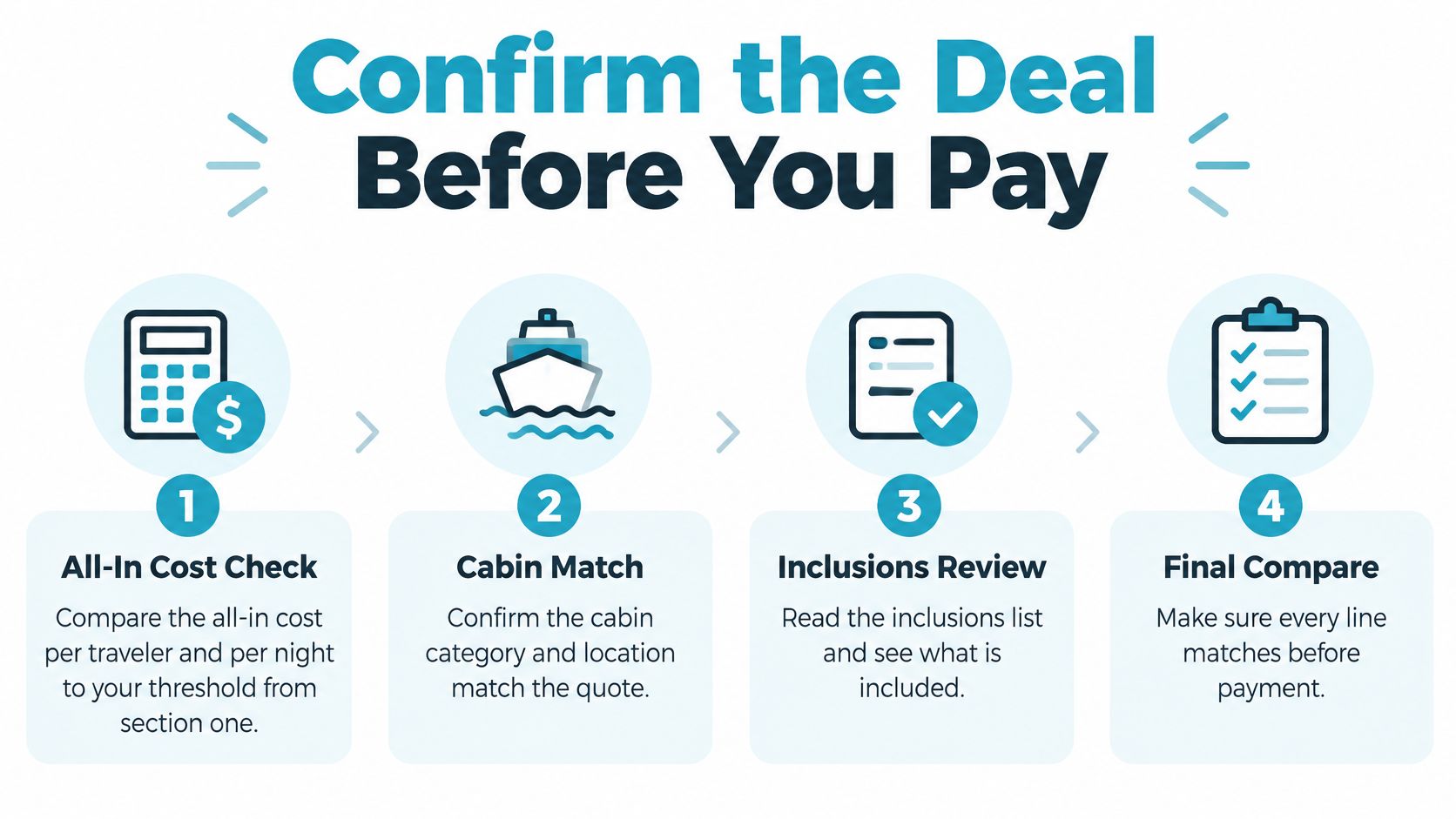
Run the list in order. Each item has altered the price of a booking.
- Check the cabin itself, past the category name. Confirm the cabin number and location match the quote you compared. A guarantee cabin assigned later is a different product under the same label.
- Read the inclusions line by line. Drinks, Wi-Fi, gratuities and dining credits, and whether each is priced per person or per stateroom.
- Confirm the cancellation schedule and deposit deadline for the specific fare code you're buying, since fare codes carry their own terms beyond the line's general policy.
- Check currency and occupancy. A per-person fare that assumes two sharing can price very differently for a solo traveler or a family of four in one cabin.
- Save the confirmation. Book online and the confirmation is issued immediately where the cruise line allows it, so keep it with your written quote and the inclusions list.
- Set two reminders. One for the final-payment date, one for a monthly fare check until then. The monthly check matters because the window for repricing closes at final payment.
Then book the first sailing that clears your all-in cost per night, and stop shopping. The search that continues past a good all-in number usually ends with a worse cabin at a similar price.
Best Cruise Rates puts more than 40 cruise lines in one search, so you can compare up to six sailings side by side on rates, itineraries and ship profiles, then request a free quote before committing to anything. Its best-price guarantee covers a lower advertised price in U.S. dollars found after booking but before final payment, with restrictions, so the number you accept can still improve. Visit Best Cruise Rates to price your date window, run the all-in math on your shortlist, and put a deposit down on the sailing that wins.
Ready to book your next cruise?
Compare 40+ cruise lines or call our specialists at 1-888-604-0279.