Royal Caribbean Cruises: Ships, Costs and How to Book
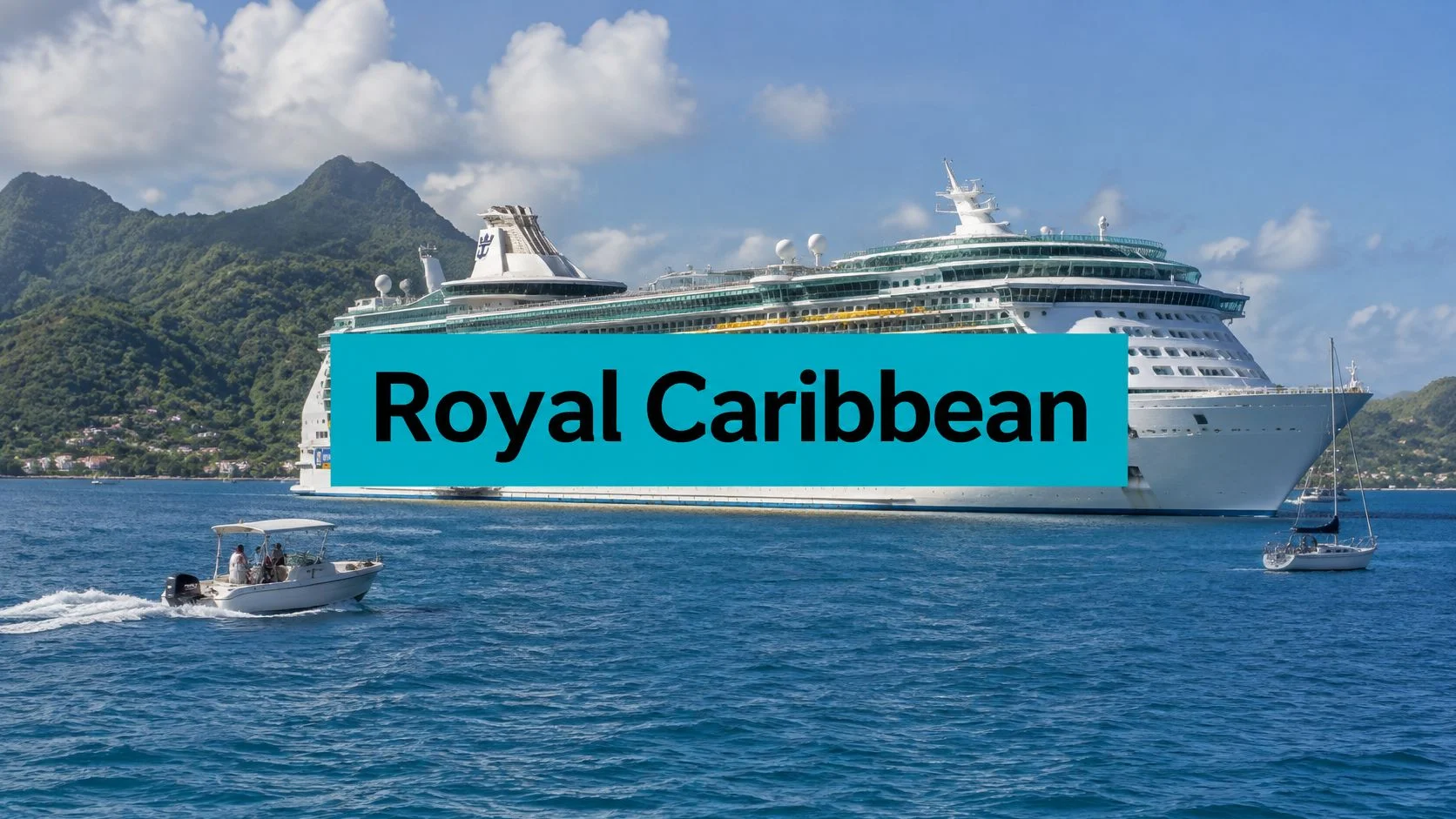
A single Royal Caribbean ship now operates at the scale of a small resort town. Icon of the Seas stretches 364.75 metres long at 248,663 gross tonnage, reaches roughly 22 knots, and accommodates about 5,600 passengers alongside an approximate crew of 2,350, powered by six Wärtsilä dual-fuel engines capable of burning liquefied natural gas (LNG) or distillate fuel and three roughly 20 MW ABB azimuthing propulsion units, according to the Baird Maritime vessel review of Icon of the Seas. Ships of that size can't call at every port, don't price like smaller vessels, and feel nothing like a classic mid-size sailing.
Booking a Royal Caribbean vacation by brand name alone leaves too much to chance. Two itineraries leaving from the same port can deliver totally different crowds, cabin layouts, and final bills depending on the season, the exact ship class, and the onboard extras you add. Planning well means matching your region, ship, cabin, and all-in budget before you put down a deposit.
Table of Contents
- Royal Caribbean Destinations and Best Seasons
- Royal Caribbean Ship Classes Compared
- Choosing Cabins and Ships for Your Travel Group
- What a Royal Caribbean Cruise Really Costs
- Handling Itinerary Changes and Missed Ports
- Book Your Royal Caribbean Sailing Step by Step
Royal Caribbean Destinations and Best Seasons
Every cruising region runs on a tight weather and pricing calendar. Use the table below to narrow down when and how long to sail before you compare individual ships.
| Region | Best months | Typical length | Main thing to check |
|---|---|---|---|
| Eastern and Western Caribbean | December to April | 3 to 7 nights | Hurricane season runs June 1 to November 30 |
| Alaska | May to September | 7 to 14 nights | Cool temperatures and scenic cruising days |
| Mediterranean | April to October | 7 to 14 nights | Many port days and summer peak prices |
| Northern Europe and Baltic | June to August | 10 to 14 nights | Long daylight and high summer demand |
| Bahamas from Florida | Year-round | 2 to 5 nights | Short sailings that sell out on holidays |
Seasonal Risks That Shift Trip Value
Two calendar factors reshape what you pay and what you experience across these routes: weather windows and school breaks. In the Caribbean, dry-season sailings from December through April bring calmer seas and lower rain odds, while hurricane season from June 1 to November 30 trades lower shoulder-month fares for a real risk of rerouted ports or rough weather. If you're choosing between island chains, comparing port styles on Eastern versus Western Caribbean cruises helps you decide whether you want beach days, snorkeling, or historic town stops before locking in dates.
School holidays push fares and onboard crowds up sharply in every region. Summer weeks in the Mediterranean and Northern Europe pair long daylight with peak airfare, packed tender docks, and crowded historic centers, while Bahamas short getaways from Florida routinely sell out around long weekends and spring break. Shoulder sailings in May or September in Alaska, or April and October in the Mediterranean, often cut fares without sacrificing core ports, provided you pack layers for cooler decks.
Matching Sea Days to Your Travel Style
Before you book any sailing, count the sea days against the port days on the itinerary. Mediterranean routes often pack port stops back to back, leaving little time to use the ship's pools, theaters, or dining rooms, whereas Caribbean and longer repositioning routes build in full days at sea to unwind.
Treat the season and the route as a single decision. A cheap fare in the wrong weather window or an exhausting port-heavy schedule when you wanted rest rarely feels like a bargain once you're onboard.
Royal Caribbean Ship Classes Compared
Royal Caribbean runs six core ship classes across its modern fleet, and the gap between the largest resort vessels and the smaller classic ships is enormous. Compare the classes side by side before picking an itinerary.
| Ship class | Example ships | Best for |
|---|---|---|
| Icon class | Icon of the Seas, Star of the Seas | Families and travelers wanting the largest resort-style ship |
| Oasis class | Oasis, Allure, Harmony, Symphony, Wonder, Utopia of the Seas | Families and groups who want many themed areas |
| Quantum Ultra class | Spectrum, Odyssey of the Seas | Thrill seekers and active guests |
| Quantum class | Quantum, Anthem, Ovation of the Seas | Mid-size ships with a balance of activities and calm areas |
| Freedom class | Freedom, Liberty, Independence of the Seas | Classic Caribbean sailings at a moderate size |
| Voyager class | Voyager, Explorer, Adventure, Navigator, Mariner of the Seas | Smaller crowds and ports that larger ships cannot reach |
Trade-Offs Across the Six Classes
Icon class ships sit at the top of the resort scale, combining large water parks, multiple themed neighborhoods like the kid-focused Surfside area, destination elevators that cut wait times, and complimentary food halls such as Aquadome Market. You get unmatched variety for multigenerational groups, though you pay premium fares, face heavier embarkation flows, and remain limited to deep-water ports built for mega-ships.
Oasis class vessels deliver a similarly massive neighborhood design with broad dining choices and headline entertainment, often at a lower fare than the newest Icon builds. The trade-off is busy pool decks on sea days and longer queues at embarkation, disembarkation, and popular shows unless you reserve times early.
Quantum Ultra class and Quantum class ships trim the footprint into a mid-to-large profile built for active itineraries and cooler-weather cruising. Quantum Ultra ships lean into thrill attractions like a skydiving simulator, while Quantum vessels balance indoor entertainment venues, ice rinks on select ships, and quieter lounges when rain or chilly air keeps guests inside. You lose the sprawling outdoor neighborhoods of Oasis and Icon, yet navigating the ship feels faster and less hectic.
Freedom class ships serve as the classic Caribbean workhorses, delivering familiar promenades and family activities at a moderate size that keeps boarding and pool crowding more manageable. Voyager class sits smaller still, giving up giant water parks and sprawling dining rosters in exchange for calmer common areas and access to tighter ports that mega-ships have to skip.
Fleet Scale, History and Environmental Tech
Royal Caribbean's Caribbean focus goes back to its founding in 1969 by hospitality entrepreneur Ed Stephan and Norwegian shipowners Sigurd Skaugen, Anders Wilhelmsen, and Gotaas Larsen, whose first vessel, Song of Norway, departed Miami on November 7, 1970, followed by two additional ships over the next two years, according to the Royal Caribbean Group company history. Five decades later, that regional startup has grown into a global giant.
In 2025, Royal Caribbean Group's global brands and partner brands operated 69 ships calling at more than 1,000 destinations across over 120 countries, generating $17.9 billion in total revenue (up $1.5 billion, or 8.8%, from $16.5 billion in 2024), with passenger-ticket revenue accounting for 69.8% of total revenue and load factors hitting approximately 110%, per the Royal Caribbean Group 2025 Form 10-K. Load factors above 100% mean third and fourth guests regularly fill sofa beds and pullman berths, which directly translates into livelier public spaces on peak family sailings.
If local port emissions factor into your ship choice, look at fuel and power capabilities as a tiebreaker rather than a guarantee of clean cruising. Dual-fuel LNG ships cut sulphur oxides and particulates compared with heavy fuel oil, though they don't eliminate greenhouse gases, and the Royal Caribbean Group 2023 Sustainability Report noted 30 ships were shore-power capable at the end of 2023 with additional retrofits planned. Plugging into a port's electrical grid cuts at-berth diesel emissions, though the climate benefit depends on whether the call port has compatible hookups and how clean its local electricity grid is.
Always check the exact ship name on your itinerary rather than just the Royal Caribbean logo. Two seven-night sailings on the exact same route can run on a Voyager-class ship and an Oasis-class ship, offering completely different onboard atmospheres.
Choosing Cabins and Ships for Your Travel Group
I'd set your cabin category and total cabin budget first, then pick the ship class that fits inside that number. The jump from an interior cabin to a balcony or suite usually swings your total trip price more than moving between two ship classes on the same route.
Before comparing stateroom tiers, it helps to picture how much time your group spends inside the cabin versus out on deck.
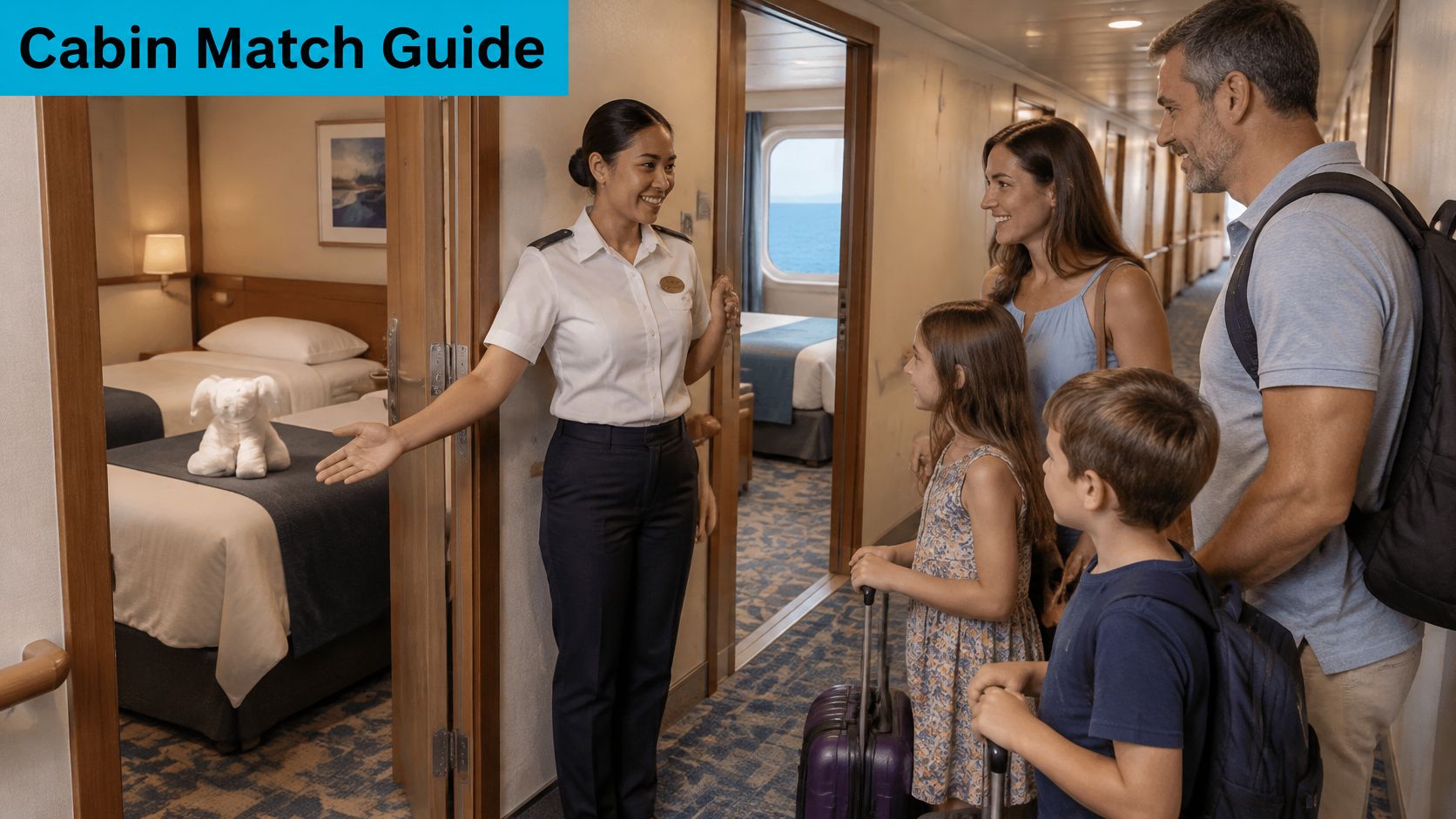
Reviewing the core trade-offs across cruise cabin types keeps you from paying for square footage or outdoor space you won't use.
| Cabin type | What you get | Best for | Main drawback |
|---|---|---|---|
| Interior | Lowest fare and no window | Budget travelers who spend most of the day out | No natural light |
| Ocean view | Fixed window with daylight | Guests who want daylight without paying for a balcony | Limited space and no private outdoor area |
| Balcony | Private outdoor space | Couples and guests who want sunrise sailings | Higher fare than inside or ocean-view cabins |
| Suite | Extra space and priority services | Families, luxury-minded guests and special occasions | Highest fare of the standard categories |
Matching Cabins and Classes to Your Group
Once you've settled on a cabin tier, match both the room layout and the ship class to how your group travels:
- Families with young kids: Look for connecting cabins or dedicated family rooms with split bathrooms, which are far easier to find on Icon and Oasis class ships alongside dedicated kids' zones like Surfside. Remember that newer mega-ships don't always offer deeper drawer storage than older vessels, so packing cubes help keep shared rooms tidy.
- Couples seeking quiet time: Weigh the price gap between an ocean-view cabin and a balcony, especially on scenic Alaska or Mediterranean routes where private morning coffee beats fighting for deck chairs. On Icon-class vessels, check whether a listing is a traditional step-out balcony or an infinite balcony (a floor-to-ceiling sliding window that adds indoor floor space instead of an open-air veranda).
- Seniors and mobility-conscious guests: Verify accessible cabin availability early and lean toward quieter, easier-to-get-around vessels like Voyager or Quantum class ships rather than sprawling mega-resorts with long walks from forward staterooms to aft dining rooms.
- First-time cruisers: Start with a Freedom or Quantum class ship if you want plenty of activities without feeling overwhelmed by mega-ship scale, or step up to Icon only if your budget comfortably covers both the higher base fare and the onboard extras.
Planning order: Lock in your must-have cabin category and ceiling price before falling in love with a specific ship. Using the ship class to refine your choice within budget prevents an affordable vacation from ballooning into an expensive one.
What a Royal Caribbean Cruise Really Costs
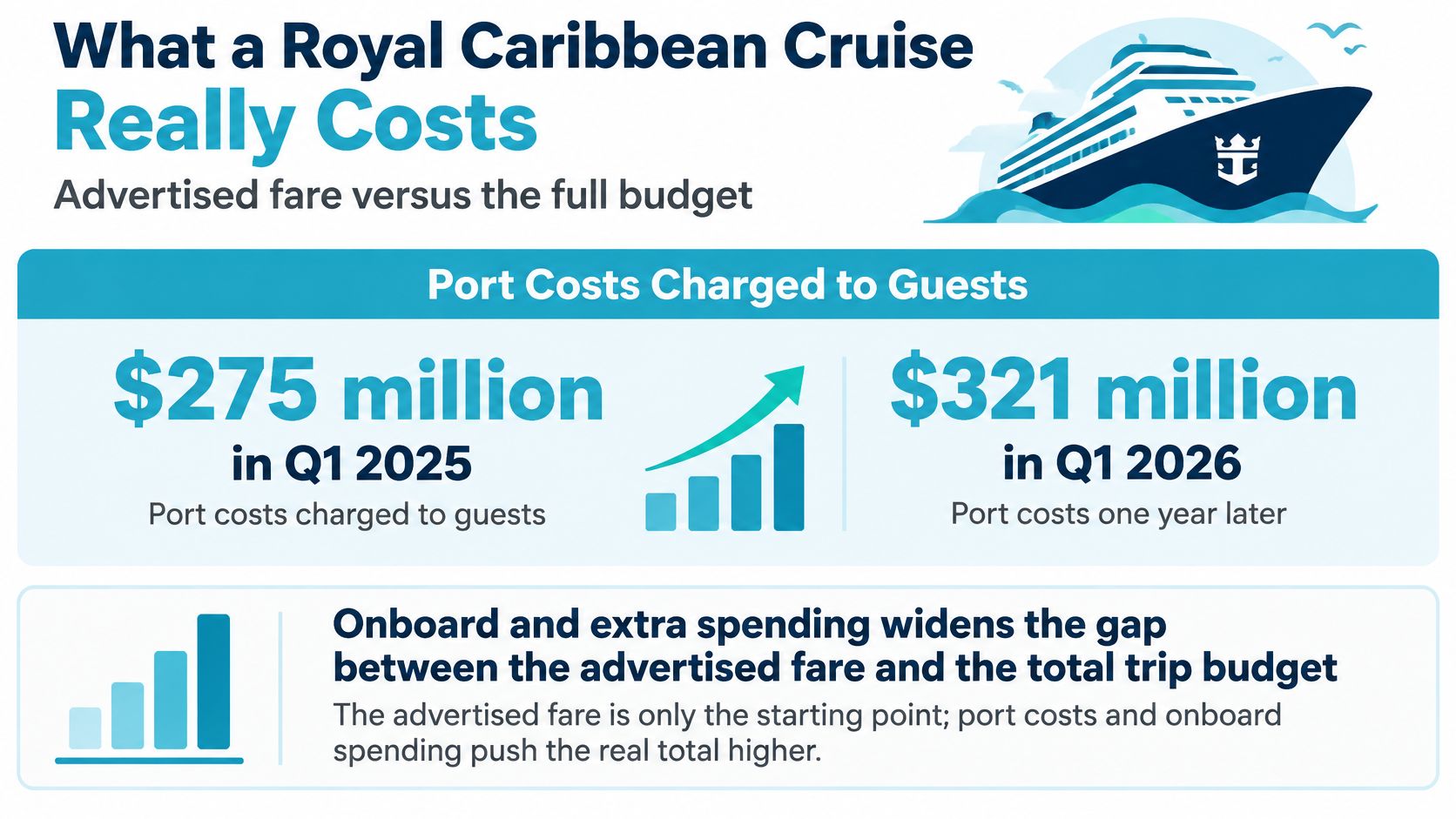
Headline fares tell only part of the financial story, and the gap between ticket price and total trip spending has widened. According to the Royal Caribbean Group Q1 2026 Form 10-Q, port costs charged to guests climbed from $275 million in Q1 2025 to $321 million in Q1 2026, a jump of roughly 17%, while onboard spending and pre-cruise purchases exceeded prior-year levels due to higher participation at increased prices.
That shift shows up quickly when you compare a promotional base fare against what hits your credit card statement.
Break down every cost line before comparing two quotes, since some fees are mandatory and others stay under your control.
| Cost line | Included in base fare? | When it is usually paid |
|---|---|---|
| Cruise fare for the cabin | Yes | At booking and final payment |
| Port fees and government taxes | No, added to the fare | At booking or final payment |
| Daily gratuities | No | Charged onboard per guest per day (check the current rate) |
| Drink packages | No | Bought before sailing or onboard |
| Wi-Fi and internet | No | Bought before sailing or onboard |
| Shore excursions | No | Booked separately, before or onboard |
| Flights to and from the port | No | Booked separately |
| Travel insurance | No | Bought before final payment |
Unavoidable Charges Versus Optional Add-Ons
Base cabin fare, port fees and government taxes, and daily gratuities are the core unavoidable cruise charges. Depending on where you live, currency conversion, local taxes, and whether gratuities are prepaid or billed daily to your onboard account can also nudge the final figure.
Drink packages, Wi-Fi, specialty dining, private-destination cabanas, and shore excursions are optional, yet strong ship occupancy gives cruise lines firm pricing power on extras. Buying beverage packages, internet plans, and specialty dining packages through the pre-cruise planner before you sail almost always beats waiting until embarkation day, when full onboard retail pricing applies. On the flip side, if you only drink two coffees and one cocktail a day, paying à la carte onboard usually saves money over an unlimited beverage package.
Running an All-In Cruise Budget
Build your real budget with a four-part formula: multiply the per-person fare by the number of guests, add total port fees and taxes, multiply the daily gratuity rate by both the number of guests and the number of nights, and add a realistic allowance for drinks, Wi-Fi, excursions, flights, and insurance.
To see how quickly those lines add up, take a hypothetical worked example for a couple booking an illustrative 7-night sailing (replace these sample numbers with your actual quote and current gratuity rates):
- Base fare: 2 guests at $1,200 per person = $2,400
- Port fees and taxes: 2 guests at $150 per person = $300
- Daily gratuities: 2 guests across 7 nights at an illustrative $16 per guest per day = $224
- Mandatory cruise subtotal: $2,924 before a single drink or tour
- Optional extras: Add $400 for drinks, Wi-Fi, and one shore excursion to reach an all-in budget of $3,324, which sits well above the $2,400 headline cabin fare.
Seeing how travelers handle prepaid extras and onboard bills helps put those numbers into practice.
Pay close attention to refund timelines before locking in prepaid items or final cruise balances. Once you cross into the final payment period, cruise cancellation penalties are strict and aren't waived even for medical reasons, so check the cancellation cutoff for both your cruise fare and any prepaid add-ons before you commit.
Handling Itinerary Changes and Missed Ports
Booking a flagship mega-ship doesn't guarantee a fixed land schedule. Operational flexibility is built into every cruise contract, and high fleet demand tightens the margin for error. In 2025, Royal Caribbean carried 9.446 million passengers, up from 8.564 million in 2024, with occupancy hitting 109.7%, and its 2026 guidance projected approximately 6.6% capacity growth, according to the Royal Caribbean Group 2025 Earnings Release. More ships and fuller decks put heavier pressure on berth slots, local transport, and busy private-destination days, especially on Alaska, Europe, and hurricane-season Caribbean itineraries.
Three Disruption Scenarios and What to Do
A missed port with no replacement turns a planned sightseeing day into an extra sea day, usually due to high swells or unsafe winds at a pier or tender dock. Port fees for the skipped stop are typically refunded to your onboard account, and your fastest move is checking the updated daily schedule right away so you can reserve newly added onboard activities or dining slots before they fill.
A port substitution sends the ship to an alternate harbor instead of the published stop. Head to guest services or check the app early in the morning to confirm dock times, shuttle details, and replacement shore excursions, because popular local tours sell out within an hour of an itinerary swap.
A delayed return to the home port is the most expensive disruption because it breaks onward flights and hotel reservations. Stay in touch with guest services for estimated disembarkation timing, use ship Wi-Fi to rebook flights immediately rather than waiting until you reach the terminal, and ask for written confirmation of the delay for airline or insurer waivers.
Documentation, Excursions and Travel Insurance
Keep your passport, booking confirmation, prepaid receipts, and any written disruption notice from the cruise line together in one folder, both digitally and on paper. If you book tours directly through Royal Caribbean, the ship generally waits for delayed cruise-sponsored groups or arranges transport to the next port; independent local tours often cost less, yet they leave you paying out of pocket if traffic or a weather-shortened call causes you to miss all-aboard time.
Read your travel insurance policy closely before buying, because insurers treat a missed port very differently from trip interruption. Many standard policies offer only a modest fixed benefit (or none at all) for a skipped stop when the voyage continues, whereas trip interruption coverage applies to covered delays or cut-short travel that force unexpected hotel nights and flight changes.
Always fly into your embarkation city at least one day early and book return flights with generous buffer time, or the next morning when schedules are tight. One extra hotel night costs far less than missing the ship or buying last-minute walk-up airfare.
Book Your Royal Caribbean Sailing Step by Step
Turning research into a confirmed reservation goes smoothly when you follow the right sequence instead of chasing flashy promo banners.
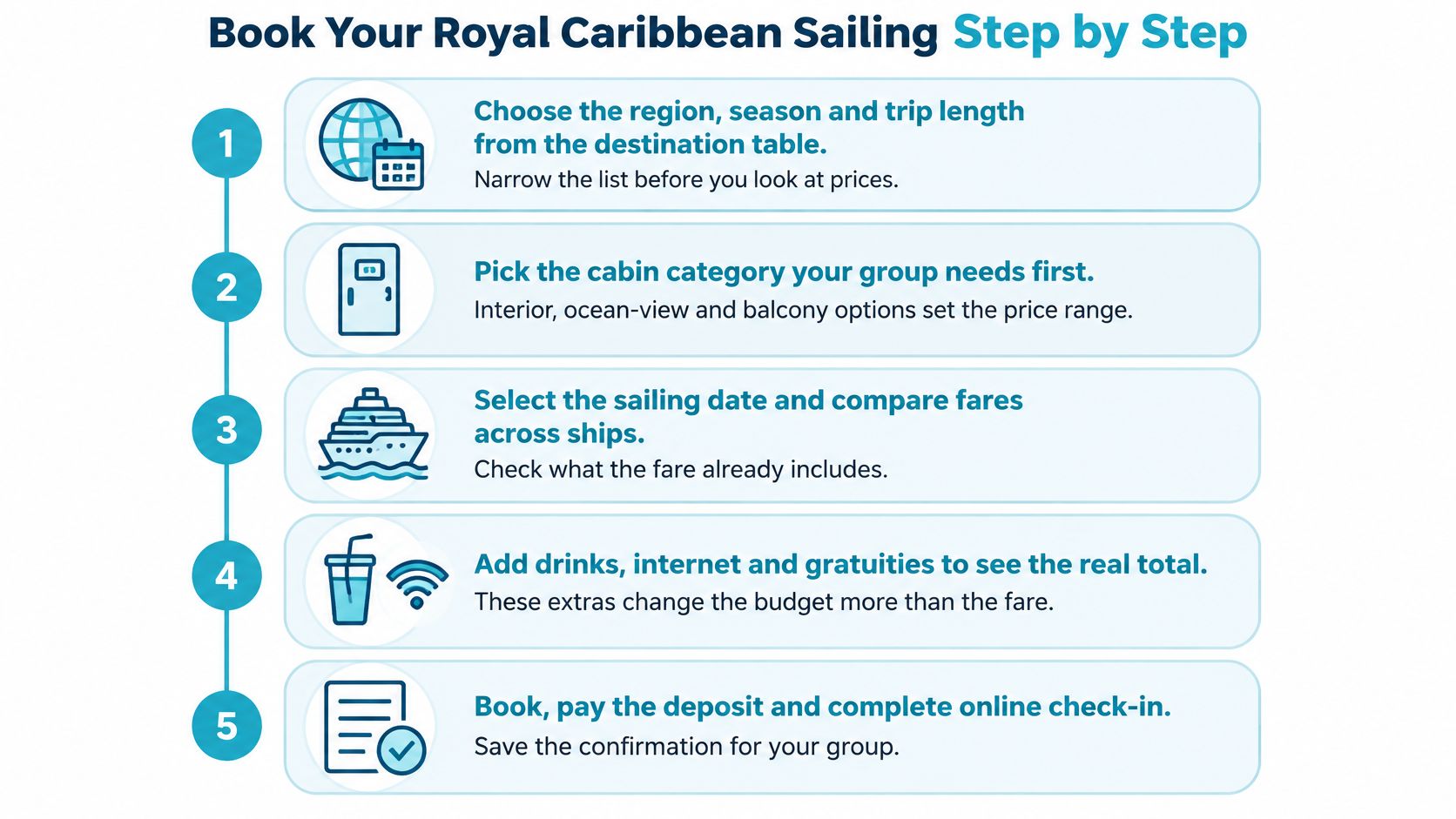
Follow these eight steps to lock in the right sailing without overpaying:
- Set your region, season, and trip length. Narrow the calendar first so weather risks, school breaks, and your preferred ratio of sea days to port days filter out mismatched options immediately.
- Choose your cabin category before the ship class. Decide whether your group needs an interior, ocean-view, balcony, or suite, then filter ship classes that stay inside your comfort level for both price and crowd size.
- Compare apples to apples across sailings. Only line up fares that share the same departure port, sailing length, and cabin category, because mixing a 4-night interior with a 7-night balcony makes price comparisons useless.
- Calculate the all-in trip total. Add port fees, taxes, daily gratuities, flights, and realistic extras to every shortlisted fare so you're comparing real out-of-pocket costs rather than teaser rates.
- Verify the exact ship name on the itinerary. Double-check which ship operates your chosen dates, since two sailings on the same route can belong to completely different ship classes with very different venues.
- Complete your booking and save every record. Whether you reserve directly or check options on where to book a cruise, keep your confirmation number, invoice breakdown, and deposit receipts together; online reservations generally issue immediate confirmation where permitted by the cruise line.
- Buy travel insurance before final payment. Lock in coverage while your full penalty window hasn't started, and confirm how the policy handles missed ports, flight delays, and medical cancellations.
- Finish pre-cruise registration and document checks. Verify passport validity and any visa rules early, then complete online pre-cruise registration (generally available after final payment), since cruise tickets are only released once every guest in the cabin finishes registering.
Comparing Your Shortlist Side by Side
Narrow your search to two or three matching sailings before pulling out a credit card. On Best Cruise Rates, our compare tool lets you evaluate up to six sailings side by side across rates, itineraries, and ship profiles, and you can request a free cruise quote whenever you want a second set of eyes on cabin categories or promotions. Once you book, your dedicated travel planner handles dealing with the cruise line on any issues or concerns at no cost to you, letting you focus on packing rather than sitting on hold. Pick your top two or three Royal Caribbean sailings that match your season, ship class, and all-in budget, put them side by side, and lock in the one that delivers the best total value for your group.
Ready to turn your Royal Caribbean shortlist into a confirmed trip without guessing at cabin layouts or hidden fees? Compare up to six Royal Caribbean itineraries side by side, request a free cruise quote, and get no-cost planner support from booking through embarkation at Best Cruise Rates.
Ready to book your next cruise?
Compare 40+ cruise lines or call our specialists at 1-888-604-0279.