Where to Book a Cruise: Compare Channels and Who Can Help
Two quotes land for the same cabin, a little apart on price, and the decision looks obvious. Then the cruise line drops a port, a better promotion appears three weeks after you booked, or a guest's name needs correcting, and the obvious choice turns into the question nobody asked at checkout. Who picks up the phone on your behalf?
Comparing where to book a cruise on price alone answers the easy half of the question. Every channel sells the same ships at broadly the same published fares, so the difference shows up later. It shows up in who can reprice a reservation, who can move a cabin without starting over, and who owns the conversation with the cruise line when a schedule changes.
Table of Contents
- Booking Channels Compared at a Glance
- Which Trips Need a Specialist and Why
- What to Compare Before You Pay
- Timing Your Booking and Tracking Price Changes
- How to Get Help With an Existing Booking
- Choose Your Channel and Book With Confidence
Booking Channels Compared at a Glance
Four channels cover nearly every cruise booking, and they differ less in what they sell than in who handles the aftermath.
Booking channels at a glance
| Channel | Best for | Who handles changes | Check before paying |
|---|---|---|---|
| Cruise line website | One cruise on a brand you already know | The cruise line | Whether other lines' sailings are worth comparing |
| Online travel agency | Comparing several lines in one search | The agency that issued the booking | Who controls refunds and cabin changes |
| Travel advisor | First cruises, groups, complex trips | The advisor, who contacts the cruise line | Any advisor fee and how repricing is handled |
| Multi-line booking platform with specialists | Side-by-side comparison with phone support | Specialist team, with the cruise line for final servicing | Repricing window and promotion restrictions |
The rule that separates them fits into two sentences. Book direct when you already know the line, the ship and the cabin, and nothing about the trip is still open. Bring in a specialist once ship, port, cabin, dates or guest count are still in motion, because the work at that point is comparing and coordinating rather than clicking.
Scale is why comparison tools earn their place. CLIA's State of the Cruise Industry Report 2025 records 34.64 million global ocean-cruise passengers in 2024, up 9.3% from 31.69 million in 2023 and 6.8% above 2019. That field runs from mainstream ocean ships to luxury, small-ship and river products, and no single line's website will show you more than its own inventory.
Three questions sort any channel before money changes hands:
- Can it reprice if the fare drops? Ask what the window is and who has to file the request. A promise of "the best price" means nothing if it expires at final payment and nobody monitors your booking.
- Will it handle a cabin change? Moving a cabin is a reservation edit, not a new booking, and the party holding the reservation has to make it.
- Who holds the payment? Money paid to an agency and money paid to a cruise line are different records, and the answer decides who refunds what.
Timing redirects the answer too. Shopping inside the final weeks trades cabin choice for price, and last-minute cruise deals only work through a channel that can see live availability across several lines rather than one line's leftover inventory.
Which Trips Need a Specialist and Why
Who takes responsibility after payment matters most when a cruise involves more than choosing a cabin and sailing date.
In 2025, travel advisors handled about 70% of U.S. cruise-market revenue, according to Phocuswright's U.S. Cruise Market Essentials 2025 analysis. In the same year, 16% of U.S. travelers used a professional travel agent, per Phocuswright's consumer-trends research. The figures measure different things: traveler use and share of revenue. Together, they show that advisors handle a large share of cruise spending even though a smaller share of travelers report using an agent.
The trip in front of you, not the market average, should decide where to start. Use the table to match the trip's moving parts with a channel that can help resolve problems after booking.
Trip situations and the best starting channel
| Trip situation | Best starting channel | Why it matters |
|---|---|---|
| Single cabin, familiar cruise line, short sailing | Cruise line website | Few variables and direct servicing |
| First cruise with questions about cabins and fees | Travel advisor | Matches cabin, ship and fare rules to your needs |
| Multigenerational or family group | Travel advisor | Keeps cabins, payments and changes coordinated for all guests |
| Luxury or river cruise | Specialist or travel advisor | Specialists account for a large share of luxury bookings (about 46% in 2025) |
| Cruise combined with flights or transfers | Travel advisor | Coordinates air, transfers and missed-connection risk |
| Comparing several lines, ships and ports | Multi-line booking platform | Shows sailings side by side in one search |
| Accessibility needs | Travel advisor or cruise line | Confirm cabin features in writing before paying |
A first cruise often brings questions that a booking page cannot answer in context. A guarantee rate assigns the cabin later, while cabin location can affect noise. A specialist can help compare those trade-offs against the ship's deck plans and the fare rules.
Groups add coordination work. Multiple cabins mean tracking deposits, payment dates and name details across the party. A travel advisor can help coordinate those details and handle communication with the cruise line if changes or concerns arise. With direct bookings, the group may need to coordinate those tasks among themselves.
Where the specialist effect is strongest
Luxury and river cruises are strong candidates for specialist advice. In 2025, travel agencies and cruise specialists accounted for about 46% of luxury-cruise bookings, against about 24% for online travel agencies and 30% for direct sales, according to Reed Intelligence's luxury cruise market analysis. These figures show that specialists account for a large share, not a majority, of luxury bookings. Fewer cabins, longer lead times and fare inclusions that vary in value can make advice useful.
An advisor is not automatically cheaper than booking on a website. The practical difference is the service and escalation path: consider who will contact the cruise line if a booking needs attention, and whether you prefer to manage that yourself. Not every traveler needs an advisor, especially when the sailing and cabin choice are straightforward.
Advisor use spans age groups. CLIA's 2024 research found 62% of Traditionalists and 56% of Baby Boomers had used a travel advisor to book a cruise in the previous six months, against 32% of Generation X, 34% of Millennials and 31% of Generation Z, with 35% across all generations, per CLIA's 2024 State of the Cruise Industry Report. The figures show that younger travelers use advisors too, though at lower rates than older generations.
The two questions that decide it: how many trip details still need coordination, and who will contact the cruise line if a problem comes up after booking?
What to Compare Before You Pay
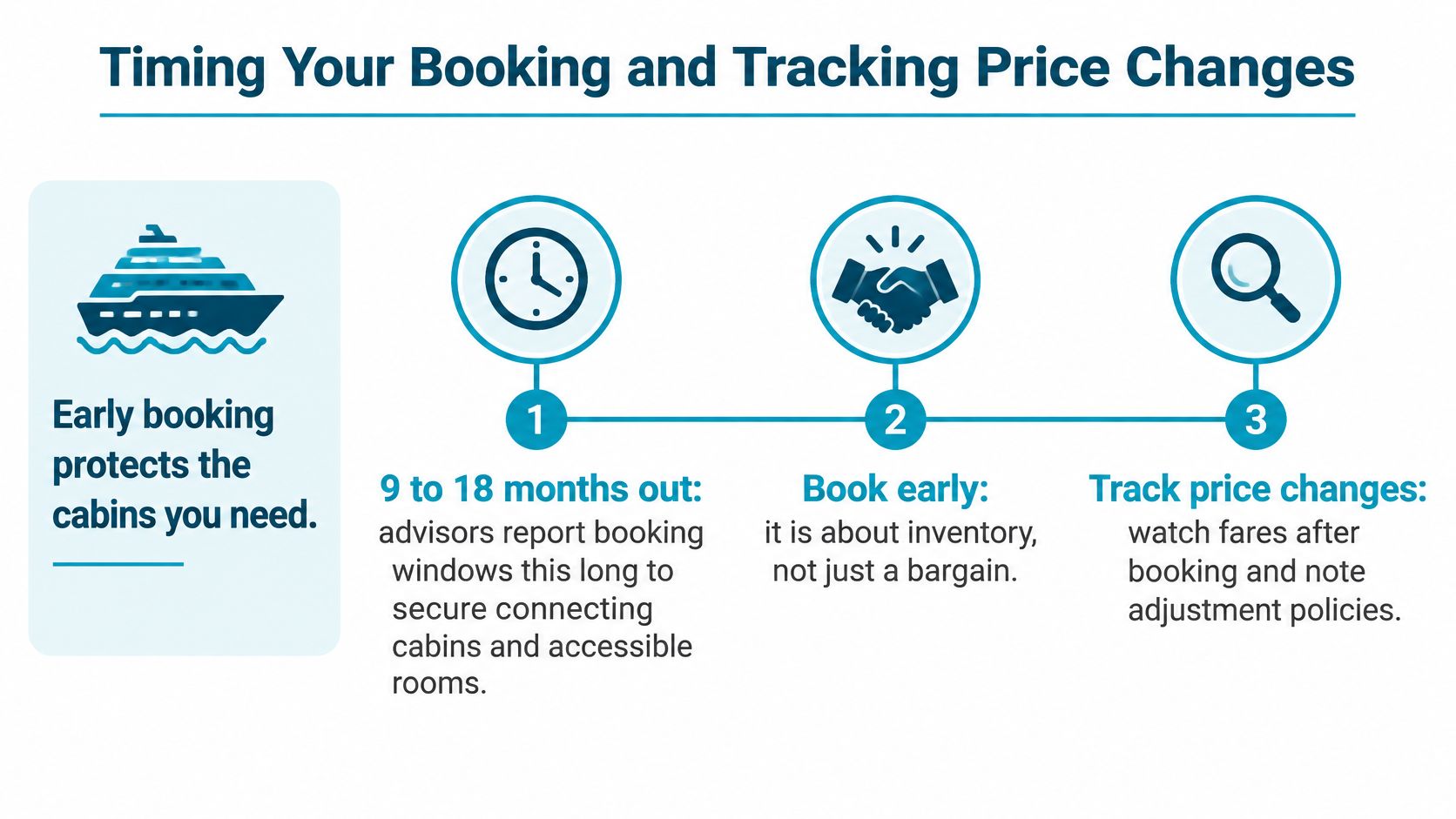
The lowest headline fare on a page is a marketing number. Two sailings become comparable only once cabin category, occupancy, sailing length and departure port match, and even then the quote you see is rarely the amount you'll pay.
Run the six checks in order, because each one changes the meaning of the ones after it.
- Total price with taxes, port fees and gratuities. Gratuities alone can outrun the gap between two fares, particularly for a family in several cabins, and they're the line item most often left out of a side-by-side.
- Deposit amount and final-payment deadline. Two sailings at the same price can ask for different deposits and different balance dates, and that date sets how long you can keep watching for a better fare.
- Cancellation penalties by date, and what's refundable. Ask for the schedule rather than a summary. "Refundable" can apply to the cruise fare but not the deposit, or the other way round.
- Inclusions. Beverage packages, Wi-Fi, shore excursions and onboard credit all change total cost. A cheaper fare that excludes three of them isn't cheaper.
- Cabin location and configuration. Deck, distance from lifts, noise above and below, connecting doors, and whether an accessible cabin has the specific features the guest needs.
- Whether a later promotion can be applied, and for how long. The repricing window matters more than the promise, because a drop you can't claim is just information.
Sailing length changes the arithmetic as well. Seven-night itineraries made up 57% of bookings on TravelTek's platform in 2024, with 14-night sailings at 17%, according to Cruise Trade News' report on the 2024 Cruise Summit. A 14-night fare carries a different deposit, a heavier gratuity load and a different flight plan, so setting it beside a seven-night quote tells you nothing.
Two Quotes on Identical Terms
Say a seven-night sailing quotes $200 less than its closest rival but is nonrefundable, excludes gratuities and sits under the pool deck. Add gratuities for two guests, put a value on the flexibility you're giving up, and the cheaper fare usually stops being cheaper.
Before you choose a channel, pick one sailing and collect two quotes on identical terms: the cruise line's own price, and a specialist quote for the same cabin, dates and inclusions. Run both through the six checks. If the specialist quote comes back higher, ask which inclusions, flexibility or post-sale support account for the difference. If it's lower, confirm the cabin category, occupancy and refund rules before you treat it as a saving. Our guide to getting the best cruise deals covers the timing side of the same process.
Timing Your Booking and Tracking Price Changes
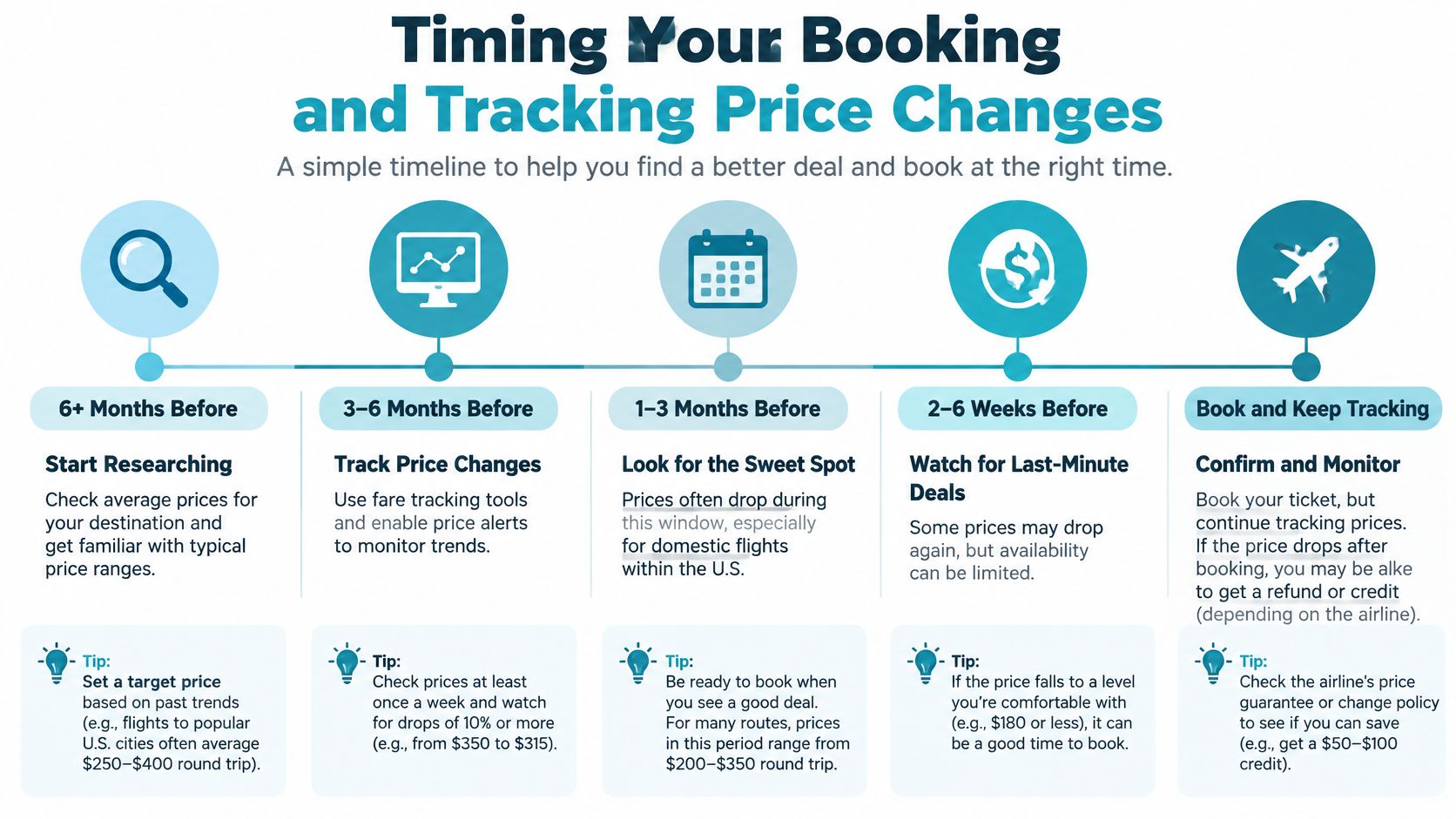
Early booking is an inventory decision, not a bargain hunt. The cabins that disappear first are the ones with no substitute: connecting pairs, accessible rooms, the sought-after suite categories, school-holiday departures and the popular embarkation ports. Price matters, but availability sets the deadline.
Booking windows have stretched. Industry reporting based on CLIA research finds more than 40% of surveyed advisors seeing booking windows extend to 9 to 18 months, while 11% of cruisers booked at least one year before departure, per Travel Market Report's cruise industry analysis.
The deadline most travelers miss
The final-payment date, not the deposit date, is the one people lose track of. It's the last day the balance can be paid, the usual cutoff for cancelling or changing without penalty, and the usual end of any repricing window. Put it in a calendar with a reminder a week earlier.
The sequence that works runs in this order:
- Research and shortlist. Do this early, especially for holiday sailings and accessible cabins, while the inventory you want still exists.
- Book once the cabin and dates are fixed. A deposit holds a specific cabin. Waiting for a fare you can't predict risks the cabin you can.
- Record the deposit and final-payment dates. Two dates, written down, with the cancellation schedule attached.
- Monitor the reservation until final payment. If you find a lower price in U.S. dollars, advertised anywhere, before final payment, we contact the cruise line to re-fare to the best promotion, and additional restrictions may apply.
- Register every guest after final payment. Cruise tickets are released only after each guest completes pre-cruise registration, which can generally be done once the balance is settled.
If you'd rather have the timing logic walked through out loud, this covers the same ground.
Practical rule: book early for the cabins you cannot substitute, and write down your fare and both payment dates so a price drop becomes an action rather than a missed email.
The best time to book a cruise shifts with the sailing, the season and the cabin type, which is why the booking window matters more than the month on the calendar.
How to Get Help With an Existing Booking
Something will change. A port gets swapped, a fare drops, a surname is misspelled, or a flight lands later than the transfer allows. What happens next depends on the channel you booked through, and cruise specialists help before, during and after booking rather than handing off once the confirmation arrives.

Most of this happens by phone and email rather than in a portal, so the quality of your first message decides how fast it gets resolved.
- Have your invoice number ready. Support teams locate a reservation by invoice number far faster than by surname, and a sailing date on its own can match dozens of bookings.
- Note every guest's name, cabin number and sailing date. Name corrections and cabin changes touch each guest record individually, so vague requests create round trips.
- Pick the right message type. Our contact form separates General Comments, Marketing Inquiries, Technical Assistance and Cruise Planning Assistance, so a login problem doesn't sit in the planning queue.
- State the exact request. "Please reprice to the fare I found today on this sailing" gets a faster answer than "is there a better price", because the second one asks for research and the first asks for an action.
- Ask who contacts the cruise line, and by when. When your travel planner owns that call, you're not the one on hold, and you get a timeframe instead of a task.
- Confirm when documents arrive. Cruise vouchers go by mail or email two to three weeks before departure, and air arrangements bought through the cruise line are generally available about three weeks out, so a quiet inbox before then isn't a problem yet.
Channel choice leaves a mark on the trip itself. CLIA's report on travel advisors finds 79% of cruise travelers say travel agents have a meaningful impact on their decision to cruise, and records consistently higher Net Promoter Scores among travelers who book through professional advisors.
Save every confirmation email, and note the name of the person who helped you. That record turns the next call into a two-minute conversation instead of an explanation.
Choose Your Channel and Book With Confidence
Request one quote from a cruise specialist for the exact sailing you're considering, then set it beside the cruise line's price for the same cabin, dates and inclusions. That single comparison teaches you more about where to book than any ranking of channels, and it costs you nothing to run.
Three facts to write down first, because they decide which channel suits the trip:
- How many guests are traveling and how their cabins should sit together, since linked bookings behave differently from four separate ones.
- The cabin type and the dates you can travel, not the dates you'd prefer, because school calendars and work commitments set most of the constraints.
- Whether flights, accessibility needs or luxury expectations are part of the trip, since each one adds a coordination problem that a search box won't solve.
Start with the channel that matches your trip's complexity, then compare at least two sailings on identical terms. If more than two variables are still open, ask for a quote: we offer a free cruise quote to travelers who contact us, and you can reach cruise experts on 1-888-604-0279 or by email at bookit@bestcruiserates.com.
Online booking can be quicker than waiting on a reply. You search, review and select your cruise, complete the booking online, and get confirmation immediately where the cruise line allows it.
Before you close the tab, write down who you call if a port changes, a payment date moves or a name needs correcting, and keep that contact with your booking records. The honest answer to where to book a cruise is the channel you can still reach after you pay.
Best Cruise Rates puts more than 40 cruise lines into a single search, so you can compare sailings by itinerary, ship and price and then hand the shortlist to a specialist who deals with the cruise line on your behalf. If you want to test a channel against the direct price before committing, Best Cruise Rates will quote the same cabin, dates and inclusions so the comparison is like for like.
Ready to book your next cruise?
Compare 40+ cruise lines or call our specialists at 1-888-604-0279.