Eastern vs Western Caribbean Cruises: Which Suits You
The usual advice, choose Eastern for beaches and Western for adventure, is too blunt to book a vacation around. It overlooks how much your experience depends on the actual ports, the journey to the ship, the sailing month and the number of passengers arriving alongside you. A beach-focused traveler can enjoy a Western itinerary, while a history enthusiast can find plenty to explore on an Eastern route.
The useful question in Eastern vs Western Caribbean cruises isn't which region wins. It's which specific sailing gives you the shore experiences you want without adding travel costs, inconvenient transfers or a schedule you won't enjoy.
Table of Contents
- Eastern and Western Caribbean Side by Side
- Ports Each Route Visits and What They Offer
- Shore Excursions and Activities That Set the Routes Apart
- Travel Time, Airfare and Embarkation Ports
- Weather, Seasons and Sea Days in Practice
- Crowding and Port Days Shape the Experience
- Confirm Your Route Before You Book
Eastern and Western Caribbean Side by Side
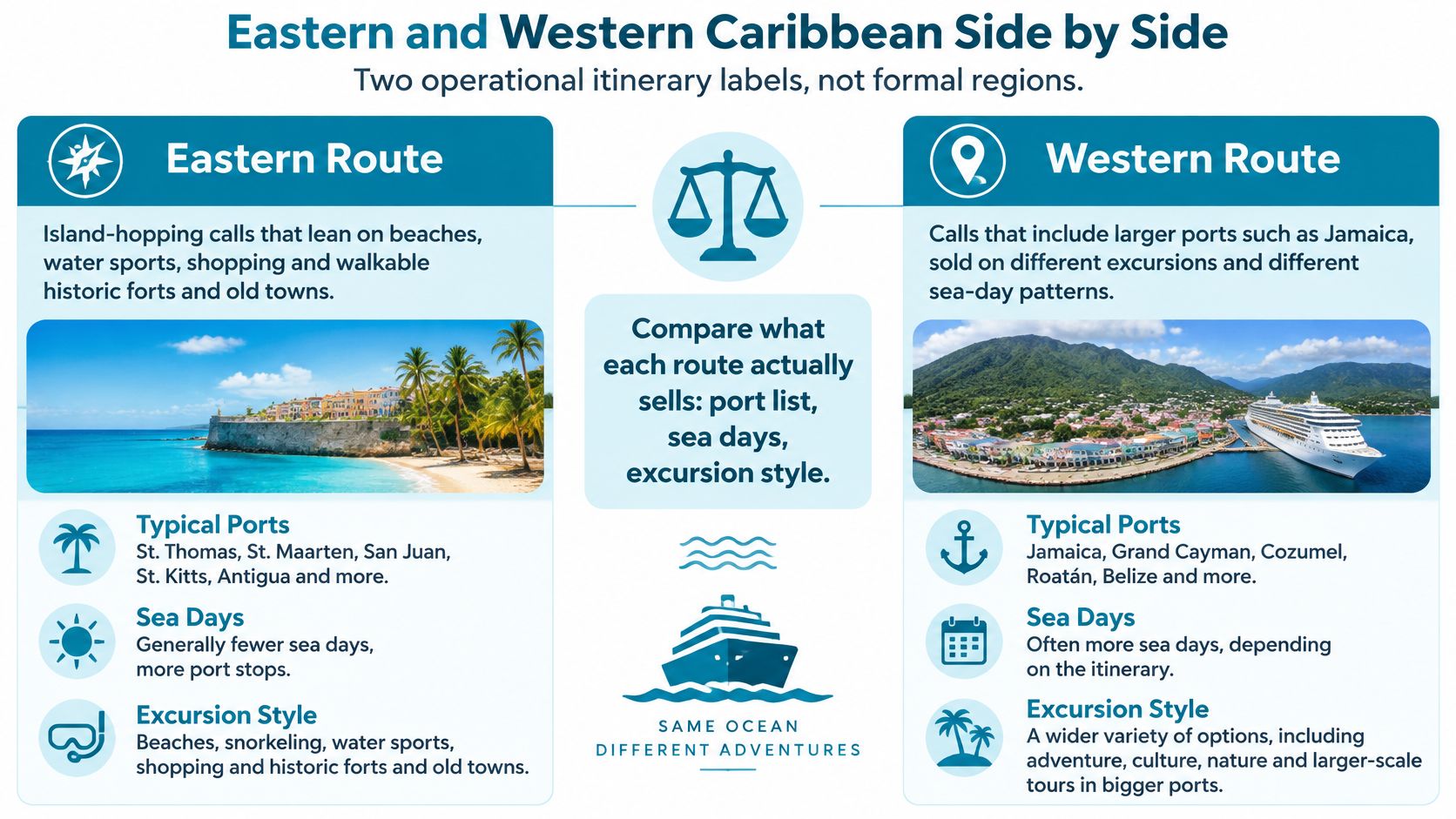
Eastern and Western are operational itinerary labels, not formally defined regions. They describe how cruise lines group destinations into saleable routes, rather than a boundary that every ship follows.
The Whistle While You Work itinerary comparison identifies the typical port groupings below and notes that a standard seven-night cruise usually visits roughly three or four ports. That makes the composition of the itinerary important: you're choosing a limited collection of port days, not complete access to either region.
Eastern vs Western Caribbean at a glance
| Factor | Eastern Caribbean | Western Caribbean |
|---|---|---|
| Typical ports | St. Thomas, Tortola, St. Maarten, St. Kitts, San Juan, Puerto Plata | Jamaica, Grand Cayman, Cozumel, Costa Maya, Belize, Roatán |
| Stop style | Many small islands and historic capitals | Island stops plus mainland ports, reefs and Mayan sites |
| Common homeports | Miami, Port Canaveral, Fort Lauderdale, San Juan | Galveston, New Orleans, Florida ports |
| Port calls on a seven-night cruise | About three or four | About three or four |
| Main shore activities | Beaches, shopping, historic forts and old towns | Reef snorkeling, diving, caves, ruins and jungle tours |
| Main weather exposure | Atlantic hurricane risk | Gulf storms and rainfall at individual ports |
The distinction is easiest to understand as a comparison of the experiences cruise lines package together.
What the label actually predicts
An Eastern itinerary generally offers a sequence of smaller-island experiences and historic Caribbean capitals. The appeal is the combination: a beach stop, an old town and another island with its own culture, shopping and scenery.
Western itineraries more often combine island destinations with mainland access. The contrast between calls can be greater, particularly when you pair a Mexican resort port with a reef outing or an archaeological excursion.
Neither description guarantees a particular pace. A traveler who books ambitious sightseeing at every Eastern stop can have a more demanding vacation than someone who chooses beaches throughout a Western sailing.
Nassau and Freeport can appear in either category. Their inclusion is a reminder that the regional name doesn't tell you everything about the route, and a Bahamas call shouldn't be mistaken for evidence that the itinerary belongs exclusively to either group.
First check: Read the complete port list before comparing the regional labels. A destination you particularly want to visit matters more than the name above the itinerary.
Treat the table as a shortlist tool. Once you identify promising sailings, compare their actual calls and arrival and departure times rather than assuming that every Eastern or Western cruise delivers the same experience.
Ports Each Route Visits and What They Offer
A port name is only useful if you understand what you'll do there. Separate the destination's headline attraction from the kind of day you want: independent sightseeing, a beach visit, a guided outing or an activity with equipment and transfers.
Key ports by route and what they offer
| Port | Route | What It Offers |
|---|---|---|
| St. Thomas | Eastern | Shopping, Charlotte Amalie historic district, beaches |
| Tortola | Eastern | Quiet beaches and island tours |
| St. Maarten | Eastern | Beaches, shopping and a two-nation island |
| St. Kitts | Eastern | Historic fortifications and rainforest hikes |
| San Juan | Eastern | Forts and streets of Old San Juan |
| Jamaica | Western | River tours and mountain landscapes |
| Grand Cayman | Western | Seven Mile Beach and stingray encounters |
| Cozumel | Western | Reef snorkeling and diving |
| Costa Maya | Western | Access to Mayan archaeological areas |
| Belize | Western | Barrier reef, caves and Mayan sites |
| Roatán | Western | Diving and reef sites |
Eastern ports reward different kinds of exploration
St. Thomas and St. Maarten are useful starting points for travelers who want beaches and shopping on the same itinerary. Don't assume that means you should squeeze both into every call. Choose the main reason you want to visit, then make anything else optional.
Tortola suits a beach-and-island-tour plan, while St. Kitts gives you a choice between built heritage and a more active nature-focused outing. San Juan makes particular sense when you want a port day organized around an old city rather than a resort or offshore activity.
That distinction matters for mixed-interest groups. Someone who doesn't want to swim can still have a clear reason to get off the ship in a historic capital.
Our homepage features Anguilla, St. Martin and the Virgin Islands among its cruise destinations. Use destination pages to identify places that interest you, but confirm that the sailing you select calls there.
Western ports need an activity-level comparison
For Western routes, start with the attraction rather than treating every destination as interchangeable adventure territory. Cozumel and Roatán make sense for a reef-focused shortlist; Costa Maya is relevant when archaeological access is a priority.
Belize deserves closer inspection because reef, cave and archaeological outings are different commitments. Check where each excursion starts, how it reaches the attraction and what physical participation it requires.
Grand Cayman can support either a beach day or a planned stingray encounter. Jamaica offers a different emphasis through river and mountain outings. Our Western Caribbean cruise destinations guide can help you narrow those choices by port.
The practical matching exercise is straightforward:
- Beaches and shopping: Start with Eastern calls such as St. Thomas and St. Maarten.
- Diving and archaeology: Examine Western combinations featuring Cozumel, Belize, Roatán or Costa Maya.
- A mixture of interests: Look for complementary calls rather than several stops where your group would choose the same activity.
A varied itinerary isn't automatically better. It's better only when the differences match what you want to do.
Shore Excursions and Activities That Set the Routes Apart
Say you choose an Eastern sailing with a San Juan call. Your plan might be a walk through Old San Juan, a fort visit and time for lunch, with the option to shorten the outing if someone gets tired.
A historic-port day can put sightseeing at the center of the experience without requiring an offshore activity.
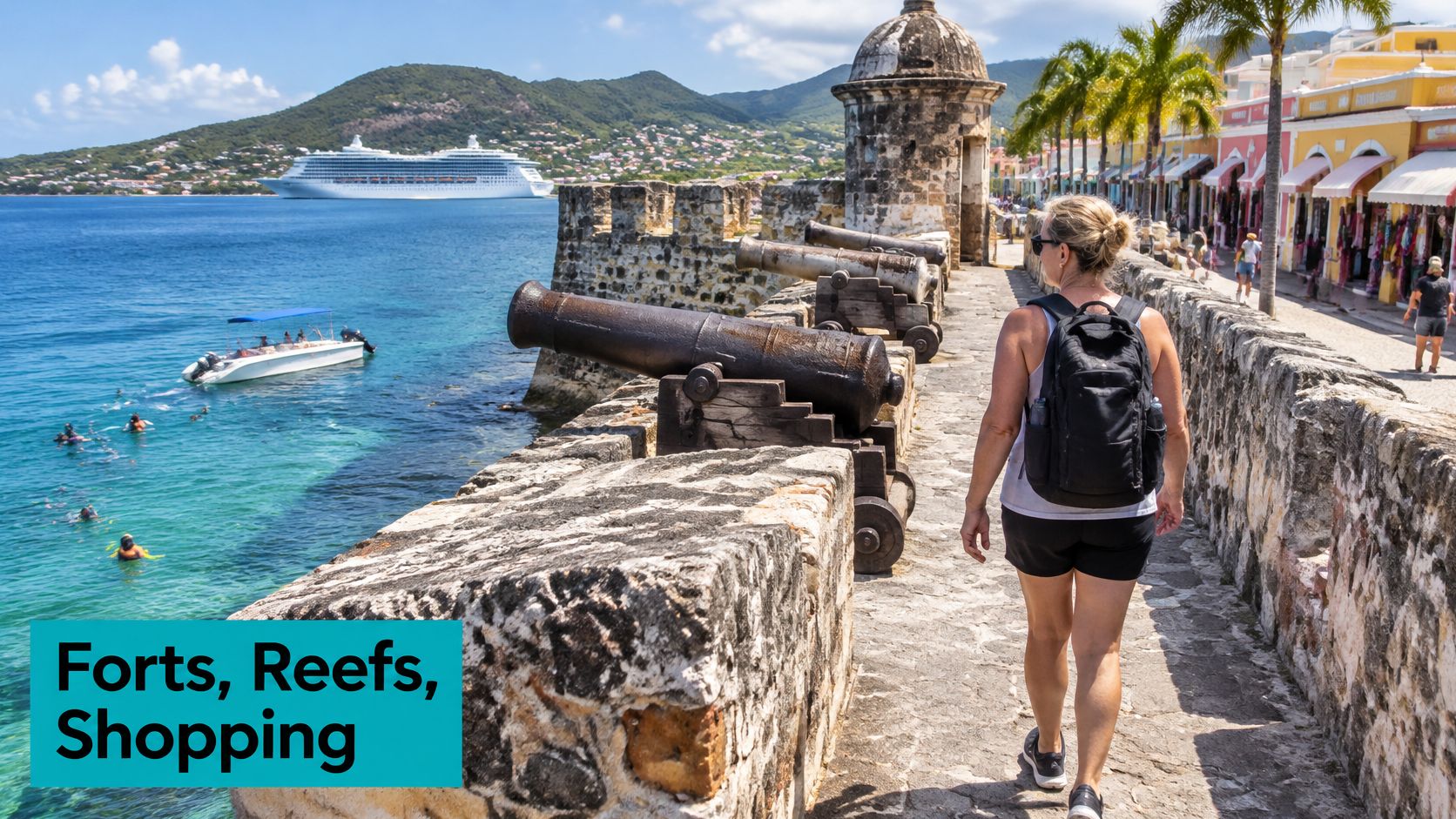
Now consider a Western call where your main objective is a reef trip or an archaeological site. You're selecting more than an attraction: you're choosing a departure time, transport arrangement, activity requirements and a return schedule.
Neither day is superior. The difference is how much of the day you control yourself and how much depends on an organized departure.
Compare the whole outing, not its headline
Don't use a generic duration estimate to judge whether an excursion fits. Read the listed duration for that sailing and determine whether it includes transfers, equipment collection, briefing time and the journey back to the terminal.
For a beach visit, identify the return transport before leaving. For diving, caves or archaeological excursions, inspect the operator's participation rules and the actual time at the attraction.
Tender arrangements need their own check. If the ship uses a shuttle boat rather than a walk-off berth, allow for the transfer process in both directions. Your usable sightseeing window isn't just the interval between the ship's published arrival and departure.
Planning rule: Work backward from the ship's all-aboard time, not forward from the attraction's closing time.
Ship-booked or independent
Compare the written terms rather than assuming that every ship excursion includes the same protection. Ask what happens if the excursion returns late, whether the ship waits and who arranges onward travel if necessary.
For an independent tour, check cancellation terms, pickup location, return commitments and the operator's response to a changed port call. Compare prices only after matching inclusions such as transport, equipment, admissions and meals.
This route-comparison video offers another way to visualize the choices.
Before choosing the sailing, write down the activities you'd most regret missing. Then match each one to a scheduled port and a feasible excursion, not to an Eastern or Western label.
Travel Time, Airfare and Embarkation Ports
Compare the trip from your front door, not just the cruise fare. An attractive sailing can lose its price advantage once you add flights, ground transport and an overnight stay.
The Cruise Critic route comparison identifies Florida and sometimes San Juan or northeastern departures as options for Eastern itineraries, while Western sailings have a stronger presence in Gulf homeports such as Galveston and New Orleans. It also emphasizes comparing airfare, transfer time and the sea days created by the route.
Build a complete travel comparison
- Match the cruise itself. Compare sailings of equal length and similar cabin categories. Check the fare inclusions before treating a lower displayed price as a saving.
- Price the flights that work for you. Search from your home airport and consider workable arrival times, baggage requirements and connections.
- Add airport-to-terminal transport. Obtain a quote for the specific airport, terminal and travel date. Include the return journey.
- Count the published sea days. Decide whether you want that time aboard or would prefer more opportunities ashore.
- Include a pre-cruise stay where needed. Add accommodation and associated transport to the same comparison, rather than treating them as incidental spending.
Our guide to the average cost of a cruise for two provides a useful starting point for organizing the budget. Use current quotes for your own dates rather than applying a general allowance to every homeport.
Homeports and their route fit
| Homeport | Usual Route | Travel Notes |
|---|---|---|
| Miami | Eastern and Western | Compare airport options, then obtain a transfer quote for your terminal |
| Port Canaveral | Eastern and Western | Check the actual airport-to-port drive and shuttle schedule |
| Fort Lauderdale | Mostly Eastern | Match airport arrival to terminal transport; read the sailing's sea-day schedule |
| San Juan | Mostly Eastern | Compare flights to San Juan and total cost against mainland departures |
| Galveston | Mostly Western | If flying through Houston, price the onward transfer separately |
| New Orleans | Mostly Western | Include airport-to-terminal transport and any overnight stay |
A traveler within convenient driving reach of Galveston should test a Western departure against the full cost of flying to Florida. Someone already visiting central Florida should examine Port Canaveral without assuming that an airport transfer will be brief.
San Juan requires a different calculation: decide whether the itinerary justifies the flight arrangements available from your airport. No homeport is universally cheapest or easiest.
Travel friction is part of the product. A modest fare saving may not be worthwhile if it adds awkward connections, a complicated transfer or a schedule that leaves you anxious before embarkation.
Weather, Seasons and Sea Days in Practice
The claim that Eastern is drier and Western is warmer isn't a reliable booking rule. Month and individual destination matter more than that shorthand.
The Celebrity Cruises weather comparison notes that Jamaica can be relatively dry in July but receive heavier rain in June and October, while Barbados's wettest period is September through November despite its comparatively lower hurricane exposure. Those examples show why rainfall and hurricane exposure need separate consideration.
Month and port weather checks
| Check | Eastern example | Western example |
|---|---|---|
| Dry-season reference | Check the chosen island's seasonal pattern; don't assign one dry period to the whole route | Jamaica relatively dry in July |
| Wetter months | Check each scheduled port's rainfall pattern individually | Jamaica heavier rain in June and October |
| Storm exposure | Atlantic hurricane risk | Gulf storm risk |
| Before booking | Month, each port and cancellation policy | Month, each port and cancellation policy |
A wet pier illustrates a different issue from rough seas: your shipboard experience and your planned shore activity can be affected separately.
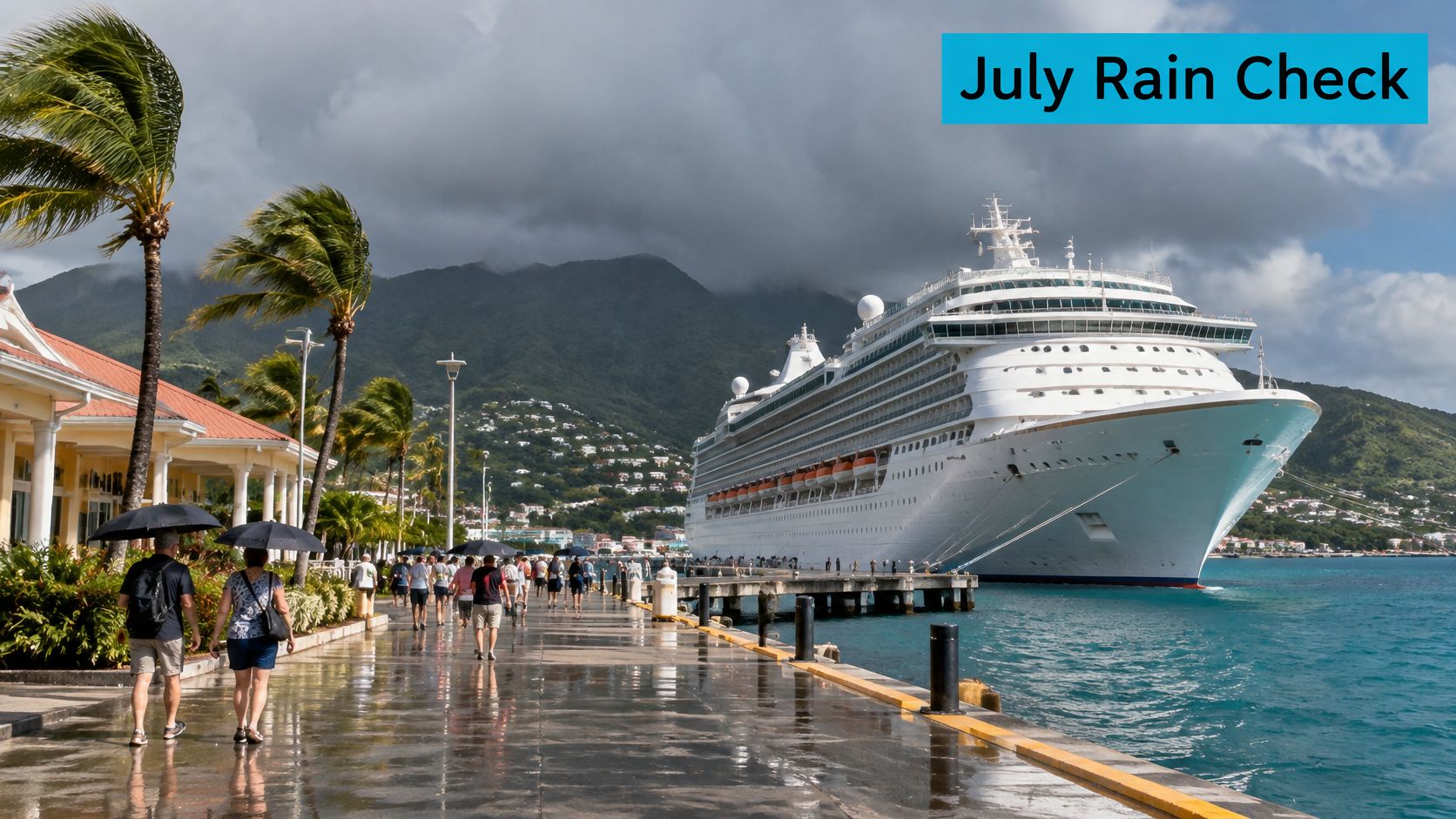
Use a month-port-direction test
Start with the month you can travel. Check the relevant storm exposure rather than selecting a region first and assuming its weather will suit the date.
Next, examine each port's seasonal conditions against your intended activity. A rainy sightseeing day and a canceled boat excursion have different consequences. If snorkeling is the reason you chose the sailing, investigate the excursion's weather policy as carefully as the beach forecast.
Finally, examine the sailing direction and your tolerance for disruption. Don't assume that reversing the order of calls guarantees better conditions, but recognize that the ship reaches different destinations on different days.
A pleasant sea day doesn't guarantee a dry port day, and rain ashore doesn't tell you how comfortable every sailing segment will be.
Winter travelers prioritizing beach weather may find selected Eastern ports appealing. Travelers whose main goals are diving and mainland excursions may prefer a Western itinerary despite weather uncertainty. Neither choice eliminates the need for destination-level checks.
Ask yourself whether you'd still enjoy the cruise if the most important call changed. If the answer is no, the itinerary carries more personal risk than its fare alone suggests.
Before paying, read the cruise contract and excursion cancellation terms. Confirm what happens to prepaid activities, port-related charges and any other claimed compensation when a destination is dropped. Don't assume a missed port produces a refund of the cruise fare.
Crowding and Port Days Shape the Experience
A destination can suit your interests perfectly and still disappoint when too many visitors reach the same attractions together. The regional label tells you little about that pressure.
Reporting by the Centro de Periodismo Investigativo puts Caribbean cruise arrivals at about 35.5 million in 2025, compared with roughly 14.5 million in 2000, and describes congestion, environmental pressure and infrastructure strain. The passenger decision isn't whether a port is popular, but whether its facilities and your planned outing can accommodate the arrivals that day.
Evaluate the overlap, not just the ship count
Check the port's published ship schedule for your date. Arrival and departure overlap matters: ships listed on the same day won't necessarily discharge passengers at the same moment.
Look at the practical implications for your party:
- Transport demand: Confirm accessible vehicles or other essential arrangements before relying on availability at the pier.
- Attraction timing: Ask when your excursion reaches the main site, not just when it leaves the terminal.
- Call length: A short visit leaves less room to wait out queues or adjust the plan.
- Group needs: Prioritize shade, manageable walking and dependable return transport where those matter more than sightseeing volume.
A less famous call can be the better choice
A sailing with quieter destinations or staggered calls may offer a more satisfying shore experience than a route built entirely around famous names. That's especially relevant when your priority is a relaxed beach visit rather than checking off landmarks.
An overnight can also be worth examining because it may let you choose a different time to explore. Confirm that the attractions and transport you want operate during those hours.
Better comparison: Which sailing gives you a realistic opportunity to enjoy the destination, rather than merely arrive there?
Crowding is also a destination issue, not just an inconvenience for passengers. Choose an excursion for its suitability and local logistics, and avoid assuming that a busy port can absorb every last-minute request without trade-offs.
Confirm Your Route Before You Book
Turn your shortlist into a booking decision by resolving the details that can change the trip. Keep the booking page, itinerary, excursion descriptions and fare conditions together so you're comparing complete offers.
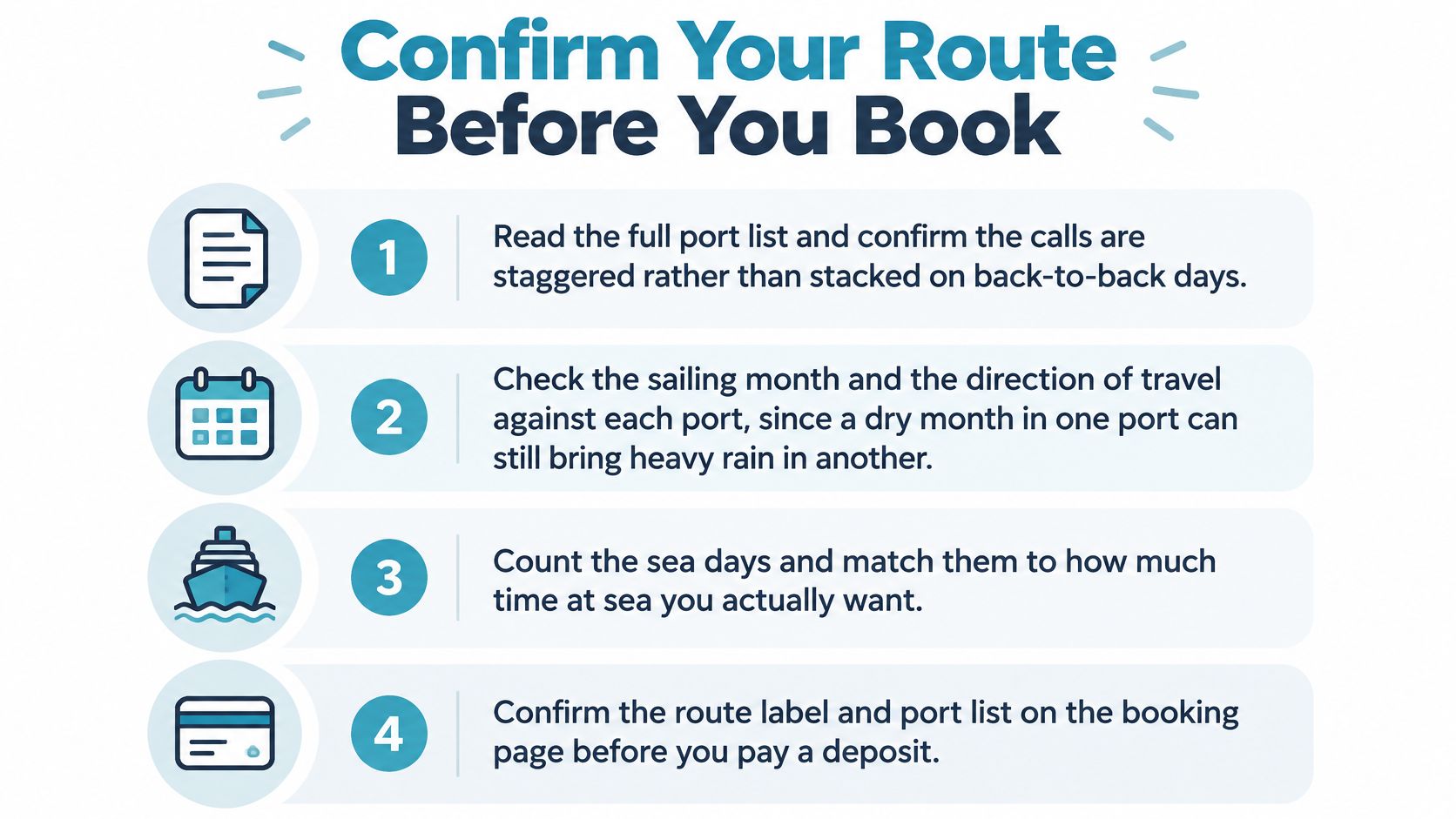
- Verify the scheduled calls. Read the full port list and arrival and departure times. Check other ships scheduled that day, and distinguish staggered visits from heavily overlapping arrivals.
- Confirm usable shore time. Identify tender calls, excursion meeting points and transfer requirements. Ask how much time you'll have at the attraction rather than counting the entire published port stay.
- Read the disruption terms. Confirm deposit and cancellation conditions, excursion refunds and what happens if the cruise line drops a port. Keep independent arrangements aligned with those risks.
- Finish the total-cost comparison. Add flights, airport transfers and any pre-cruise accommodation. Include the excursions that motivated your route choice.
Use this visual checklist alongside the sailing's written details.
Put comparable sailings together
Our booking engine lets you search by destination, cruise line, ship, embarkation port and date range. Use our cruise ship itinerary planning guide to organize the route details, then compare up to six sailings side by side for rates, itineraries, ship profiles and more.
If you find a qualifying lower advertised price in U.S. dollars after booking but before final payment, we'll contact the cruise line to seek re-faring to the best promotion. Additional restrictions may apply; this isn't an unconditional promise of a refund.
Shortlist a few sailings and complete the checks for each. Choose the itinerary whose practical details match your priorities, not the regional label that sounds most appealing.
Best Cruise Rates offers searchable itineraries, side-by-side sailing comparisons and cruise-specialist planning assistance to help you evaluate Eastern and Western options. Visit Best Cruise Rates, select your embarkation port and travel dates, and compare your shortlisted sailings before paying a deposit.
Ready to book your next cruise?
Compare 40+ cruise lines or call our specialists at 1-888-604-0279.