Alaska Cruise Ship Routes: Which Itinerary Fits You
Which Alaska cruise should I book? Search that question and you'll get the same answer everywhere: Juneau, Ketchikan, Skagway, Glacier Bay. The list is accurate, and it's also nearly useless, because those four names sit on sailings that behave nothing alike. One leaves Seattle and returns to Seattle seven days later. Another ends in Seward and puts you on a train toward Denali the next morning.
The question that sorts Alaska cruise ship routes is a different one. How does the ship get to Alaska, what can it promise once it's there, and how much of your vacation happens off the boat? Answer those three and the port list becomes a detail rather than the decision.
Table of Contents
- Alaska Cruise Routes at a Glance
- Embarkation Ports and Gateway Cities
- Inside Passage Ports and Scenic Passages
- Why Glacier Views Can Change After Booking
- Which Route Suits Your Travel Style
- Choose Your Route and Confirm the Itinerary Before Booking
Alaska Cruise Routes at a Glance
Alaska sailings fall into two families, and the split is lopsided. In summer 2024, about 74% of cruise passengers sailed a round trip from a Pacific Northwest port, while 26% took a one-way cross-gulf route, according to the Alaska Visitor Volume Summer 2024 report from the Alaska Travel Industry Association. That second group is where most planning confusion lives, and it's also the only group with a practical path into the interior.
Nearly every Southeast sailing shares one stretch of water. The Inside Passage is the sheltered coastal corridor of islands, channels and fjords running along British Columbia and Southeast Alaska, and it's where round trips spend most of their scenic hours between port calls.
The Four Route Patterns Side by Side
| Route pattern | Start and end | Typical length | Main trade-off |
|---|---|---|---|
| Round trip from Seattle | Seattle to Seattle | 7 days | No flight out of Alaska; often includes Victoria |
| Round trip from Vancouver | Vancouver to Vancouver | 7 days | Same Southeast ports; different departure city and flights |
| One-way Vancouver to Whittier or Seward | Vancouver to Alaska gateway | 7 to 14 days | Connects to land tours toward Anchorage and Denali |
| One-way Seattle to Whittier or Seward | Seattle to Alaska gateway | 7 to 14 days | Adds a longer open-water Gulf of Alaska crossing |
Two things stand out. The port list barely changes across the top two rows, since a Seattle round trip and a Vancouver round trip often call at the same Southeast towns in a slightly different order. And the bottom two rows aren't a different port list so much as a different trip, because the ship finishes somewhere you can keep traveling north from.
What Actually Changes Between Them
Four criteria separate these patterns more reliably than any brochure list of ports.
- Airfare. A round trip means one arrival airport and one departure airport, usually Seattle or Vancouver. A one-way sailing means flying home from Anchorage or a Southcentral gateway, so you're pricing an open-jaw ticket.
- Hotel nights. Round trips usually need a night before the cruise and nothing after. One-way sailings generally need a night before plus a night or two after, because the land portion begins the morning you disembark.
- Ground transfer. Whittier and Seward both sit a road and rail ride from Anchorage, and both connect to Alaska Railroad service toward Denali. On a round trip, that transfer is a separate trip you organize yourself.
- Total trip length. Seven days on a round trip is a seven-day vacation plus flights. Seven days one-way with three nights inland is a ten-day vacation with different packing and a different budget.
Take a family of four flying into Seattle with Denali on their wish list. They have two workable paths. Path one is a one-way sailing that ends in Seward, then a road transfer or the Alaska Railroad north, then a flight home from Anchorage. Path two is a Seattle round trip, followed by a flight to Anchorage and a land portion booked separately. The first is one continuous trip with one unpacking. The second keeps the cruise simple and treats the interior as its own vacation inside the vacation.
Practical rule: Book a cross-gulf sailing only when an inland extension is genuinely part of the plan. If nobody in your group is going to Denali, choose the pattern first and compare ports inside it.
That's why two cruises calling at the same Southeast foursome can produce vacations of very different length, cost and logistics. The ports tell you what you'll see. The pattern tells you what the trip will feel like.
Embarkation Ports and Gateway Cities
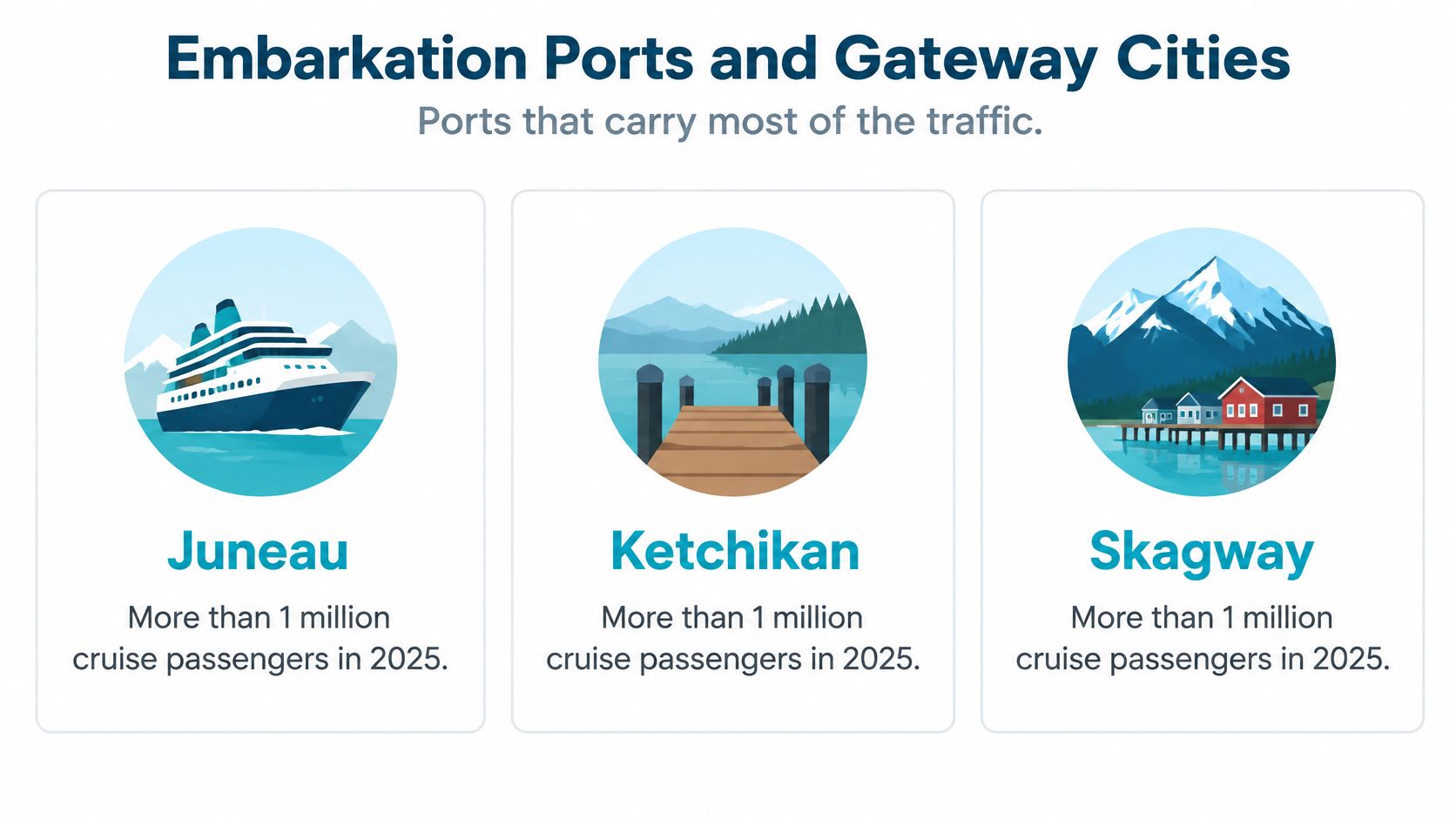
Juneau, Ketchikan and Skagway carry Alaska cruising, and in 2025 each received more than 1 million cruise passengers, according to the Alaska Visitor Volume Summer 2025 report. Thirteen Alaska ports received at least 10,000 cruise passengers that year. Earlier analysis in the same body of visitor data found the big three capturing between 78% and 98% of statewide cruise-passenger volume, depending on the year and the measurement used.
Where the Passengers Actually Go
| Port | Role on routes | Volume or capacity note |
|---|---|---|
| Juneau | Core Southeast port on round-trip and one-way itineraries | More than 1 million cruise passengers in 2025 |
| Ketchikan | Core Southeast port, often an early call | More than 1 million cruise passengers in 2025 |
| Skagway | Core Southeast port, gateway to the White Pass rail route | More than 1 million cruise passengers in 2025 |
| Sitka | Secondary port call | A fraction of the big three's volume |
| Icy Strait Point | Secondary port call at Hoonah in Southeast Alaska | Port complex expanded to handle the largest ships calling in Alaska |
| Whittier | One-way gateway toward Anchorage and Denali | Turnaround point, connected by road and rail to Anchorage |
| Seward | One-way gateway, expanded for ships above 4,000 passengers | Turnaround point at the end of the Kenai Peninsula |
| Anchorage | Land-tour hub, not usually a ship port of call | Handles a small share of ship passengers compared to the Southeast ports |
That concentration is normal, not a weakness in the itinerary. Mainstream schedules run a core corridor through the Inside Passage where docks, tenders and excursion capacity already exist, which lets a ship visit several communities inside a single week. Port repetition on your shortlist is a sign you're comparing mainstream sailings, not a sign you picked badly.
Gateways Are Not Port Calls
First-time travelers often read a port list as one flat column of names. Read it as two different jobs instead. A port call like Sitka is a place passengers step ashore for a few hours, then the ship moves on. A gateway like Anchorage works more like an airport hub: it is where a one-way trip ends at the dock and continues on land toward the interior.
Ship size complicates this further. The National Park Service reports on changing visitor patterns that Ketchikan, Juneau, Skagway and Hoonah have expanded infrastructure to handle the largest ships calling in Alaska, including vessels carrying up to about 7,600 passengers, while Seward is being expanded for ships exceeding 4,000 passengers along with a larger passenger terminal. A route branded "Alaska" may therefore swap ports depending on whether your ship fits a berth.
On reading a port list: Count the Southeast calls, check whether a gateway appears at one end, and note whether the itinerary names a port outright or hedges with "scenic cruising."
Three Southeast calls and no gateway means a loop. A gateway plus three Southeast calls means a one-way trip with a land option attached.
Inside Passage Ports and Scenic Passages
A scenic passage isn't a port. Nobody ties up, nobody shops, and the ship may spend an afternoon idling past ice while you stand on deck in a coat. That distinction matters because passages carry access rules that ports don't, and one passage in particular is rationed.
| Scenic passage | Where it sits | Access rule | What to check |
|---|---|---|---|
| Inside Passage | Sheltered waters along Southeast Alaska | Open to ships on most Southeast routes | Scenic cruising time between port calls |
| Glacier Bay | Protected national park waters | Two ships per day; up to 184 use days June to August and 122 in May and September | Authorization, concession contract and a dated entry slot |
| Tracy Arm | Fjord near Juneau | Depends on ice and geological conditions | Whether the itinerary names it as guaranteed |
| Endicott Arm | Fjord used as a substitute for Tracy Arm | Set by each itinerary; not guaranteed | Whether it is the planned route or a replacement |
| Hubbard Glacier | Glacier in the Gulf of Alaska region | Set by each itinerary; not guaranteed | Whether it is listed as a dedicated scenic stop |
| College Fjord | Fjord near Prince William Sound | Set by each itinerary; usually on Whittier or Seward routes | Whether the route reaches it from a Whittier or Seward gateway |
Why Glacier Bay Is Different
Glacier Bay is a capacity-constrained route segment rather than an unrestricted scenic detour. Commercial cruise ships need both authorization and a concession contract, and entry is capped at two cruise ships per day year-round under the Glacier Bay National Park special regulations. Seasonal quotas tighten it further, allowing as many as 184 cruise-ship use days from June through August and 122 use days in May and September.
The consequence is scheduling, not scenery. A sailing that includes Glacier Bay must hold a regulated entry slot, so availability depends on concession access and quota use as much as on how many cabins the ship still has. That's why Glacier Bay dates can sell out while the same sailing shows open inventory elsewhere, and why the itinerary is concentrated among operators that hold access.
If a late-season departure is on your list, our guide to Alaska cruises in September covers what shifts as the season narrows.
Reading a Passage List Correctly
Tracy Arm, Endicott Arm, Hubbard Glacier and College Fjord are not interchangeable with Glacier Bay, even when the surrounding port calls look identical. College Fjord in particular usually appears on routes that run through Prince William Sound toward a Whittier or Seward gateway, not on a Seattle loop.
A passage name tells you where the ship intends to go. It doesn't tell you what you'll see, or whether that plan survives the ice.
Why Glacier Views Can Change After Booking
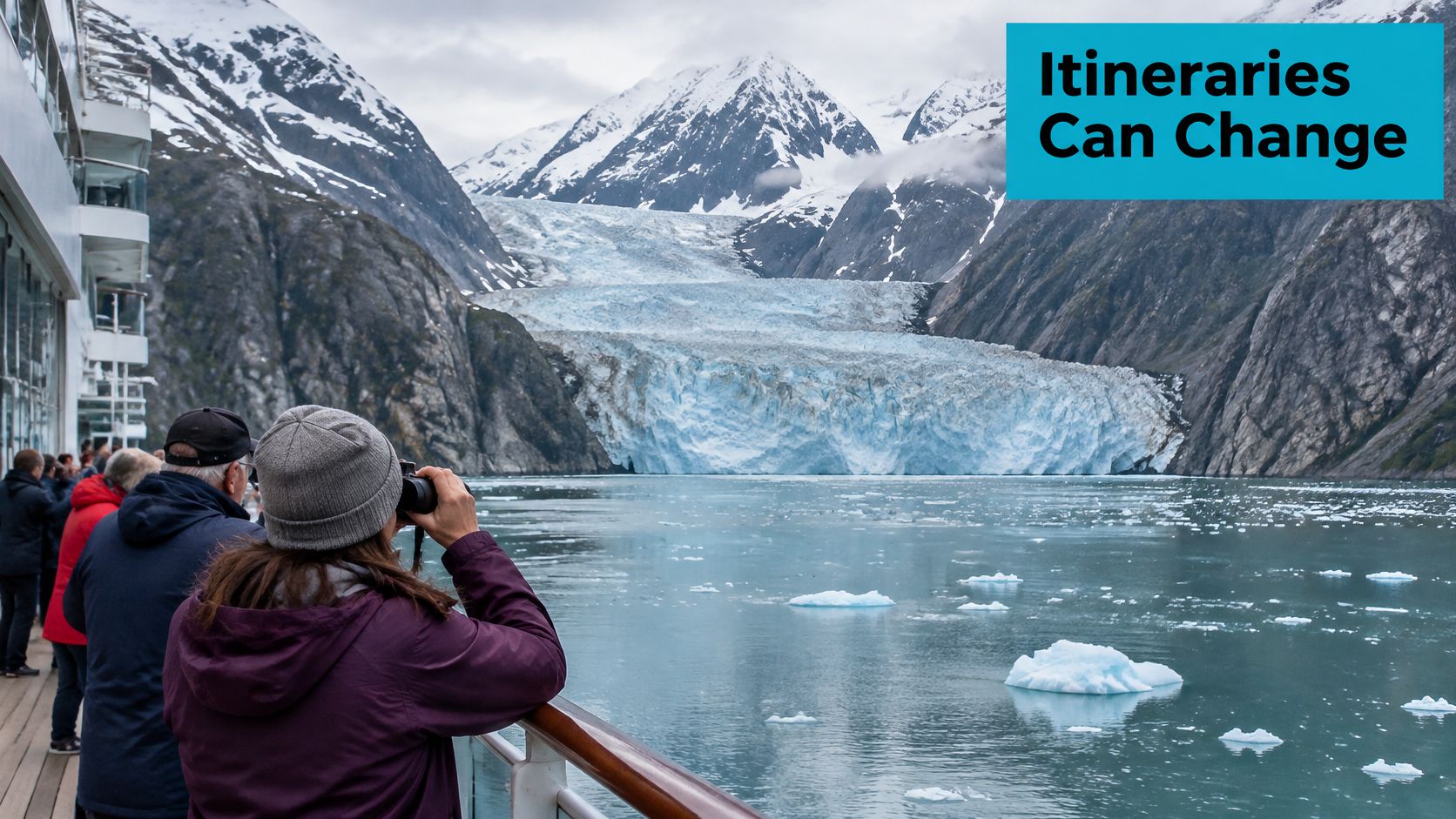
Here's the part most route guides skip. During the 2026 season, Holland America, Princess and Carnival canceled planned Tracy Arm visits because of unstable ice and geological conditions, substituting Endicott Arm instead, as Cruise Critic's Alaska season coverage reports. Several operators were also reported to be replacing Tracy Arm with Endicott Arm for 2027 sailings.
So a route guide can list Tracy Arm in bold while the ship you booked reaches a different fjord entirely. That's not a bait and switch. It's ice, and no line controls it.
Four Questions to Ask Before Booking
Work through these while the itinerary is still in front of you, not after final payment.
- Is the scenic area guaranteed or conditional? Some itineraries name a fjord as a scheduled stop. Others list "scenic cruising" and nothing firmer.
- What's the substitute, and does it deliver? Endicott Arm has its own tidewater glacier at Dawes, so a swap can still be a good day. A swap to open water is not.
- How much notice does the line give? Ask what communication looks like when a passage changes, and where it appears.
- Is there a shore-based glacier option? A helicopter or floatplane excursion to a glacier, or a port call with a glacier reachable by road, gives you a second route to the same sight.
The contrarian point is worth stating plainly. The most heavily promoted glacier itinerary isn't automatically the most dependable access to a named glacier. Price and marketing weight track cabin categories and demand, not the odds that ice lets you through.
Booking rule: A headline fjord is an intention unless your booking names it as guaranteed. Read the substitution wording before you compare prices.
Which Route Suits Your Travel Style
Route choice has shifted from counting destinations to weighing travel style, port depth and hours ashore. Recent deployments show the shift clearly: MSC began its first Alaska season with seven-night Seattle sailings, Virgin Voyages entered Alaska with adults-only voyages, Azamara offered 10- to 13-day itineraries with longer port stays, and expedition operators added Klawock and Valdez, according to Alaska cruise itinerary coverage.

Match the traveler to the route before you look at a single price.
- First-timers who want the classics fit a seven-day round trip through Juneau, Skagway and Ketchikan. You get the headline towns, one flight in, one flight out.
- Travelers who'd rather stay longer in fewer places should look at the longer itineraries with extended calls, where an evening in port replaces a four-hour window.
- Adults wanting a quieter ship now have adults-only Alaska voyages as a real option rather than a compromise.
- Anyone planning Denali needs a one-way sailing into Whittier or Seward with a land tour attached, because a loop can't get you there by ship.
- Travelers chasing smaller communities should look at expedition-style routes calling at Klawock or Valdez, where the port itself is the attraction.
Keep one geographic quirk in mind: a Seattle round trip often includes Victoria, British Columbia, as its final call. That's a pleasant stop and it isn't Alaska, which matters if your goal is maximum Alaska hours.
A Simple Port-Depth Score
Ignore the destination count. Score each itinerary on three things instead: unique ports, overnight or extended calls, and inland-transfer convenience.
Two seven-day sailings can list the same three Southeast ports and still feel completely different. Say one adds a fourth call at Icy Strait Point and gives you a long day in Juneau with an evening ashore. The other gives you three short morning windows and two sea days. Same region, different vacation. The first scores higher on depth without adding a day or a dollar to the schedule.
Comparing sailings this way is easier when ship profiles sit next to each other, which is what our cruise ship comparisons are built to show.
Most of these routes run between May and September, the same stretch when scenic-passage access is tightest, so an early or late departure changes both crowds and slot competition.
Choose Your Route and Confirm the Itinerary Before Booking
A route decision works like choosing the road before choosing the scenery. The ship's path sets the ports it can reach, the passages it may use, and the time left ashore. Make the choices in order, because each answer narrows the next.
- Pick round trip or one-way. Base it on flights and whether Anchorage or Denali is in the plan. A one-way sailing can pair Alaska with inland travel, while a round trip keeps air arrangements easier.
- Confirm the port sequence. Check whether the sailing uses a gateway such as Whittier or Seward, or stays in a Southeast loop. Those patterns give you different access to inland connections and Alaska ports.
- Check hours in port. Note any overnight call. A short tender stop can lose much of its window to boarding, so compare time ashore, not just port names.
- Read the passage wording. Look for the named scenic area and the substitution policy attached to it. A route promise is only useful when you know what happens if conditions or scheduling change.
- Compare the shortlist the same way. Use port repetition, time ashore, passage language, and inland connections on every sailing. That keeps one flashy itinerary from looking stronger only because it is described differently.
You can search by destination, cruise line, ship, embarkation port, and date range, then place up to six sailings side by side for rates, itinerary, and ship profiles. The detailed cruise ship itinerary comparison helps you line up those route details before you pay. Confirm the final itinerary with a travel planner and ask how the line handles a changed port or passage.
By the end, hold two or three itineraries with a known port sequence, a known gateway, and a written passage policy. Best Cruise Rates gives you one place to search Alaska sailings and compare options. Cruise specialists can review gateway logistics, passage wording, and land-transfer questions before you commit. Start at Best Cruise Rates.
Ready to book your next cruise?
Compare 40+ cruise lines or call our specialists at 1-888-604-0279.