Cruise Cabin Types: Which Category Fits Your Trip
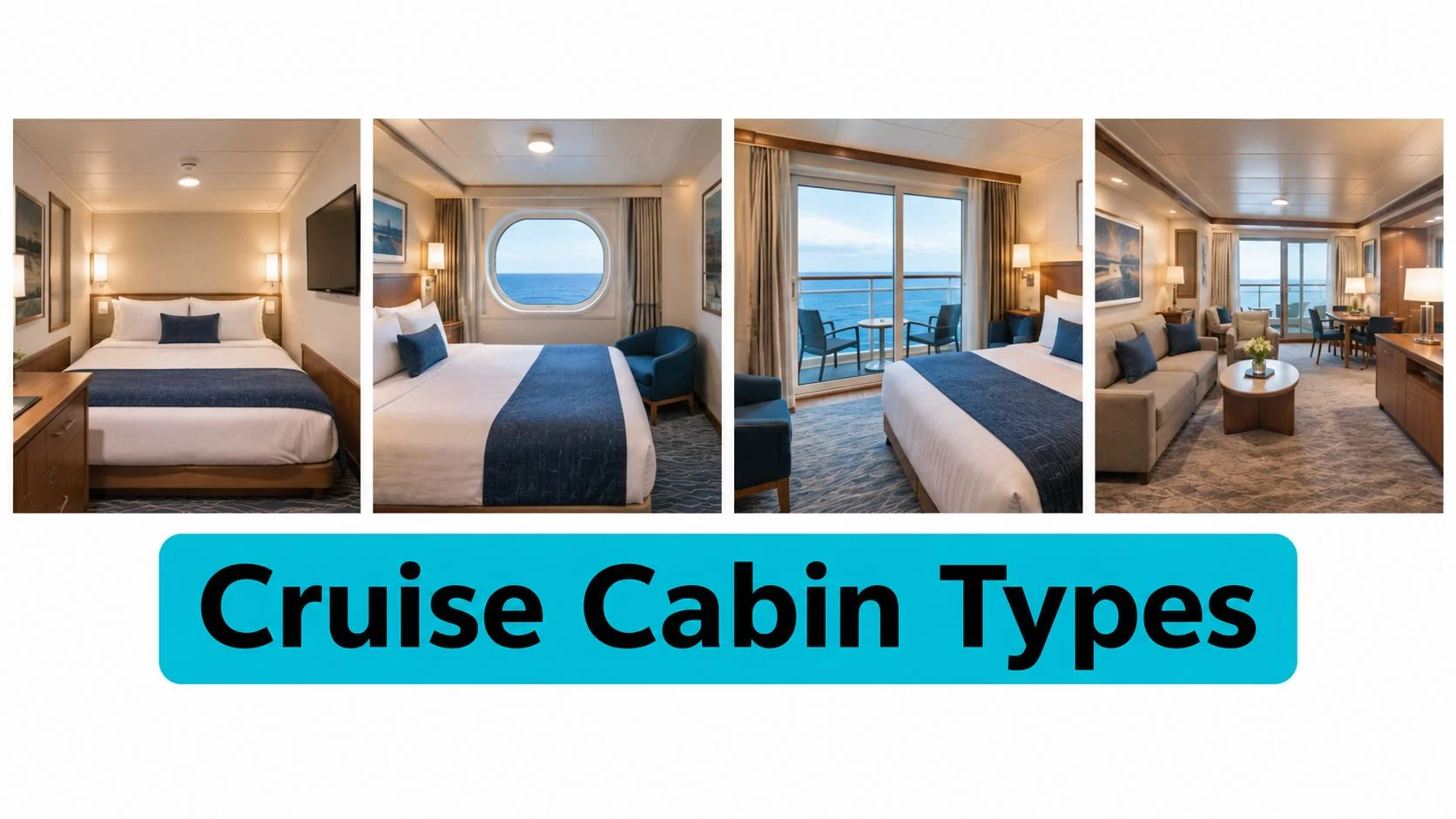
You're staring at four prices for the same ship and sailing, and the only difference on screen is a word. Interior, ocean-view, balcony, suite. The photos all show a neat bed and a small bathroom, so it's tempting to pick by price and move on. That shortcut is where most disappointment starts. Cruise cabin types aren't just labels for decor. They describe whether you'll get daylight, whether you can step outside, how much room you have to move around, and where you'll be sleeping when the ship rolls or the theater empties out above you.
Table of Contents
- The Four Cabin Categories at a Glance
- What Interior and Ocean-View Cabins Really Offer
- How to Judge a Balcony Cabin Before You Pay
- Suites and Solo Cabins Compared
- Accessible Cabins Need a Fit Check, Not a Label
- Match Your Trip and Confirm the Cabin
The Four Cabin Categories at a Glance
Four category names can hide very different rooms. Compare what you can use: floor space, the view, outdoor access, and cabin position. These details make the price ladder easier to understand.
| Category | Outdoor Access | Living Space | Price Position |
|---|---|---|---|
| Interior | No window | Single room, usually the smallest category | Lowest |
| Ocean-view | Sealed window or porthole | Single room; size varies by ship and deck | Mid-range |
| Balcony | Private veranda | Single room with outdoor seating; veranda size and layout vary | Higher |
| Suite | Balcony or terrace | Often includes a separate living area | Highest |
The OECD cruise shipping report groups cabins as interior, ocean-view, balcony, and suite. The categories generally indicate increasing access to daylight and outdoor space, along with more living area and a higher price. They are a starting point, not a guarantee of a particular layout.
Reading each row
An interior cabin is a single room with no exterior window. It is generally the most economical category, with space for sleeping, storage, and a bathroom.
An ocean-view cabin adds a sealed window or porthole. It brings daylight and a view, but the window does not open and there is no outdoor seating.
A balcony cabin has a private veranda connected to the room. The label alone does not tell you how much usable space is inside or outside, or whether the furniture leaves room to move around.
A suite often has a separate living area, as well as a balcony or terrace. The term can cover different layouts, so check what the particular cabin includes rather than assuming every suite offers the same setup or services.
Cabins with extra berths can accommodate more guests than those with only the standard sleeping spaces. If you are comparing rooms for a group, check both the bed arrangement and the space available when all berths are in use.
Match the category to how you will use the room. An interior may suit a trip where the cabin is mainly for sleeping. Choose ocean-view for a window without outdoor access, or consider a balcony if stepping outside from your room matters. A suite may suit guests who want a distinct sitting area. In every category, compare the actual layout and position before treating the label as a promise.
What Interior and Ocean-View Cabins Really Offer
An interior cabin's trade-off is simple to state and easy to underestimate. With no window, you get no daylight and no natural signal of morning or evening. On a port-heavy trip where you're off the ship all day, that may not matter. On long sea days, some guests love the darkness for sleep, while others feel disoriented and spend more time hunting for a window seat in public areas.
Ocean-view solves half of that. A sealed window or porthole gives you light, weather cues, and a view while you dress. It doesn't give you fresh air or a place to sit outside. Don't confuse seeing the sea with stepping out to it, because those are different products at different prices.
Position matters more than the label
Deck position changes how either cabin feels underway. The MSC Meraviglia ship page lists interior cabins around 12 to 22 m², which shows how wide one category can run before you even consider location. Lower, centrally located cabins generally experience less pitch and roll than cabins high up toward the bow or stern. If motion worries you, midship beats a slightly larger room at the front.
Noise is the other quiet factor. Cabins near theaters, nightclubs, elevators, galleys, or engine-related spaces may pick up more sound or vibration. Before you accept a cabin, look at the deck plan and check what's above, below, and next door, not just what's inside the room.
Consider two guests. A night owl who wants a dark, quiet room to sleep late might choose an interior cabin tucked between other cabin decks, away from public venues. A guest who reads in bed in the morning and likes to watch the ship arrive in port might choose an ocean-view on a mid-deck and accept the higher fare.
Neither choice is wrong. Ask yourself one honest question before you book either one. How much of each day will you spend in the cabin, and what will you be doing there?
How to Judge a Balcony Cabin Before You Pay
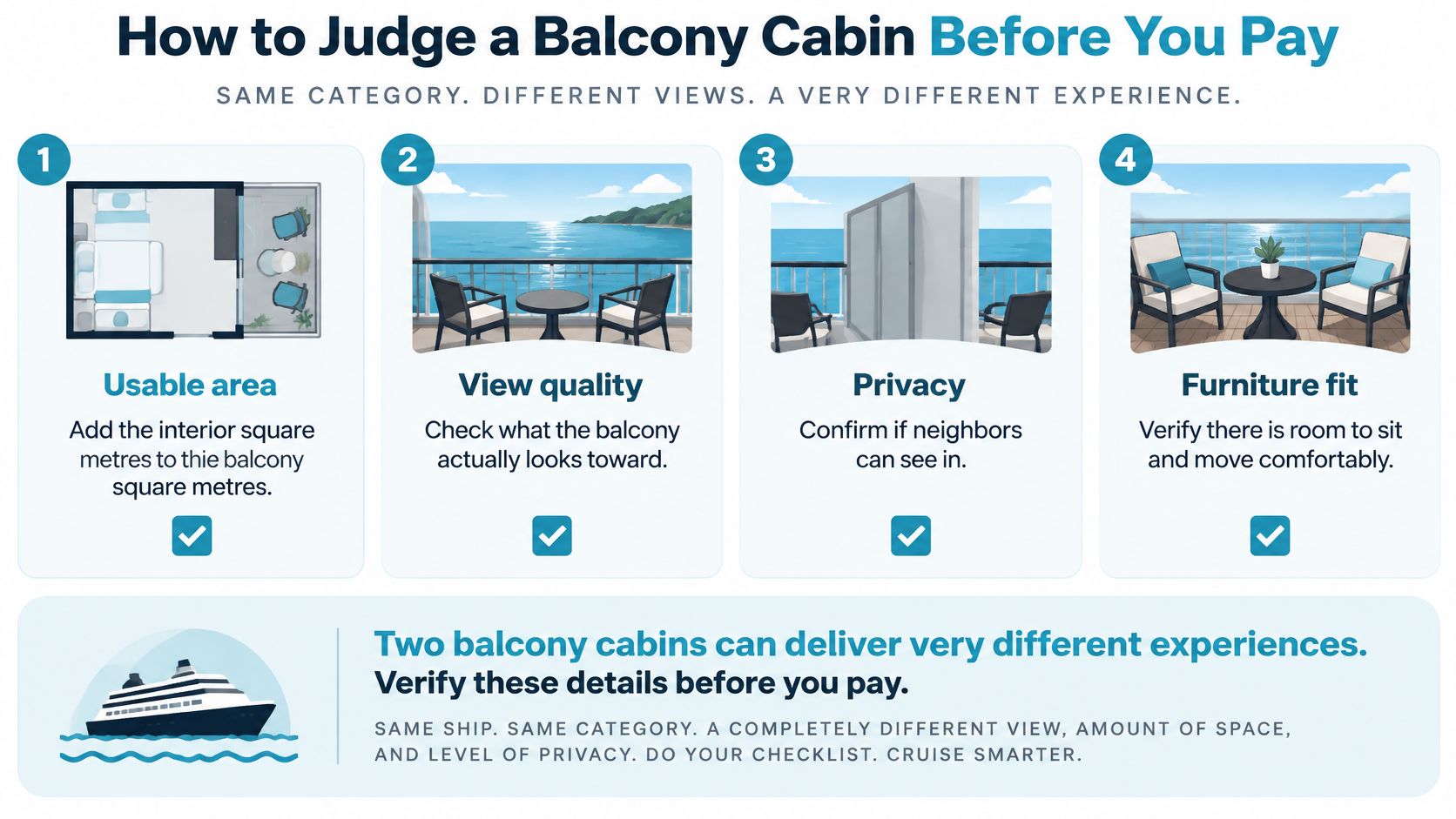
Two cabins can both be sold as balcony rooms and deliver very different weeks at sea. One gives you a clear horizon and room for two chairs. The other gives you a lifeboat at eye level and a balcony you can barely turn around on. Run these checks in order before you pay.
Six checks that take ten minutes
- Add up the usable area. Compare usable interior area plus exterior area, not the label alone. The MSC World Europa cabin listings show standard balcony cabins around 16 to 17 m² internally, with balconies across that ship running from about 5 to 65 m². Confirm whether the quoted total already includes the balcony, because that one detail changes the comparison completely.
- Confirm what you'll see. A partial-view balcony may have outdoor space without an unobstructed horizon. Lifeboats, hull structure, and promenade geometry can all block the sightline you're imagining.
- Read the obstruction symbols. Open the ship-specific deck plan and find your exact cabin. Look for the symbols and notes attached to that number, not the generic category description.
- Check height and fore-aft position. A balcony high toward the bow or stern will move more than one lower and midship. If you're motion sensitive, position can matter more than a small difference in floor area.
- Compare against a standard room at the same money. Ask whether the premium buys you meaningful space or only outdoor access. For families and longer voyages, interior room for storage and moving around during bad weather can outweigh a small balcony.
- Write down the cabin number. Size, layout, and furniture can differ within the same category. The number is the product. The category is only the shelf it sits on.
Practical rule: If a listing won't tell you the balcony size, the obstruction status, and whether the area includes the balcony, you don't have enough information to judge the price.
Scenic sailings are where this check pays off most. On an Alaska or fjord itinerary, an unobstructed balcony can be worth more than a larger interior room, because the view is the entertainment for hours at a time. On a warm-weather sailing where you'll be at the pool or ashore, the same premium might buy you a door you'll open twice. Judge the balcony against your itinerary, then check the exact cabin number against the plan before you book.
Suites and Solo Cabins Compared
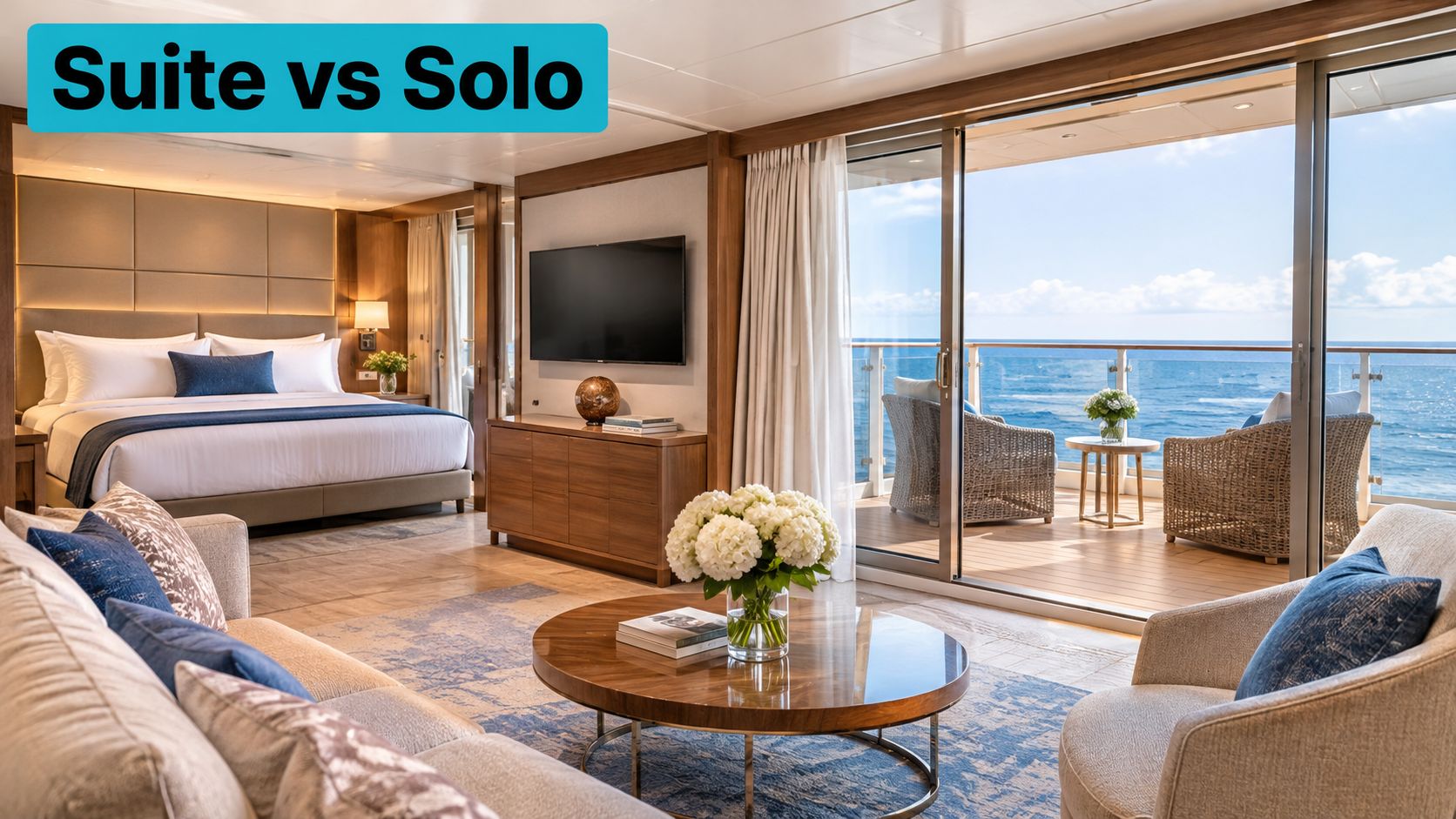
If two people share a cabin but keep different schedules, a suite's separate sleeping and sitting areas can make the room more usable. Suites may also include enhanced services, while a larger terrace adds outdoor space. Compare the extra room and services with the fare: a suite label alone does not tell you how much space is inside or how useful its layout will be.
The image below shows a suite layout with distinct sleeping and seating areas that open onto a balcony.
Solo travelers face a different comparison: a dedicated cabin may avoid the single supplement charged on a standard room, but it is not automatically the lowest-cost choice. According to Travel Weekly coverage of CLIA figures, solo travelers represented 7% of cruisers in 2025, after reaching 12% in 2024. Holland America announced solo cabins, including balcony staterooms, as part of a $500 million refurbishment of six ships. Dedicated solo inventory is limited to selected sailings, so dates and cabin choices may be narrower.
The video below shows solo and upgraded cabins, helping you compare their layouts with how you expect to use the space.
| Factor | Dedicated solo cabin | Standard cabin with single supplement |
|---|---|---|
| Total price | Fare set for single occupancy; compare the final total | Standard cabin fare plus single supplement |
| Availability | Selected sailings only | Usually more sailings and cabins available |
| Balcony access | Balcony solo staterooms are available on Holland America | Available when you book a balcony category cabin |
| Size and location | Often a compact studio layout in a fixed location | More choice of category, deck, and position |
Solo fares may be available on selected sailings and can sell out faster than double-occupancy inventory, so flexible dates can help. Compare the total price for a dedicated solo cabin with a standard cabin and its supplement. Then check the cabin's deck position, view, balcony access, and usable space. A lower fare matters less if the room's layout or location does not suit your trip.
Accessible Cabins Need a Fit Check, Not a Label
An accessible symbol tells you which cabins to investigate, not whether one will suit your needs. The fit depends on the exact room layout: a doorway may be wide enough, yet the bed, bathroom or door swing may leave too little usable space for your equipment.
Published cabin sizes can offer a rough comparison. Accessible rooms may range from 159 to 298 square feet, according to TravelWings coverage of cabin types. But square footage is only the room's total area. Where that space sits matters: clear floor area beside the bed may be more useful than extra space elsewhere.
Cruise lines typically describe accessible staterooms with features like extra turning space, wider doors, roll-in showers and grab rails, but the exact set varies by ship. Check the details for your specific cabin rather than treating the category label as a guarantee.
Questions the label doesn't answer
- Can your wheelchair fit and turn? Ask about clear floor space beside the bed, as well as doorway width.
- Can you use the bathroom independently? Confirm the shower layout, bench, rails and toilet height.
- Can you reach the balcony? Ask whether the threshold is accessible in that exact cabin.
- What information must you provide, and when? Confirm any accessibility forms, medical details or equipment limits, and the deadline for submitting them.
| Check | Reference Value | What to Confirm |
|---|---|---|
| Turning space | Clear turning space beside the bed (confirm dimensions with the line) | Your equipment turns beside the bed with clearance |
| Room size | 159 to 298 sq ft across accessible rooms | The room suits your equipment, not just the label |
| Bathroom | Accessible bathroom features vary by ship | You can use the bathroom independently |
| Doorways | Wider doors, with dimensions varying by ship | Door swing and clearance for your chair |
| Balcony threshold | Exact threshold measurement for your cabin, confirmed in writing | Whether the threshold is accessible on your exact cabin |
| Documentation | Form requirements and deadlines vary by line | The line's form deadline and any equipment limits |
Start with the measurements of your equipment and the turning space you need. Then ask the cruise line or your travel planner to check those measurements against the exact cabin number and deck plan. Confirm the bathroom and balcony details, plus any form deadline, before you pay. If an answer is unclear, ask for specifics: changing cabins after boarding may not be simple.
Match Your Trip and Confirm the Cabin
Don't start with a category. Start with the one priority you'd protect if you had to give up the rest. It might be budget, daylight, space, scenery, motion, or accessibility. Find that row in the infographic and table below, then run the single check listed for it.
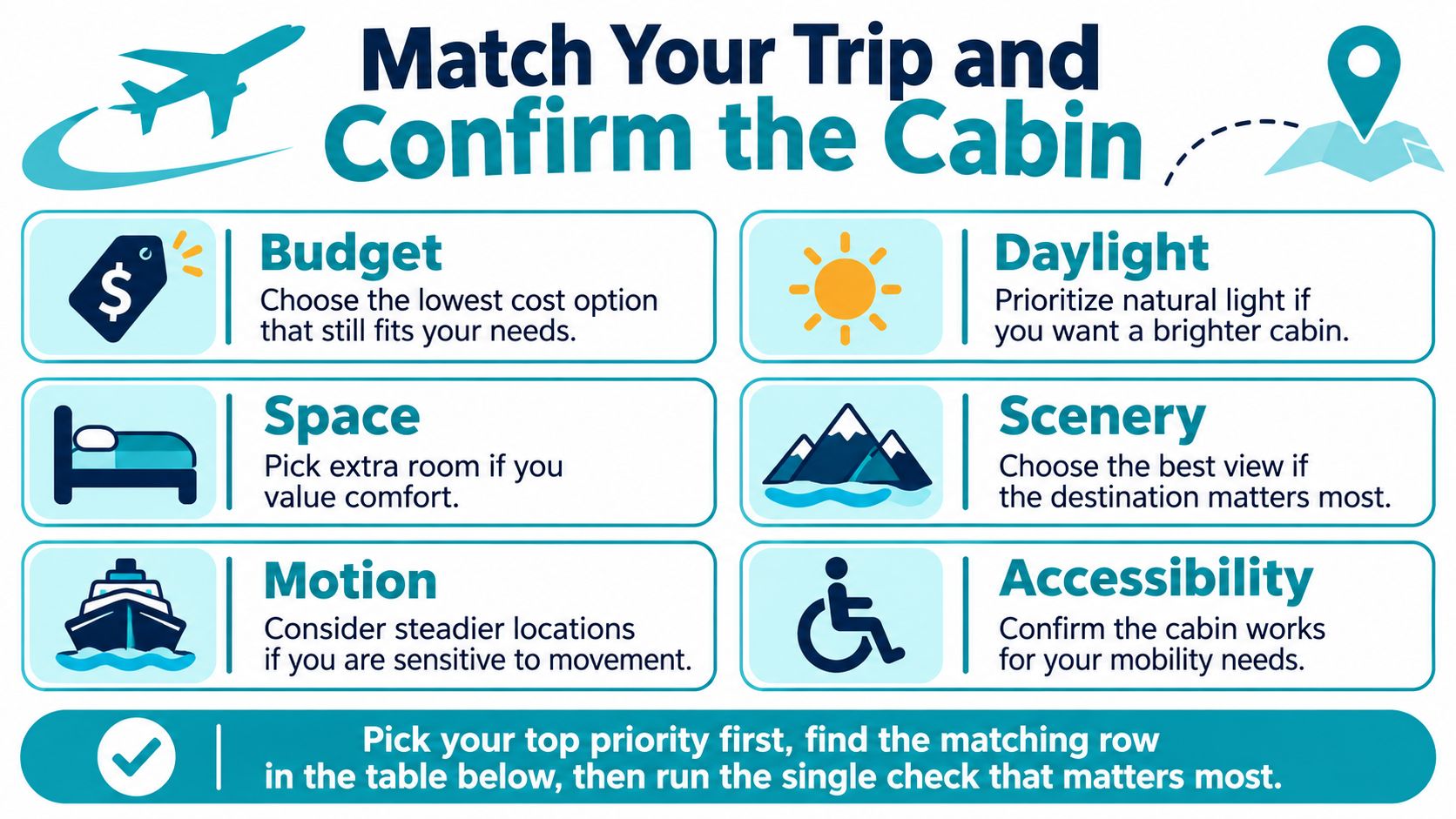
| Traveler Situation | Usually Best Fit | Check Before Booking |
|---|---|---|
| Budget solo traveler | Interior or dedicated solo cabin | Total price against a standard cabin with single supplement |
| Family with children | Cabin configured for three or four passengers, or a suite layout | Berth count and how sleeping space is arranged |
| Scenic itinerary such as Alaska | Balcony with an unobstructed view | Obstruction symbols on the exact cabin's deck plan |
| Motion-sensitive traveler | Mid-deck, central ocean-view or balcony | Position away from the bow, stern and noisy venues |
| Accessibility needs | Accessible cabin on your chosen ship | Fit of your equipment and the line's form deadline |
| Special occasion trip | Suite | Balcony size, included services and availability |
Three quick examples
Say a grandparent couple books a scenic Alaska sailing and ranks the view first. An unobstructed balcony beats a larger interior room for them, even though the interior wins on floor space, because they'll watch glaciers and coastline from their own chairs for hours. Their one essential check is the obstruction status of the exact cabin.
Say a family of four needs everyone in one room. Their priority isn't the category word, it's whether the cabin is configured for four and how the extra berths work for the children's ages and bedtime. A suite layout might solve the crowding, but only if the sleeping arrangement, not just the berth count, fits the family.
Say a guest knows they get seasick. They should look at mid-deck, central cabins first, in whichever category their budget allows, and treat a high cabin near the bow as a poor trade even if the price looks attractive. A solo traveler runs a similar totals-first check, because the cheapest route alone isn't always the dedicated solo cabin.
You're buying a cabin number, not a category label. Confirm that number against the deck plan before any money changes hands.
Confirm before you book
Run this final pass on your shortlist:
- Total price: Confirm the full amount, including any single supplement, so you're comparing real totals.
- Quoted area: Confirm whether the figure includes the balcony, and how the space splits between inside and outside.
- Deck position: Confirm what's above, below, and beside the cabin, plus its fore-aft location.
- Accessibility fit: Confirm your equipment measurements against the cabin and note the form deadline.
- Berths and bedding: Confirm who sleeps where, especially with children or a third and fourth guest.
When you have a few sailings that could work, our compare tool lets you compare up to six sailings side by side for rates, itinerary, ship profiles and more, so you can weigh cabin choices across ships without reopening every listing. Our travel advisors help with new bookings, pricing questions, and cruise planning guidance when a listing leaves something unclear. Write down the cabin number for your leading option, check it once against the deck plan, and only then book it.
Ready to put a real cabin number to your shortlist? Visit Best Cruise Rates to compare sailings side by side, check rates and ship profiles for interior, ocean-view, balcony, and suite options, and talk through pricing questions with our travel advisors. Bring your top priority, whether that's scenery, space, motion, or accessibility, and we'll help you match it to a cabin that fits your trip.
Ready to book your next cruise?
Compare 40+ cruise lines or call our specialists at 1-888-604-0279.