Royal Caribbean Cruise Guide: Ships, Routes and Booking
You're three tabs deep into a booking search, the date filter is set, and forty sailings are staring back at you with prices that seem to have nothing to do with each other. One seven-night Caribbean itinerary starts at a number that looks like a typo. The next, same week, same region, costs nearly twice as much. Neither price tells you what the week will cost.
That gap is the whole game with a Royal Caribbean cruise. The advertised fare covers the cabin, the main dining room and the shows. It doesn't cover the daily gratuity, the internet your teenager will burn through, or the specialty dinner you'll book on night three. A cheap fare on a huge ship sailing from a far port can end up costing more than a pricier fare you can drive to.
Treat ship class and all-in cost per guest as one decision, because that's how the money works. Pick the ship that fits your crowd tolerance, then price the entire week before you compare anything.
Table of Contents
- How to Choose a Royal Caribbean Sailing
- Royal Caribbean Ship Classes Compared
- Destinations and Itineraries by Region
- What the Fare Includes and What Costs Extra
- What Connectivity Really Costs Onboard
- How to Compare and Book a Sailing Step by Step
- Book Your Royal Caribbean Sailing Today
How to Choose a Royal Caribbean Sailing
A family of four opens a Royal Caribbean search and the first number is a two-guest interior. That is not their price. Quote the cabin for the people who will sleep in it, then add what each guest pays on top, or you will book the wrong sailing.
Royal Caribbean International is the mainstream brand people mean by Royal Caribbean. Celebrity Cruises and Silversea sit in the same corporate group, at higher price points and with different ship styles. Confirm the brand on the sailing before you line up fares. A Celebrity price and a Royal Caribbean price are not the same product.
The group runs a large combined fleet, and the ships are not interchangeable. Third and fourth berths sell often, so a stateroom listed for two can sleep four. The per-person rate moves with how many of those berths you fill. Price your real party, not the two-adult default the search screen assumes.
Four choices set the week, and they move together. Ship class sets the venues, the crowd, and which ports the ship can enter. A bigger ship narrows that port list. Region and itinerary set your flights and how many sea days you get. Fare category (interior, oceanview, balcony, or suite) is the biggest lever on the base price. Gratuities, internet, drinks, specialty dining, and excursions sit on every category.
Run the same week two ways before you trust the low fare. Multiply daily gratuities and a basic internet plan by every guest, then add one specialty dinner and the cost of reaching a distant port. The interior that looked cheapest can lose to a higher balcony fare on a ship you can drive to, once those lines are in the total per guest. Onboard and other spending is a real share of what these sailings bring in, so treat it as part of the comparison, not leftover money.
Answer three questions before you open a sailing page. How many guests are travelling? How many nights do you have? What can you spend per day once extras are in? Those three answers remove most of the forty options in front of you.
Royal Caribbean Ship Classes Compared
The fleet spans from a handful of smaller ships to the largest resort vessels afloat. Royal Caribbean started with one ship, Song of Norway, which entered service on November 7, 1970, carrying 724 passengers out of Miami's Dodge Island, per the company's own history. It was designed for cruising rather than converted from a ferry or ocean liner, and that decision set the template every class below still follows.
| Ship class | Example ships | Best fit |
|---|---|---|
| Icon class | Icon of the Seas, Star of the Seas | Families and guests who want the largest venues and a water park |
| Oasis class | Oasis, Allure, Harmony, Symphony, Wonder, Utopia of the Seas | Guests who want neighbourhood-style areas and many dining options |
| Quantum Ultra and Quantum class | Quantum, Anthem, Ovation, Spectrum, Odyssey | Travellers who want technology features and a balance of size and port access |
| Freedom class | Freedom, Liberty, Independence | Mid-size comfort with a wide choice of activities |
| Voyager class | Voyager, Explorer, Adventure, Navigator, Mariner | Travellers who want a moderate crowd and familiar layouts |
| Radiance class | Radiance, Brilliance, Serenade, Jewel | Couples and guests who want smaller ships and access to smaller ports |
How to read the table
Start at the top only if you want the biggest version of everything and can tolerate queues on sea days. The Icon class is the current flagship experience: water park, multiple neighbourhoods, the widest spread of restaurants. The newest ship in the fleet also carries the newest-ship price, so an Icon sailing at a low-looking lead fare is rarely the cheapest week once you compare the same cabin type across classes.
My default recommendation for most groups is Oasis class. It pioneered the neighbourhood layout, the dining spread is nearly as wide as Icon's, and the ships have been in service long enough that pricing settles below the flagship premium. You give up the water park and little else.
Move down and you trade venues for breathing room. Quantum and Quantum Ultra ships carry strong technology features and a broad cabin range, suiting travellers who want a modern ship without the maximum crowd. Freedom and Voyager sit in the middle: enough activities for a week, fewer people competing for them, and consistently lower per-night pricing than the two biggest classes. Radiance class ships are the ones to pick when the itinerary matters more than the onboard circus, because their size opens ports the big ships can't use.
Shortlist rule: choose the class by crowd tolerance and must-have venues first, then check which itineraries that class actually sails. Doing it the other way round means falling in love with a route you can't book on the ship you want.
Why size changes your itinerary
Icon of the Seas measures approximately 364.75 metres in length with gross tonnage of about 248,663 GT, and it runs six Wärtsilä dual-fuel engines, three 14V46DF units at roughly 16,030 kW each and three 12V46DF units at roughly 13,740 kW each, per Royal Caribbean's technology guide. Those engines burn liquefied natural gas as the primary fuel with a distillate fallback, and Royal Caribbean identifies Icon as the first ship in its fleet capable of using LNG as its main fuel.
The part that affects your booking is simpler. Berth length, draft, port passenger-handling capacity and LNG bunkering availability all constrain where a ship this size can go. A 22-knot design speed helps scheduling, but it doesn't create a berth that isn't there. Expect the largest classes to concentrate on the ports built to absorb them, which means shorter, repetitive Caribbean loops. If your priority is an unusual itinerary, a Radiance or Voyager class ship will get you there at a lower per-night rate, and the smaller crowd means the extras you do buy, specialty dining, spa time, prime pool chairs, are easier to use.
Destinations and Itineraries by Region
Region and season decide more of your trip than ship choice does. Match your available dates to the table first, then narrow by port.
| Region | Typical length | Common departure ports | Best season |
|---|---|---|---|
| Caribbean | 3 to 7 nights | Miami, Fort Lauderdale, Port Canaveral, Tampa | November to April |
| Bahamas | 3 to 5 nights | Miami, Port Canaveral | Year-round |
| Bermuda | 7 nights | New York | May to October |
| Alaska | 7 nights | Seattle, Vancouver | May to September |
| Mediterranean and Northern Europe | 7 to 14 nights | Barcelona, Rome (Civitavecchia), Athens | May to October |
| Asia-Pacific and Australia | 7 to 14 nights | Singapore, Sydney | Seasonal, varies by region |
The Caribbean is the default for a reason: short flights from most of the U.S. East Coast, four Florida embarkation ports, and 3 to 7 night options that fit a work calendar. If you're weighing the two main routes, this breakdown of eastern versus western Caribbean cruises covers the port stops and sea-day differences. The Bahamas is your long-weekend product, 3 to 5 nights, year-round, and the cheapest way to test whether you like cruising at all.
Bermuda runs as a 7-night round trip from New York between May and October, which makes it the rare itinerary where you can skip flying entirely. Alaska is 7 nights from Seattle or Vancouver, May to September, and it's a different trip: scenery and excursions over pools and waterslides. Mediterranean and Northern Europe sailings stretch to 7 to 14 nights from Barcelona, Rome or Athens between May and October, so flights and hotel nights before the cruise become a real line item. Asia-Pacific and Australia itineraries run 7 to 14 nights from Singapore or Sydney on a seasonal calendar.
The port rule that saves the most money
Price the flight to each embarkation port before you compare fares. A sailing from a distant port can cost more than a lower fare once airfare, a pre-cruise hotel night and transfers land on top. Two fares $300 apart can flip completely when one port is a two-hour drive and the other is a five-hour flight.
Royal Caribbean's own reporting shows why itinerary choice also carries an environmental cost. Its 2025 sustainability reporting shows approximately 10.16 million metric tons of combined Scope 1, 2 and 3 emissions, with biofuels at about 2% of the fuel mix avoiding an estimated 100,000 metric tons of CO2e, per the 2025 sustainability report summary. The same reporting points to 6.7% capacity growth in 2026 and a roughly 4% improvement in fuel consumption per available passenger cruise day.
That combination is the honest picture: efficiency per passenger is improving while total capacity, and total emissions, keep rising. If footprint matters to you, the biggest lever isn't the ship. It's a shorter flight to the embarkation port and a longer stay rather than two short trips.
Pick your region by dates, then your port by total flight cost, then your itinerary length by budget per day. That order solves most itinerary decisions.
What the Fare Includes and What Costs Extra
You and a friend book the same week. You take the lower cabin fare, then add a drink package and a second Wi-Fi device. Your friend pays more for the cabin and skips both. By the last night, your cheaper fare is the more expensive trip per person.
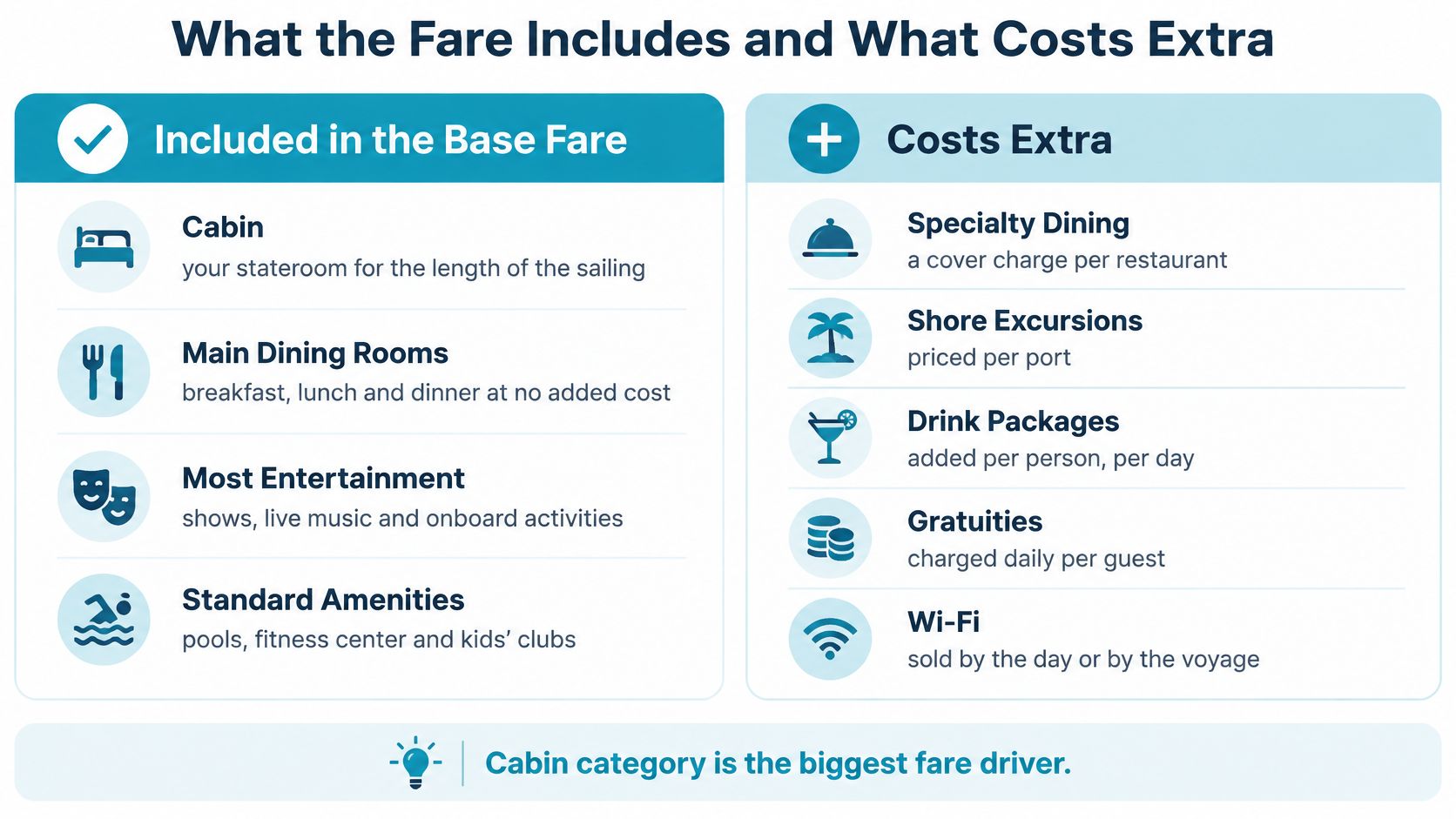
| Item | Usually included? | Typical cost | How to estimate |
|---|---|---|---|
| Cabin fare | Included | Depends on cabin type and season; compare the same cabin category across sailings | Match category, nights, and departure window |
| Gratuities | Extra, often added automatically | About $16 to $18 per guest per day | Guests multiplied by nights |
| Wi-Fi (VOOM) | Extra | About $17.99 to $23.99 per device per day | Devices multiplied by days |
| Drinks packages | Extra | Priced per person, per day, by package tier | Drinks you expect to order each day multiplied by nights |
| Shore excursions | Extra | Priced per excursion, per guest | Price of each excursion multiplied by guests |
| Specialty dining | Extra | Priced per meal, per restaurant | Number of planned meals multiplied by price per meal |
| Travel insurance | Extra | Quoted by age and trip cost | Get the quote before final payment |
The base fare covers your stateroom, the main dining rooms, most entertainment, and standard amenities: pools, the fitness centre, and kids' clubs. Every row marked Extra sits on top of that fare. Judge the sailing by all-in cost per guest.
Price the category, then the extras
Hold the cabin category still. An interior and a balcony are different products, even in the same week on the same ship. Once the category, the nights, and the departure window match, the gap left on the screen is a real fare difference.
Recent reported examples put one-device VOOM plans at roughly $17.99 to $23.99 per day on selected sailings, according to Royal Caribbean Blog's explanation of Wi-Fi pricing. Two guests on a seven-night sailing owe about $224 to $252 in gratuities at $16 to $18 per guest per day. One device for those seven days adds about $126 to $168. Those two lines alone land near $350 to $420 for the cabin, about $175 to $210 per guest, before a drink or a shore day.
The all-in formula: fare per cabin, plus gratuities per guest per night, plus devices times days times the Wi-Fi rate, plus the packages you will actually use. Run that on every shortlisted sailing. The lowest fare often stops being the lowest trip.
The Royal Caribbean app still works onboard without a full package. You can view schedules, reserve activities, and message through app features. That is not ordinary web access, email, social media, or streaming. Do not plan to work from the app.
If drinks are on your list, price the package against what you would order. This guide to whether cruise drink packages are worth it works through the break-even math. Cruise line policies, procedures, itineraries, and FAQ information can change at any time without notice, so confirm the current terms on the sailing you book.
What Connectivity Really Costs Onboard
The per-device daily rate is the number that decides this line item, and it scales brutally with party size. The same rate produces these totals for four common traveller profiles across a full sailing.
| Traveller | Devices | Days | Estimated Wi-Fi cost |
|---|---|---|---|
| One adult, messaging only | 1 | 7 | About $126 to $168 |
| Couple sharing streaming | 2 | 7 | About $252 to $336 |
| Remote worker | 1 | 14 | About $252 to $336 |
| Family of four, two devices each | 8 | 7 | About $1,007 to $1,343 |
Read the last row again. Eight devices on a seven-night sailing can cost more than a second cabin in some fare categories. That's the line that turns a family budget upside down, and it's the one the booking screen never shows you.
Cheaper ways to stay connected
- Share one package: buy a single device plan and rotate who's logged in. Slower, but a fraction of the cost for a family that only needs occasional messages.
- Use port Wi-Fi: coffee shops and terminal Wi-Fi cover email and uploads on port days. Download offline maps before you leave the ship.
- Check your cellular plan: a travel day pass from your carrier can beat a ship package for light use, but confirm the roaming rate before you switch data on at sea.
- Buy early, but compare: pricing can differ between pre-cruise purchase and onboard rates. Check both before you commit for the whole voyage.
Decide by counting devices and days first, then pick the cheapest option suited to the messaging or work you need. Most travellers overbuy internet and underbuy shore time.
How to Compare and Book a Sailing Step by Step
Run this sequence once, on paper or in a spreadsheet, and the decision usually makes itself.
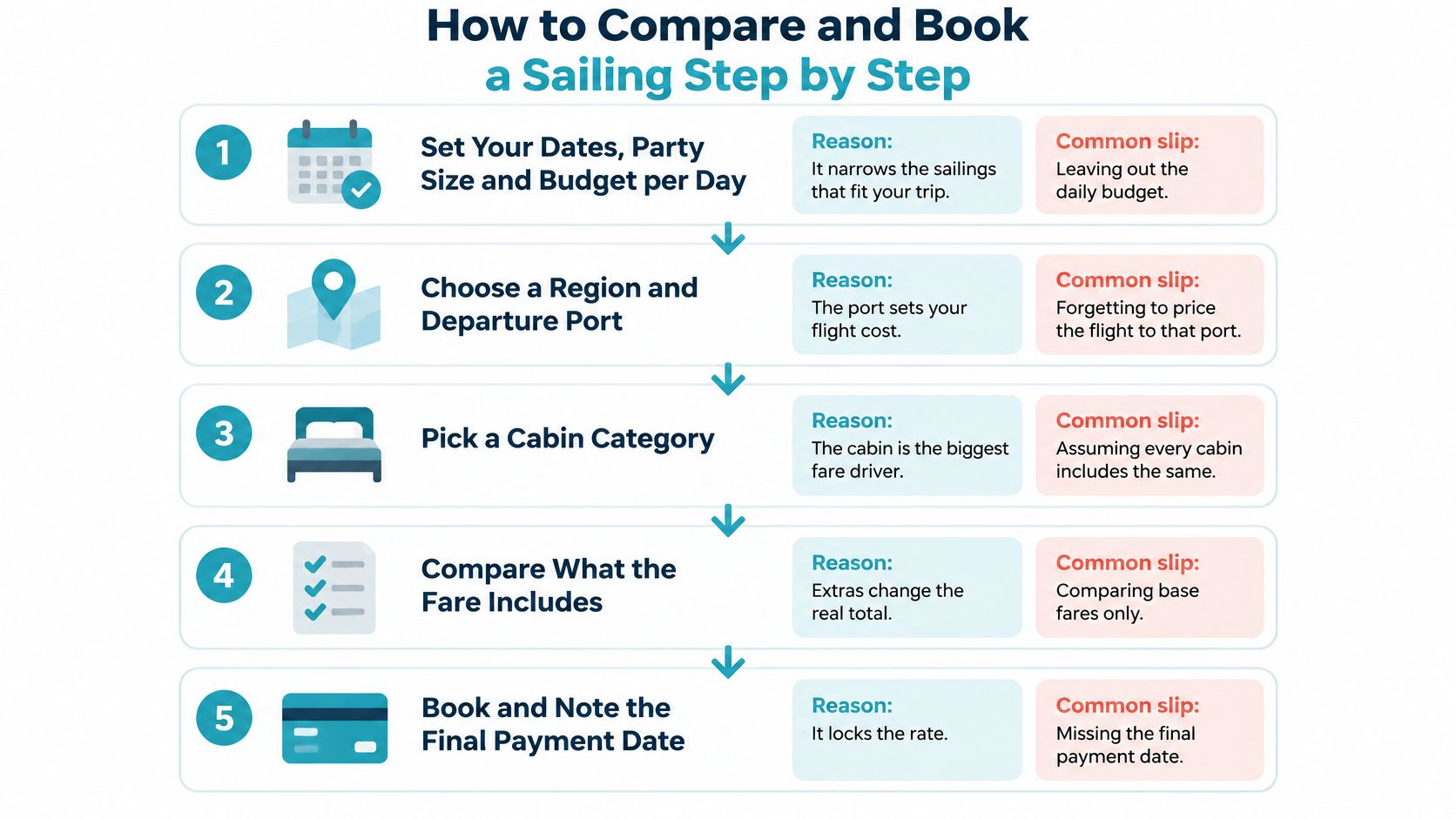
The seven steps
- Set dates, party size and a budget per day. Without a daily ceiling you'll compare a 5-night and a 9-night sailing as if they were the same purchase. The typical slip is leaving the daily number out entirely.
- Choose a region and departure port, then price the flight. The port sets your airfare, and airfare can outweigh a fare difference. Skipping this step often leads to surprise at checkout.
- Shortlist two or three ship classes that match your crowd tolerance and the venues you care about. Don't shortlist ten.
- Compare in the same cabin category, same nights, same departure window. Mixing categories makes a cheaper sailing look better than it is. This is the most common comparison error.
- Add gratuities, the Wi-Fi budget for your device count, and any drinks or excursion packages to every option. Now you're comparing real totals.
- Check the cruise line's terms and confirm the itinerary. Policies and itineraries can change without notice. Verify passport and citizenship documents well before departure, because the cruise line and booking partners aren't liable for fees or penalties if a passenger is denied boarding for inadequate proof of citizenship.
- Book where immediate confirmation is allowed, or hand it to a specialist to manage the reservation and any changes. Confirm cancellation terms and travel insurance before final payment.
Step you'll be tempted to skip: number four. It's the one that produces the wrong answer most often.
The comparison checklist
Before you pay a deposit, confirm six things: total cost per guest, embarkation port and flight cost, ship class and must-have venues, travel documents, insurance, and cancellation terms. If any of those six is blank, you're not ready to book.
Booking online gives you immediate confirmation where the cruise line allows it. A specialist helps when your dates are flexible, when you're combining flights and transfers, or when you want someone else to sit on hold. This overview of where to book a cruise covers the trade-offs between booking direct, through an agent and through a comparison site.
Book Your Royal Caribbean Sailing Today
Decide three things and stop researching: one ship class, one region, one fare category. Then compare two or three sailings on total cost per guest rather than the headline fare.
That's the comparison Best Cruise Rates is built for. It offers sailings from Royal Caribbean alongside Carnival Cruise Line, Celebrity Cruises, Princess Cruises, MSC Cruises, Norwegian Cruise Line, Disney Cruise Line and many others, with personalized cruise planning, access to exclusive deals and dedicated reservation support. Its best-price guarantee works like this: if you find a lower advertised price in U.S. dollars after booking but before final payment, Best Cruise Rates contacts the cruise line to re-fare to the best promotion, and restrictions apply.
Talk it through by calling 1-888-604-0279 to speak with cruise experts, or email support@bestcruiserates.com. Then write down your dates, party size and budget per day, and run the seven-step comparison before you choose.
Best Cruise Rates puts Royal Caribbean sailings next to 99 cruise lines and more than 25,000 itineraries worldwide, so you can compare ships, ports and cabin categories side by side instead of across a dozen browser tabs. Cruise specialists handle the reservation questions and the cruise-line calls, before and after you book, at no cost to you. Start with your dates, party size and budget per day, then visit Best Cruise Rates to price the whole week rather than just the fare.
Ready to book your next cruise?
Compare 40+ cruise lines or call our specialists at 1-888-604-0279.