River Cruises vs Ocean Cruises: Which Fits Your Trip
34.6 million people took an ocean cruise in 2024, 16.8% more than in 2019 and 9.3% more than in 2023, and 43% of them sailed the Caribbean. The same CLIA 2024 annual report puts European river cruising at about 1.22 million passengers in 2023, counting international visitors alongside source markets such as the United States, Canada, Germany, Austria, Switzerland and France.
Those figures don't measure identical things, since one covers global ocean voyages and the other covers European waterways, but the ratio is the point. Ocean cruising is a mass industry spread across every continent. European river cruising is a compact, geographically concentrated market built around the Rhine, the Danube and a handful of other corridors.
Volume doesn't settle the choice, though. A traveler weighing river cruises vs ocean cruises is picking between two trip designs, and the numbers that decide it are days at sea, walking distance from the gangway, and what the fare covers once drinks, tours and gratuities land.
Two claims get repeated so often they've hardened into assumptions. The first is that river ships are more dependable because they never cross open water. The second is that they're easier for travelers with mobility limits because they're smaller. Both deserve testing against the specific itinerary rather than the format.
Table of Contents
- River and Ocean Cruises Compared at a Glance
- What Ship Size Changes on Board
- How Itineraries and Ports Shape Each Day
- What Each Fare Includes and What Costs Extra
- Where Each Format Is Most Likely to Disrupt Your Trip
- Accessibility and Mobility Limits
- Choose the Right Cruise for Your Trip
River and Ocean Cruises Compared at a Glance
The two formats don't compete for the same trip. Ocean lines sell onboard variety and sea days. River lines sell a berth within walking distance of a town square. Every other difference follows from that split.
| Factor | River cruise | Ocean cruise |
|---|---|---|
| Typical length | Most sailings run a week or a little longer | Average 7.1 days (CLIA, 2024) |
| Guests per ship | Capped by lock width and beam, so a few hundred at most | Premium ships near 930; megaships above 5,500 |
| Typical ports | City centers along the river | Large coastal ports, with tender stops at small harbors |
| Days at sea | Few or none on most itineraries | Several, sometimes most of the trip |
| Main regions | Europe, mainly the Rhine and Danube | Worldwide; Caribbean holds 43% of ocean passengers |
| Main draw | Destination immersion and city access | Onboard venues, variety and sea days |
Read the table as patterns, not promises. Ship classes break rows all the time: a small expedition vessel crosses oceans with fewer guests than the largest river ships, and a double-width river boat carries more people than its length suggests. What survives every exception is the trade each format makes between space on board and access to land.
The two rows that decide most bookings
Days at sea and port access shape a trip more than cabin category or cuisine. Ocean routes need open-water crossings between regions, and many itineraries turn those crossings into the product, with pool decks, theaters and specialty restaurants filling the hours. River schedules move the ship overnight and moor in the morning, which puts a market, a cathedral or a museum a short walk from the gangway.
Demand follows those patterns. The 2024 State of the Cruise Industry report recorded 31.7 million ocean passengers in 2023, equal to 107% of the 2019 level, and forecast 39.7 million by 2027, a projection rather than a result. River traffic is narrower but international: travelers from the United States and Canada accounted for 515,157 passengers on European rivers, German-speaking markets for 450,701 and France for 100,100, with the Rhine and Danube the busiest waterways.
Quick check: if you want to wake up somewhere new most mornings, weigh the river column. If you want sea days and a packed schedule of onboard venues, weigh the ocean column.
Neither column ranks quality. A traveler who books against the grain of their own preferences finds the ship too quiet or too crowded, and the fix is choosing the itinerary shape first and the cabin second.
What Ship Size Changes on Board
A river ship's dimensions are dictated by the waterway it has to squeeze through, not by what naval architects would prefer to build. The infographic below shows the envelope that results.
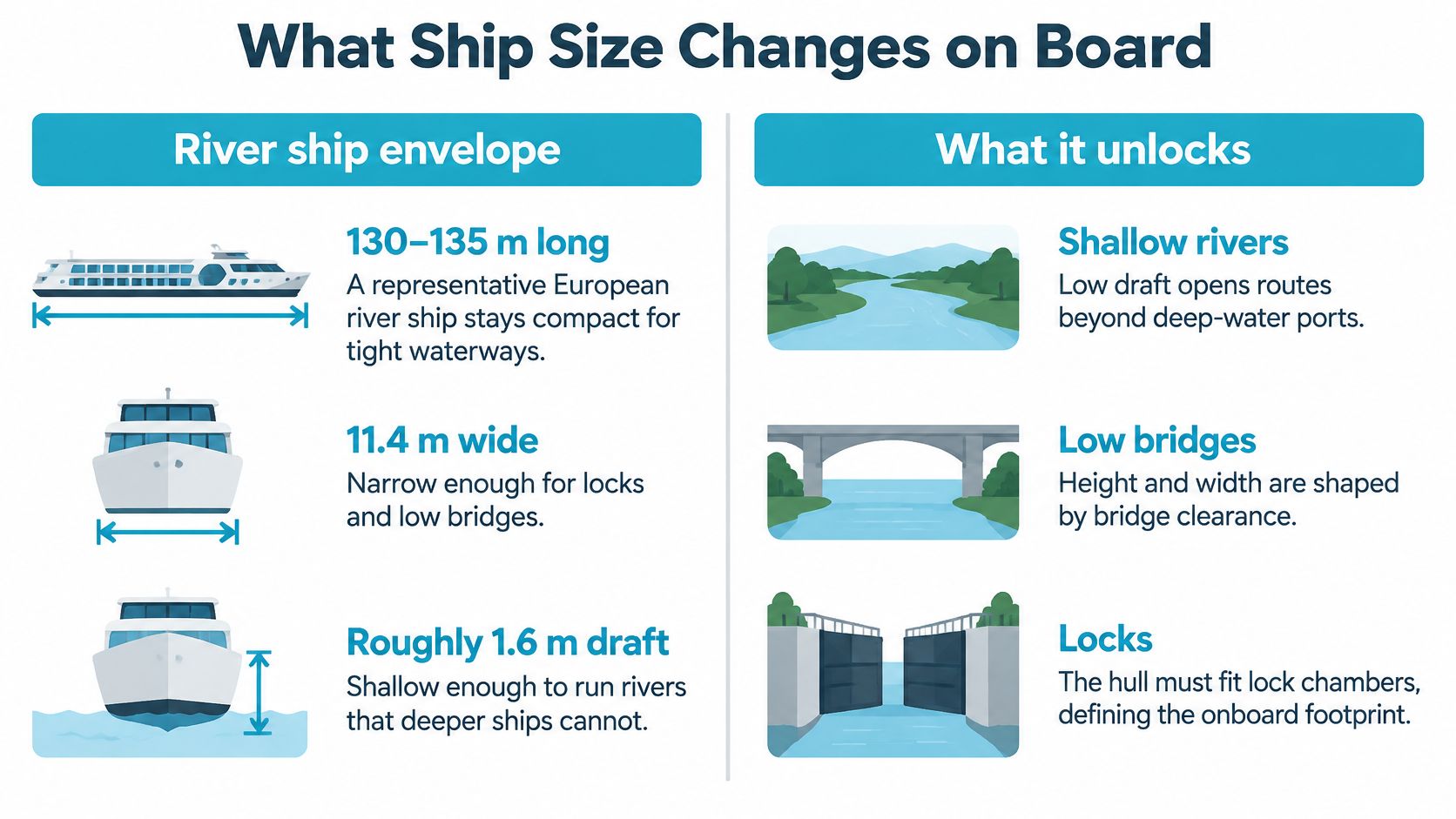
A representative European river-cruise vessel runs about 130 to 135 m long, 11.4 to 11.45 m wide, and draws roughly 1.6 m, with an air draft near 6.0 m, per cruise port data on river ship dimensions and lock rules. Those numbers let it pass shallow channels, low bridges and canal locks, and they also cap what can be stacked on the hull. The same constraint produces the format's best feature for sightseeing, since it can dock close to historic centers, and its fragility, because water levels and bridge clearance can rewrite the schedule.
Ocean vessels answer to a different set of limits. Premium ships typically carry roughly 900 to 1,000 guests and sit far below the megaship class in length and volume, while published specifications for Oasis-class megaships list about 362 m in length, 225,282 GT and more than 5,500 passengers, with draft around 9.3 m. That kind of draft is why ocean itineraries depend on dredged channels, berth length and turning basins instead of lock chambers.
Size reaches the passenger as a set of small daily moments. On a river ship the lounge, the dining room and the sundeck are the whole ship, so you recognize most faces by the second evening and rarely wait for a table or a lift. Cabins tend to be compact, and a balcony usually comes down to which deck you booked, so read the deck plan for cabin width before you pick a category.
On a megaship the arithmetic reverses. Several restaurants, theaters, pools and family zones absorb the crowd, but embarkation, buffet lines and elevator waits cost real time, and a walk from a forward cabin to an aft dining room becomes part of the evening. The crowd never disappears; it just distributes. Ask which shared space will be busiest on your sailing and book the alternative before you board.
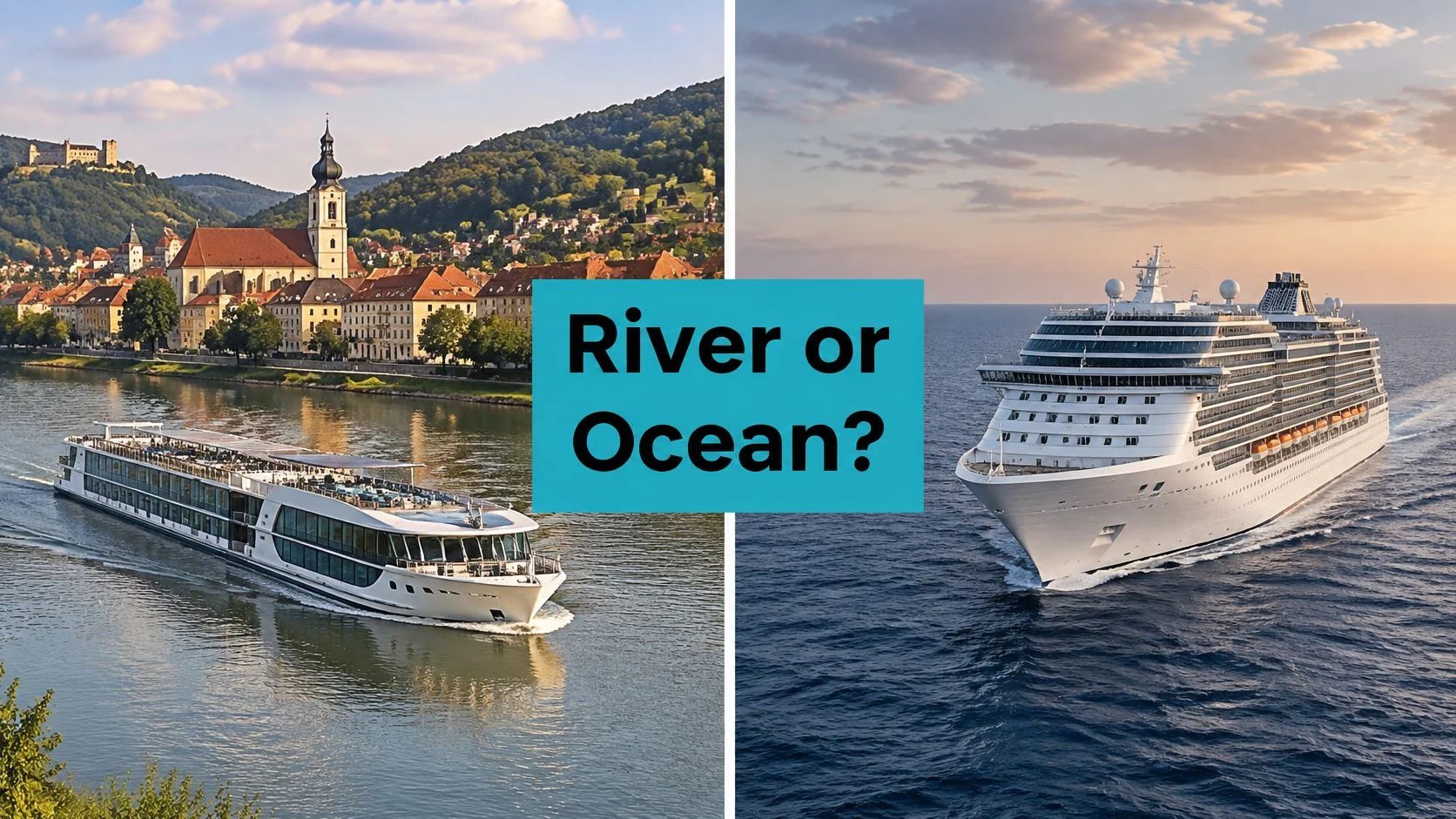
Here's how the two hulls look against each other in motion.
Match the hull to the trip. A quieter, destination-focused itinerary suits a smaller ship, while a trip built around choice on board suits a larger one.
How Itineraries and Ports Shape Each Day
Same week, similar budget, two different trips. One is a Rhine sailing from Amsterdam to Basel calling at Cologne, Koblenz and Strasbourg. The other is a western Mediterranean loop that reaches Barcelona, Marseille, Civitavecchia for Rome and Palma. The fares can land close together. The days won't.
A river day starts on land
On the Rhine itinerary you wake already moored. Breakfast runs while the gangway opens, and by nine you're walking into Cologne's old town, minutes from the hull to the cathedral steps. The ship sails around lunchtime, passes the Loreley stretch in the afternoon and ties up in Koblenz before dinner.
Lock and bridge timing explains most of the small unpredictability. A vessel that clears a low bridge at normal water may not clear it after heavy rain, and a queue at a lock pushes an afternoon arrival toward evening. Operators build slack into the schedule, but the buffer is thinner than on open water because there's nowhere else to go, and some sailings substitute a coach for a stretch of river.
An ocean day runs on the ship
On the Mediterranean loop the ship may spend a full day at sea before Barcelona and another on the return. For a lot of passengers those are the best days: the theater, the pool deck, the kids' club and the specialty restaurants all compete for the same hours. Port days run on a different clock, with an early arrival, a tour meeting point and an all-aboard time that rarely leaves room for a long run inland.
Where the ship ties up changes the day as well. Ocean terminals sit in working harbors, often a shuttle ride or taxi from the historic center, and some ports use tenders, which means a boat to shore and a queue coming back. River moorings are usually a short walk from the old town, though berth availability in peak season can put you a town or two from the advertised stop.
A river itinerary sells the hour you step off the ship. An ocean itinerary sells the hours you spend on it.
The port test
Run this against any shortlist before you compare prices.
- List every port and mark whether you can walk off into town or need a transfer. Count the transfer ports.
- Count the sea days and ask whether you'd enjoy them, not whether you could tolerate them.
- Check port times, because four hours ashore and eight hours ashore support completely different plans.
- Ask about contingency transport on river sailings, including coach transfers and hotel nights if low water closes a stretch.
Our guide to how a cruise ship itinerary is built explains how port times, sea days and overnight stays get scheduled in the first place. The itinerary that fits is the one whose pace you'd keep at home.
What Each Fare Includes and What Costs Extra
The headline fare is the least reliable number in cruise pricing, because two sailings at the same sticker price can differ by four figures once extras land. Compare inclusions before you compare prices.
| Cost item | River cruise | Ocean cruise |
|---|---|---|
| Shore excursions | Often bundled into the fare on many lines | Usually sold separately |
| Drinks | Wine or beer with meals on some lines; spirits extra | Standard drinks often extra; packages sold separately |
| Gratuities | Often prepaid or included on some lines | Usually added per guest per day |
| Wi-Fi | Included on some lines, charged on others | Usually sold as a package |
| Port fees and taxes | Usually quoted inside the fare; check the breakdown | Often added at checkout |
Run the arithmetic before you compare
Take two seven-night sailings as a worked example. The ocean fare is $1,600 per person. Add $450 of shore excursions, $300 of drinks and $120 of gratuities and the trip costs about $2,470, or roughly $353 a night. The river fare is $2,800 and already bundles excursions, so add $300 of drinks and you reach about $3,100, or roughly $443 a night.
The headline gap was $1,200. The actual gap is $630, and it moves again the moment one line includes a drinks package and the other doesn't. Bundling is what makes the arithmetic interesting, because a river fare that folds excursions, wine with dinner, Wi-Fi and gratuities into one number can undercut a cheaper-looking ocean fare once you buy the same components.
Rule of thumb: compare cost per night after drinks, tours, gratuities and transfers. The lower headline fare loses that contest more often than the marketing suggests.
Inclusions change by line, by ship and by season, so get the exact list in writing before you pay a deposit. Airport transfers and a pre-cruise hotel night usually sit outside the fare, and on river itineraries the transfer to the ship is sometimes bundled and sometimes not. Best Cruise Rates' comparison tool shows up to six sailings side by side with rates, itineraries and ship profiles, which makes those gaps visible before you commit. Our guide to the best affordable cruise lines covers which operators build the most into the base price.
Where Each Format Is Most Likely to Disrupt Your Trip
River cruising's main disruption risk sits at the meeting point between a stable vessel and a changing waterway. Ocean cruising carries disruption too, but the cause and the replacement day tend to differ.
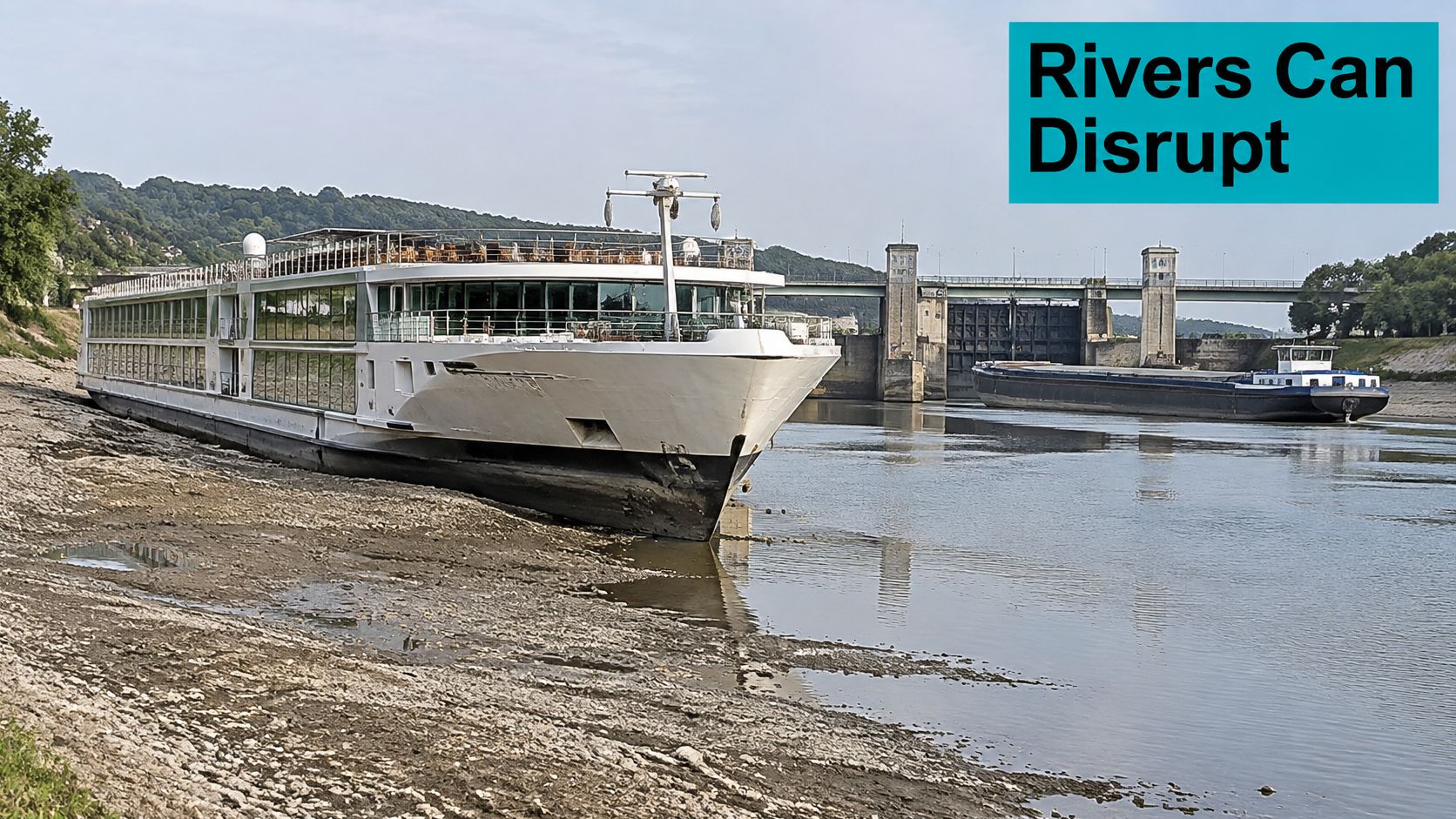
The Central Commission for the Navigation of the Rhine counted 1,217 vessels at Iffezheim in the first half of 2025, up 7.6% year over year, and 1,736 at Jochenstein, up 52.4%, with passenger counts there up 61.9%. Those figures point to heavier use of the same lock chambers, moorings and berthing space. The analytical question is not whether river ships are steady in normal conditions. It is how often the route itself changes when traffic, water levels or port capacity tighten.
Low water, flooding and lock delays matter more on rivers because the itinerary is built around a chain of towns and quays. Operators may bus passengers around a closed stretch, swap ports or keep everyone on board. Each option changes the value of the trip differently. A bus transfer preserves the cruise but weakens the promise of stepping directly into each town. A port swap may keep the sailing intact while removing the place that drove the booking. Staying aboard limits disruption, but it also turns a destination-rich day into a transit day.
Ocean cruises lose ports to storms and swells too. The usual substitute is another sea day rather than a coach between river towns, which can be less damaging if the ship, dining and onboard programme matter as much as the ports. It can be more damaging if one rare call was the reason for booking. Reliability, then, is itinerary-specific. A river route with frequent town access is more exposed to waterway conditions, while an ocean itinerary with several sea days already builds in tolerance for one missed port.
Score each itinerary: low-water season exposure, flood risk, lock bottlenecks, and the quality of the substitution if a stretch closes.
Ask the operator how often it altered a route during the month you plan to sail, and get the answer in writing before the final payment date. A truthful answer about a wet-season Rhine sailing tells you more than any brochure line about reliability.
Accessibility and Mobility Limits
The idea that a smaller ship is an easier ship doesn't survive contact with the evidence. A 2025 European river-cruise market survey reported that only 4% of operators considered their accessibility arrangements complete, while 73% described them as partial.
Partial is where the details decide the trip. A gangway that's gentle at normal water turns steep when the river drops, and cobblestones, locks and historic sites are as much of a barrier as the ship itself. Ocean cruises carry their own obstacles: tender ports where you board a small boat, long walks through terminals, and excursions built around coaches that may not kneel or take a wheelchair.
Get written answers to these before booking either format.
- Gangway and decks: ask for the gangway slope at expected water levels and whether a lift reaches every deck, including the sundeck.
- Cabin: confirm step-free entry, doorway width, grab rails and a roll-in shower, not just an "accessible" label.
- Shore excursions: ask which tours use step-free routes and which coaches have accessible lifts.
- Tender ports: get a straight answer on whether you can stay aboard on tender days and what the day looks like if you do.
- Written confirmation: keep it in an email, because crew and schedules change between booking and departure.
No standard comparison covers door widths, lift access, embarkation, tendering, coach transfers and excursion alternatives across both formats, so the checking falls to you. The format doesn't decide accessibility. The specific ship, dock and itinerary do.
Choose the Right Cruise for Your Trip
Match the traveler to the format, then verify the details that the format can't promise.
| Traveler | Better fit | Deciding factor |
|---|---|---|
| First-time cruiser who wants variety | Ocean | Many onboard venues and several sea days |
| Culture-focused traveler in Europe | River | Docks near historic town centers |
| Family with children | Ocean | Onboard family facilities and activities |
| Traveler with mobility needs | The specific ship and itinerary | Written answers on ramps, elevators and coach transfers |
| Repeat cruiser who wants a quieter trip | River | Smaller ship and fewer guests |
| Budget-focused traveler with many port days | Compare total cost | Price excursions, drinks and gratuities first |
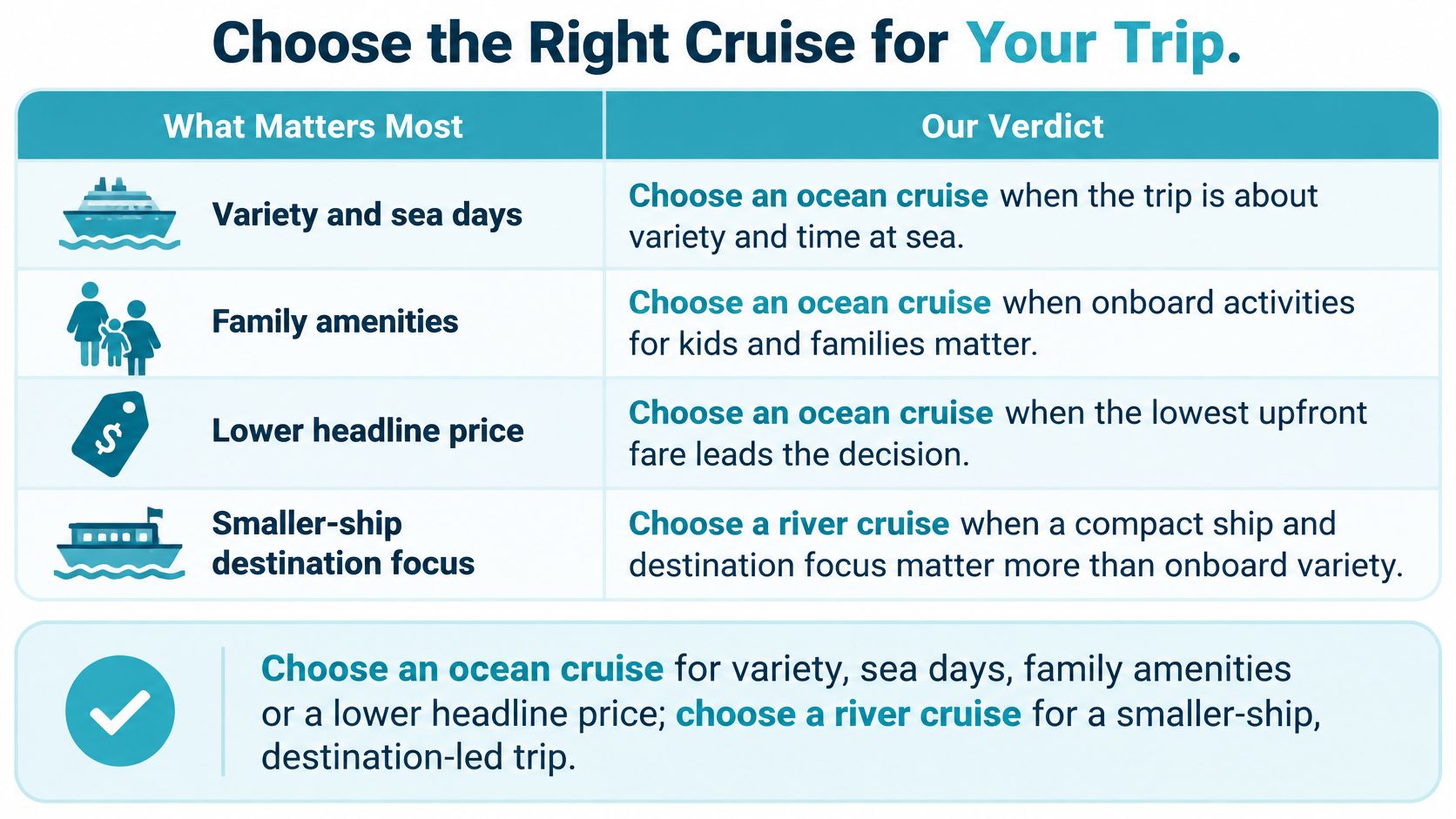
The rule under the table is short. Choose an ocean cruise when the trip is about variety, sea days, family amenities or a lower headline price. Choose a river cruise when it's about towns, culture and a short walk from the dock.
If you're leaning river, our guide to choosing a river cruise line covers which operators bundle excursions, drinks and gratuities and which charge them separately. Best Cruise Rates offers a free cruise quote for travelers who contact the company, and its advisors help with new bookings, pricing questions and planning guidance.
Then work through five steps in order. Shortlist two sailings of the same length and month, one per format. Price both with drinks, excursions, gratuities and transfers included. Request the water-level plan, lock contingency and accessibility answers in writing. Score both against the disruption test and the accessibility checklist. Book only after the written answers are in hand.
Best Cruise Rates puts river and ocean sailings from more than 40 cruise lines on one platform, so you can price a Rhine week against a Mediterranean loop with the same tools and see where the extras really sit. If you'd rather have a person run the comparison with you, its advisors handle new bookings, pricing questions and trip planning at no extra cost. Request a free cruise quote and start your search at Best Cruise Rates.
Ready to book your next cruise?
Compare 40+ cruise lines or call our specialists at 1-888-604-0279.