Which Deck Is Best on a Cruise Ship: Pick by Priority
The familiar advice to book low and midship is a useful starting point, not a complete answer. It won't tell you whether you'll hear pool chairs overhead, need repeated elevator trips, or enjoy the ocean view you paid for. Choosing which deck is best on a cruise ship means deciding which matters most to you: motion, noise, views, or access.
Table of Contents
- Quick Answer by Priority
- How Deck Position Shapes Motion and Seasickness
- Noise, Vibration and Sleep Across the Ship
- Views, Access and the Trade-Offs That Matter
- What Each Deck Choice Costs
- Choosing Your Deck and Booking the Right Cabin
Quick Answer by Priority
There's no single best deck, but a lower passenger cabin near the ship's midpoint is the most sensible default for travelers concerned about movement. Choose a different location when uninterrupted sleep, outdoor living, or accessible routes matter more.
Midship means the central part of the ship along its length, between the bow at the front and the stern at the back. It doesn't necessarily mean an interior cabin or a middle-height deck.
Best Deck Area by Traveler Priority
| Priority | Best deck area | Why it works | Trade-off |
|---|---|---|---|
| Least seasickness risk | Decks 2-4, near midship | Closer to the center of motion and nearer the waterline | Fewer views and less outdoor access |
| Balance of stability and views | Decks 5-7, near midship | Moderate movement with better sightlines | Some sway in rough water |
| Ocean views and balconies | Higher decks, near midship | Broad panoramas | Noticeable sway in rough weather |
| Quiet sleep | Interior midship cabin away from venues | Fewer nearby noise and vibration sources | Check the neighbors on the deck plan |
| Easy pool and outdoor access | Deck next to the main pool area | Short walks to sun areas | Noise and foot traffic, especially from above |
| Step-free access | Deck with elevator connections to dining and muster stations | Fewer transfers each day | Confirm lift access on the ship's plan |
Treat these as relative deck bands, not universal addresses. Ships use different numbering systems, and their restaurants, lifeboats, cabins, and outdoor spaces occupy different levels.
The important distinction is between a comfortable position and a promise of comfort. The Drake Passage passenger study indexed by PubMed found no statistically significant association between cabin location and motion sickness, so a favorable location shouldn't be sold as prevention.
Choose your nonnegotiable first. A beautiful balcony isn't a worthwhile upgrade if the location compromises the part of the trip you care about most.
For a family planning frequent pool visits, a short walk outdoors might outweigh an occasional busy corridor. For a light sleeper who turns in before evening entertainment ends, separation from public venues should take precedence over pool convenience.
Match your main priority to a row, then locate that area on the specific ship's official deck plan. Don't select a cabin from its deck number alone.
How Deck Position Shapes Motion and Seasickness
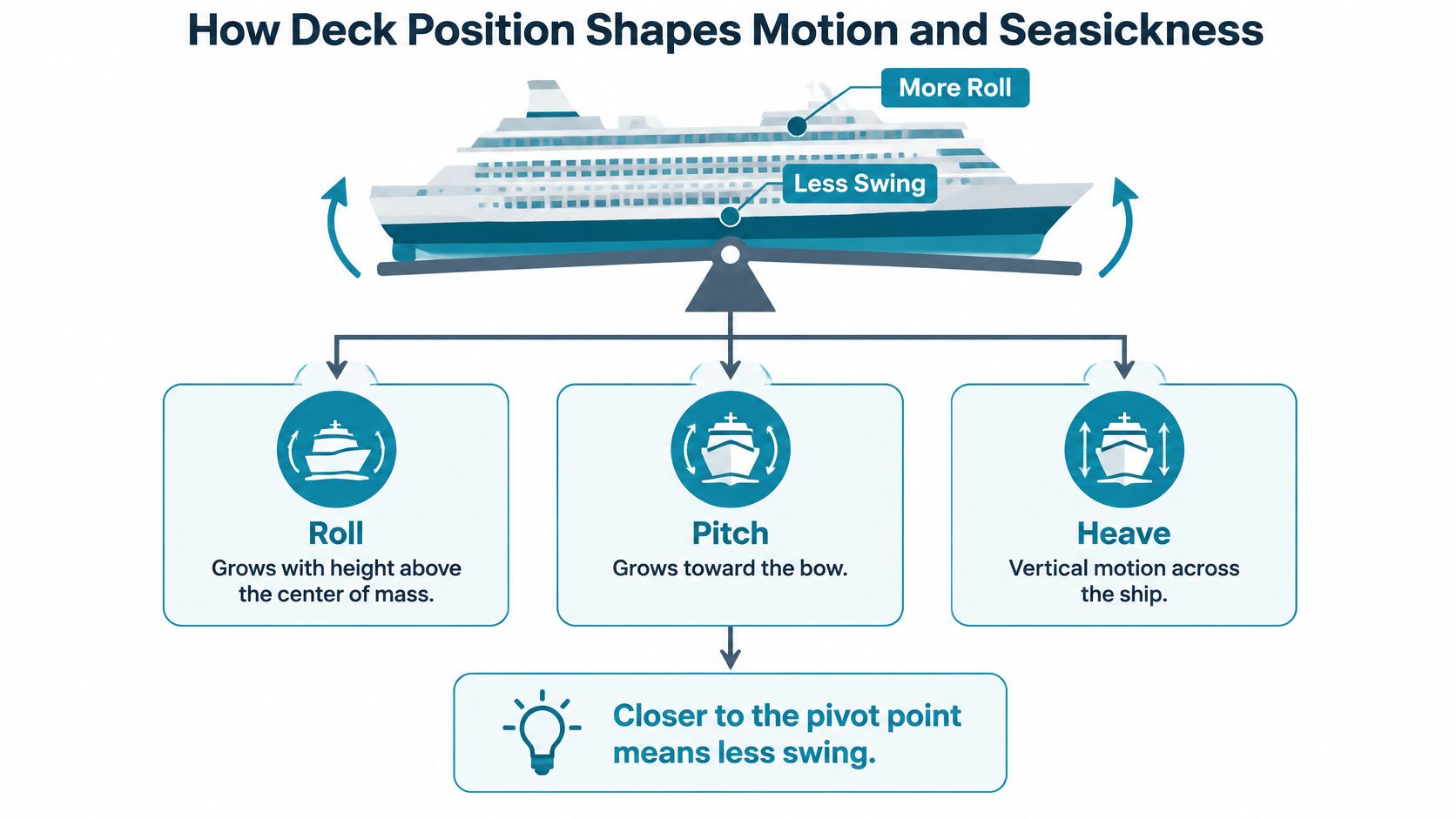
Think about sitting on a seesaw: near the pivot, you travel through a smaller arc than someone at the end. That's a useful analogy for cabin selection, although a ship moves in more directions than a playground seesaw.
Roll is side-to-side rotation, pitch is the bow and stern rising and falling, and heave is vertical movement. Higher locations can experience greater movement from roll, while cabins toward either end can experience more movement from pitch.
The diagram separates those movements and shows why a central location is a practical starting point.
How Deck Band and Position Feel at Sea
Cruisebound's deck guidance places decks 2-4 among the steadiest options, decks 5-7 between stability and views, and decks 12-16 or higher among those more likely to transmit noticeable sway in rough conditions.
| Zone | Typical motion | Views | Watch for |
|---|---|---|---|
| Lower passenger decks, midship | Usually the least angular movement | Lower-level outlooks or no window | Theaters or other public venues overhead |
| Middle passenger decks, midship | A compromise between movement and elevation | Balanced outlook | Sway in rough water |
| Upper passenger decks | More noticeable sway in rough seas | Broad panoramas | Reliance on elevators for lower-deck activities |
| Bow or stern, any deck | More pitching than near the midpoint | Forward-facing or wake-facing outlooks where available | Thruster noise forward or propulsion vibration aft |
Less Movement Doesn't Guarantee Less Sickness
The findings are more nuanced than the seesaw analogy suggests. A Journal of Travel Medicine study of 260 passengers crossing the Drake Passage found no statistically significant association between cabin location and motion-sickness likelihood; age and sex were associated with risk, while passengers able to lie supine had substantially lower risk.
That doesn't make cabin position irrelevant. It means reducing motion exposure and preventing symptoms aren't the same thing. Weather, route, ship design, stabilizer performance, and individual susceptibility can outweigh the difference between neighboring decks.
A window also introduces a separate consideration. The PLOS ONE study on horizon viewing and postural stability supports the value of a visible horizon for reducing postural sway, rather than proving that a window cabin prevents seasickness.
For a motion-sensitive traveler, a practical plan combines a lower-central cabin with manageable access to a clear horizon and a bed for resting. Don't assume a high observation lounge or bow balcony will be the most comfortable place during rough weather.
Before booking, check the itinerary for exposed crossings, confirm whether the ship has stabilizers, and locate the cabin relative to the midpoint. Ask about nearby machinery separately, since less movement doesn't necessarily mean less vibration.
Noise, Vibration and Sleep Across the Ship
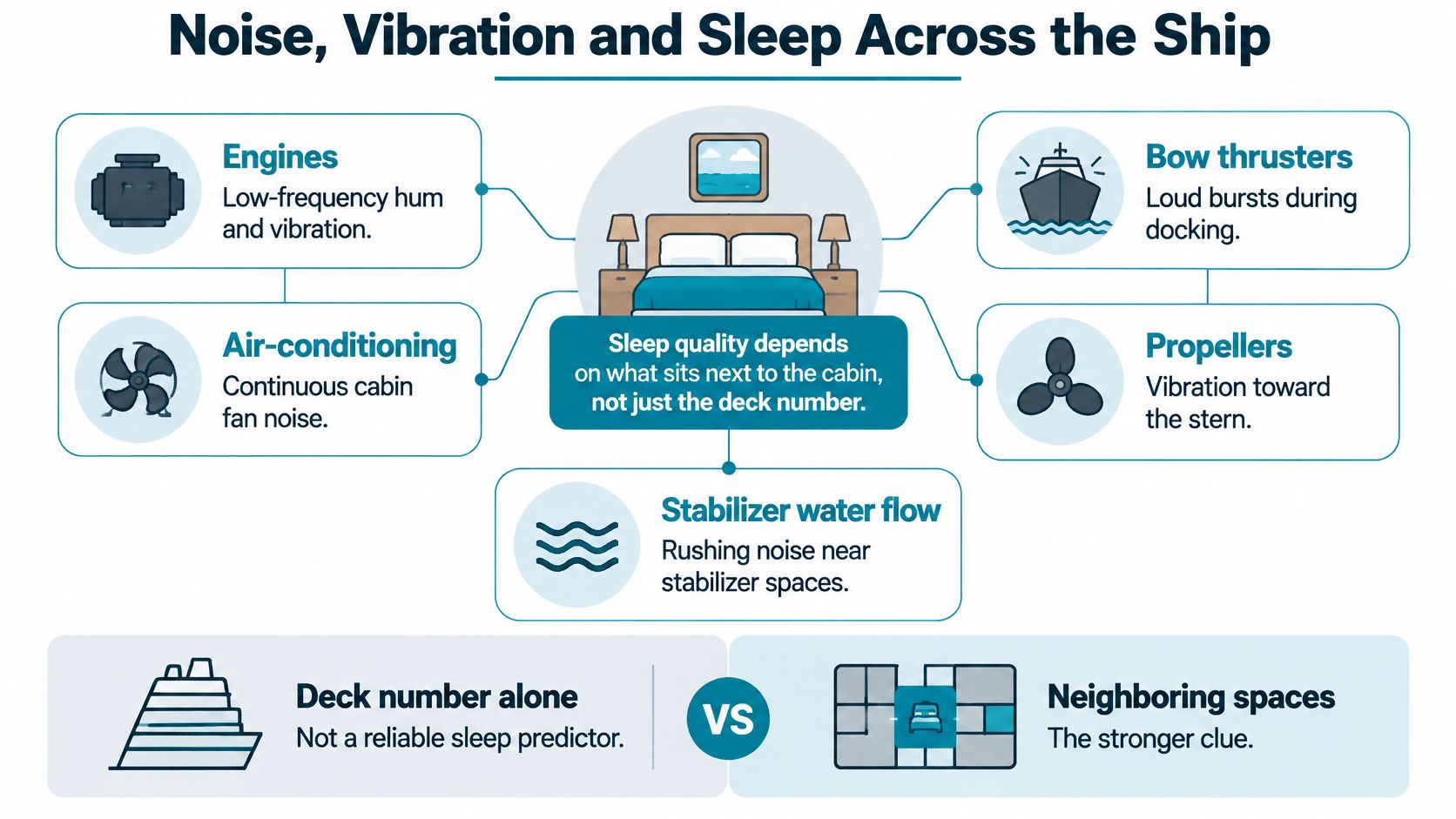
A cabin's neighbors often tell you more about sleep quality than its deck label. A centrally positioned room can still be a poor choice if it shares a boundary with a busy entertainment space.
Shipboard sound comes from engines, air-conditioning, bow thrusters, propellers, stabilizer water flow, structural creaking, and passenger movement. Some sources are continuous; others become noticeable during docking, performances, or outdoor-deck setup.
This infographic identifies the machinery sources worth checking around a candidate cabin.
Measured Shipboard Noise by Area
A 2025 comparative shipboard measurement study recorded approximately 63-65 dB(A) in navigation-bridge and crew-rest areas, 75-80 dB(A) in some passenger saloons, and roughly 118-120 dB(A) in engine-room locations.
| Area | Measured noise | What it means for you |
|---|---|---|
| Navigation bridge and crew rest | About 63-65 dB(A) | Quietest of these measured areas, not a passenger-cabin benchmark |
| Some passenger saloons | About 75-80 dB(A) | Check acoustic separation from public rooms |
| Engine room | About 118-120 dB(A) | Machinery location matters, but this isn't a cabin measurement |
These readings describe the measured spaces, not the sound level inside an adjacent cabin. Insulation and structural transmission determine how much reaches a bedroom, so don't interpret an engine-room reading as passenger exposure.
Check Above, Below and Beside
For sleep, favor an interior midship location with cabins or corridors separating it from public venues. Avoid rooms directly beneath open pool areas or above theaters and nightclubs when quiet is your priority.
A cabin surrounded by other cabins is usually a better starting point than a cabin chosen only because it's on a desirable deck.
Older or smaller ships may also transmit vibration and creaking that a simple deck-height comparison won't reveal. Use cruise cabin reviews to investigate specific rooms, distinguishing recurring location complaints from isolated disturbances.
Use the video alongside the deck plan when assessing your shortlist.
Before committing, identify the spaces directly above, below, and alongside the room. A venue's operating hours matter as much as its name when your bedtime is early.
Views, Access and the Trade-Offs That Matter
A higher cabin can make the ocean feel like part of your living space. A lower cabin may suit someone who spends little time in the room and values a more settled position.
Neither choice automatically makes daily life easier. A good view and a good route through the ship are separate benefits, and you should evaluate them separately.
Compare the View You'll Actually Use
If you expect to read outside each morning, balcony usability deserves attention alongside elevation. Check whether the view is obstructed, whether the balcony faces a public area, and what you can see while seated.
If you mainly want scenery during sailaways, convenient access to a public outdoor deck may meet your needs without making the cabin view your main selection criterion. Compare the layouts in the cruise cabin types guide before treating every ocean-facing room as equivalent.
| Your daily routine | Favor this relationship |
|---|---|
| Frequent pool visits | A short, manageable route to the pool |
| Dining and evening shows | Convenient connections to restaurants and theaters |
| Quiet time on a private balcony | A suitable outlook with separation from busy public areas |
| Use of a walker or wheelchair | Verified step-free routes to essential facilities |
Choose Routes, Not Just Elevator Symbols
For travelers with mobility limitations, the best deck minimizes unavoidable transfers. A low cabin can be inconvenient if dining requires repeated elevator trips, while a high cabin may depend heavily on lifts during busy periods.
The U.S. Access Board's passenger-vessel accessibility assessment identifies interdeck access, gangways, door widths, passageways, deck-edge transitions, vessel motion, and emergency assistance as important concerns. An accessible cabin alone doesn't establish that every desired destination has a usable route.
Check elevator stops, thresholds, passageway widths, accessible-cabin availability, and routes to dining and medical facilities. Some upper sun decks may not be accessible, and elevators don't necessarily reach every outdoor space.
Route test: Write down the places you'll use each day, then trace the complete journey from each candidate cabin.
Include the return trip when you may be tired, not just the outward walk. Confirm muster arrangements and emergency assistance with the cruise line, because normal passenger elevators aren't a substitute for an emergency plan.
For access-related planning questions, our cruise specialists can help you identify what needs confirmation before you book. Describe your actual mobility needs rather than asking only whether a ship is accessible.
What Each Deck Choice Costs
Compare cabin categories before comparing deck premiums. A balcony room and an interior room aren't equivalent purchases, even if they occupy neighboring decks.
Your live quote is the useful evidence for price. Sailing dates, cabin category, occupancy, availability, and fare conditions can change the result, so don't assume a higher deck always costs more or a lower deck always saves money.
Separate the Room From the Position
Interior cabins are a useful starting point for a budget comparison if you don't need daylight or private outdoor space. For quiet sleep, evaluate their surroundings rather than assuming that no window means no disturbance.
An oceanview cabin adds a window, while a balcony adds private outdoor space. Suites may add room and amenities, but none of those category changes automatically provides a better location for your priorities.
| Comparison | Keep consistent | What to assess |
|---|---|---|
| Same category on different decks | Sailing, occupancy and fare terms | Whether location justifies any price difference |
| Interior versus oceanview | Comparable room features | Whether daylight is worth the quoted upgrade |
| Oceanview versus balcony | Sailing and included benefits | Whether you'll use private outdoor space |
| Standard versus accessible cabin | Required access features | Suitability first, not a presumed price relationship |
Pay for a Benefit You'll Use
Start with the cabin prices guide, then compare current quotes for suitable rooms. Note the total fare and conditions beside each cabin number so a promotion doesn't obscure a location compromise.
- Set the category budget. Decide which room features you need before choosing an elevation.
- Compare like for like. Check the same category across available deck bands.
- Test the cheaper option. Savings only help if the cabin still meets your sleep, motion, or access requirements.
- Secure essential features early. If you require an accessible layout or a specific location, check availability before making other travel commitments.
Don't pay a premium merely for the word higher. Pay for a confirmed feature or location benefit that improves your trip.
Choosing Your Deck and Booking the Right Cabin
The most useful shortlist contains specific cabin numbers, not broad preferences such as somewhere in the middle. That lets you compare real surroundings, routes, and views instead of relying on a category description.
Keep the official ship plan open while you make your notes. Confirm that it matches the vessel and sailing you're considering, especially if the cruise line shows different layouts for different operating periods.
Use a simple written comparison to keep attractive photos from outweighing practical needs.
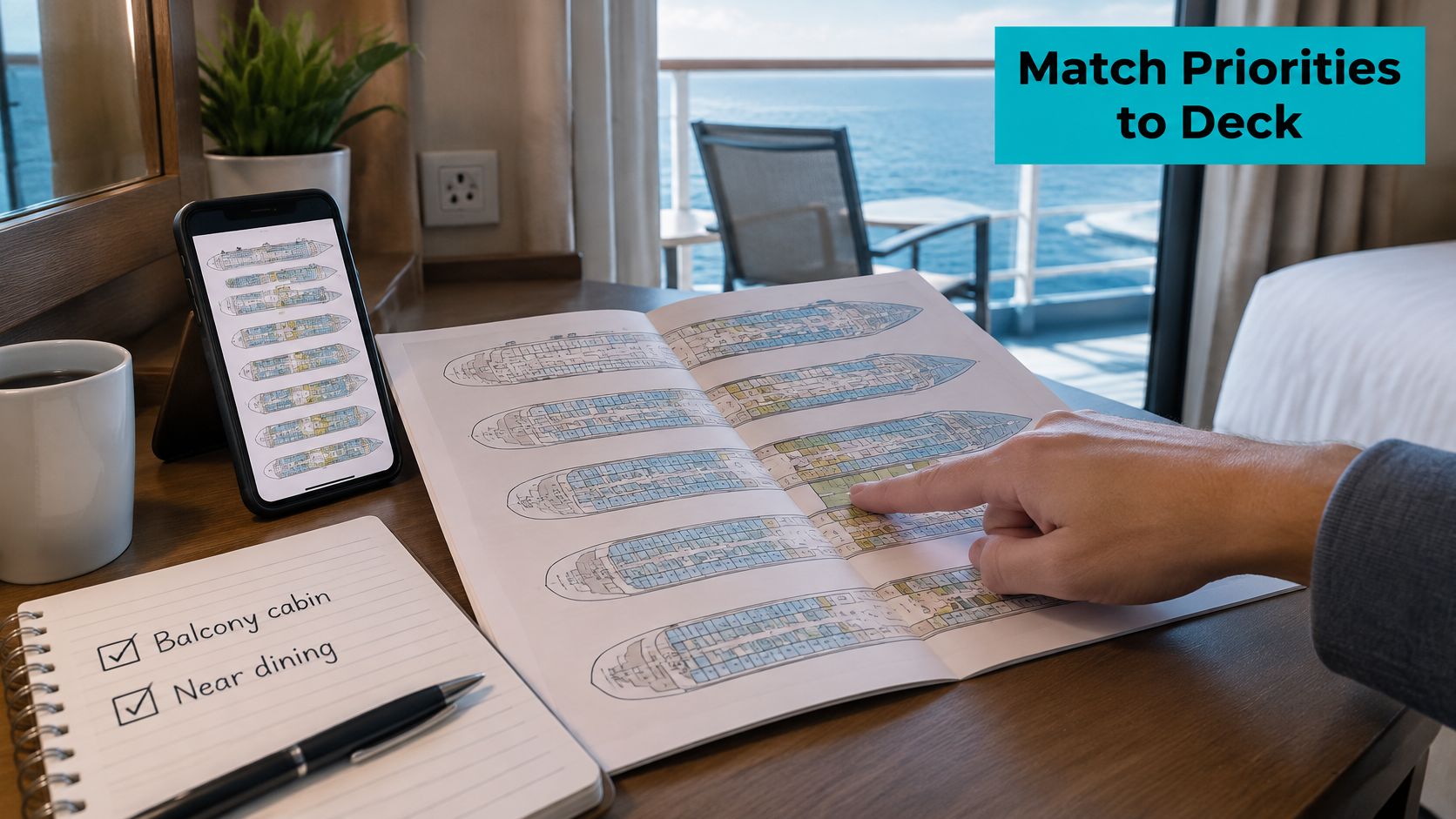
Build a Cabin Shortlist You Can Defend
Rank your priorities. Put stability, sleep, views, and access in order. Decide which requirement would make you reject an otherwise appealing room.
Find the matching deck area, then locate the ship's longitudinal midpoint. Don't assume that the middle elevator bank marks the exact center.
Inspect each cabin's surroundings. Read the plans for neighboring decks as well as the cabin deck. Flag public venues, outdoor seating, service spaces, and busy access points.
Trace the journeys you expect to make regularly. If mobility is a concern, verify the entire accessible route and emergency arrangements rather than relying on a nearby elevator icon.
Compare the finalists side by side. Give each cabin a short note for movement exposure, likely disturbance, usable outlook, and daily convenience. Mark unresolved questions instead of filling them with assumptions.
Review the fare and booking terms only after the cabins pass your essential requirements. An attractive price shouldn't erase a known access problem or an unwanted venue overhead.
Match the Cabin to the Sailing
At Best Cruise Rates, our comparison tool lets you compare up to six sailings side by side for rates, itineraries, ship profiles, and more. Use that broader comparison when the ship's layout matters more than a particular departure.
Our cruise experts can discuss planning and pricing questions at 1-888-604-0279, and we offer a free cruise quote to people who contact us. Have your shortlisted ships, cabin numbers, and nonnegotiable needs ready for a more focused conversation.
Deck choice reduces avoidable compromises; it doesn't guarantee comfort. Choose the cabin whose trade-offs you understand and can accept, rather than chasing a deck number that sounds universally best.
Visit Best Cruise Rates to compare sailings and request a free cruise quote for a trip that fits your cabin priorities. Bring your shortlisted cabin numbers and your main concern, whether that's motion, quiet sleep, views, or step-free access, so our cruise specialists can help you assess the options before booking.
Ready to book your next cruise?
Compare 40+ cruise lines or call our specialists at 1-888-604-0279.