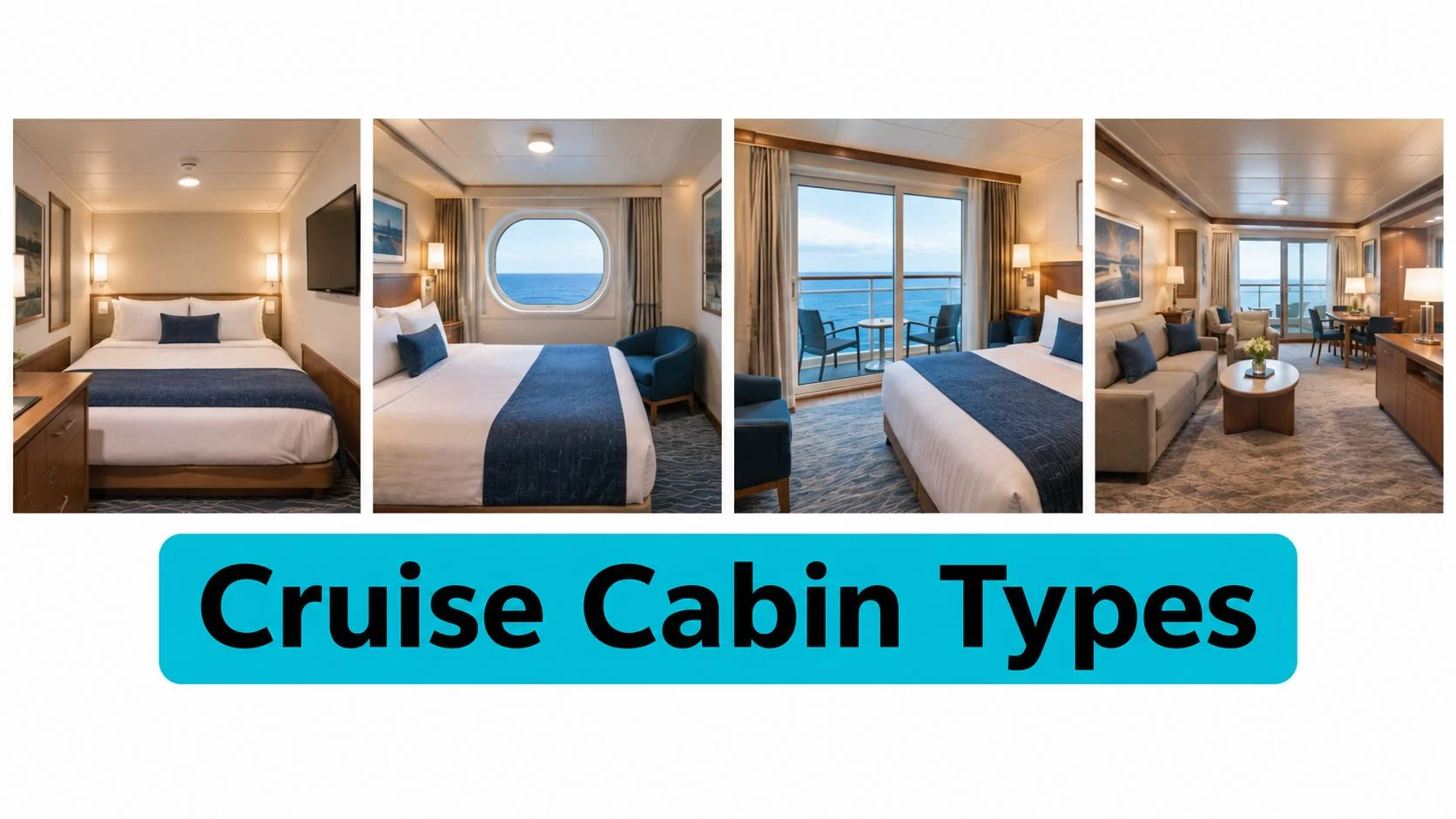
8 Cruise Cabin Reviews to Read Before You Book in 2027
You've found a cabin that looks right: a comfortable bed, a sunny balcony, and a fare you can live with. Say you're booking as a couple, and the photographs settle it. Then you board and discover that the wall behind the bed adjoins a laundry room, while a lifeboat blocks the downward view from your balcony.
The room might match its category description perfectly. It still isn't the room you thought you were buying.
Brochure photographs show furnishings, not the full experience. They won't tell you whether chairs scrape overhead before breakfast, whether the wardrobe rattles during port arrivals, or whether opening the sofa bed blocks the bathroom. Cruise cabin reviews help you investigate those details before you pay.
Read for the details you can verify
The most useful approach combines review sources, including Cruise Critic, CruiseMapper, and TripAdvisor, with feedback about location, interiors, balconies, suites, and family accommodation. Don't look for a universally perfect cabin. Look for evidence that a particular room fits how you sleep, move, pack, and spend your time.
Keep the ship's current official deck plan open alongside each review. Match the cabin number, inspect what's beside it and on neighboring decks, and separate documented problems from personal preferences.
Table of Contents
- Read for the details you can verify
- 1. Cruise Critic Cabin Reviews
- 2. CruiseMapper Ship Deck Plans and Cabin Reviews
- 3. TripAdvisor Cruise Cabin Reviews
- 4. Cabin Location and Deck Reviews
- 5. Interior Cabin and Virtual Balcony Reviews
- 6. Balcony Cabin Reviews
- 7. Suite and Luxury Cabin Reviews
- 8. Family and Connecting Cabin Reviews
- Where to Find Cruise Cabin Reviews and What Each Source Reveals
- Turn Cabin Reviews Into a Confident Booking Decision
1. Cruise Critic Cabin Reviews
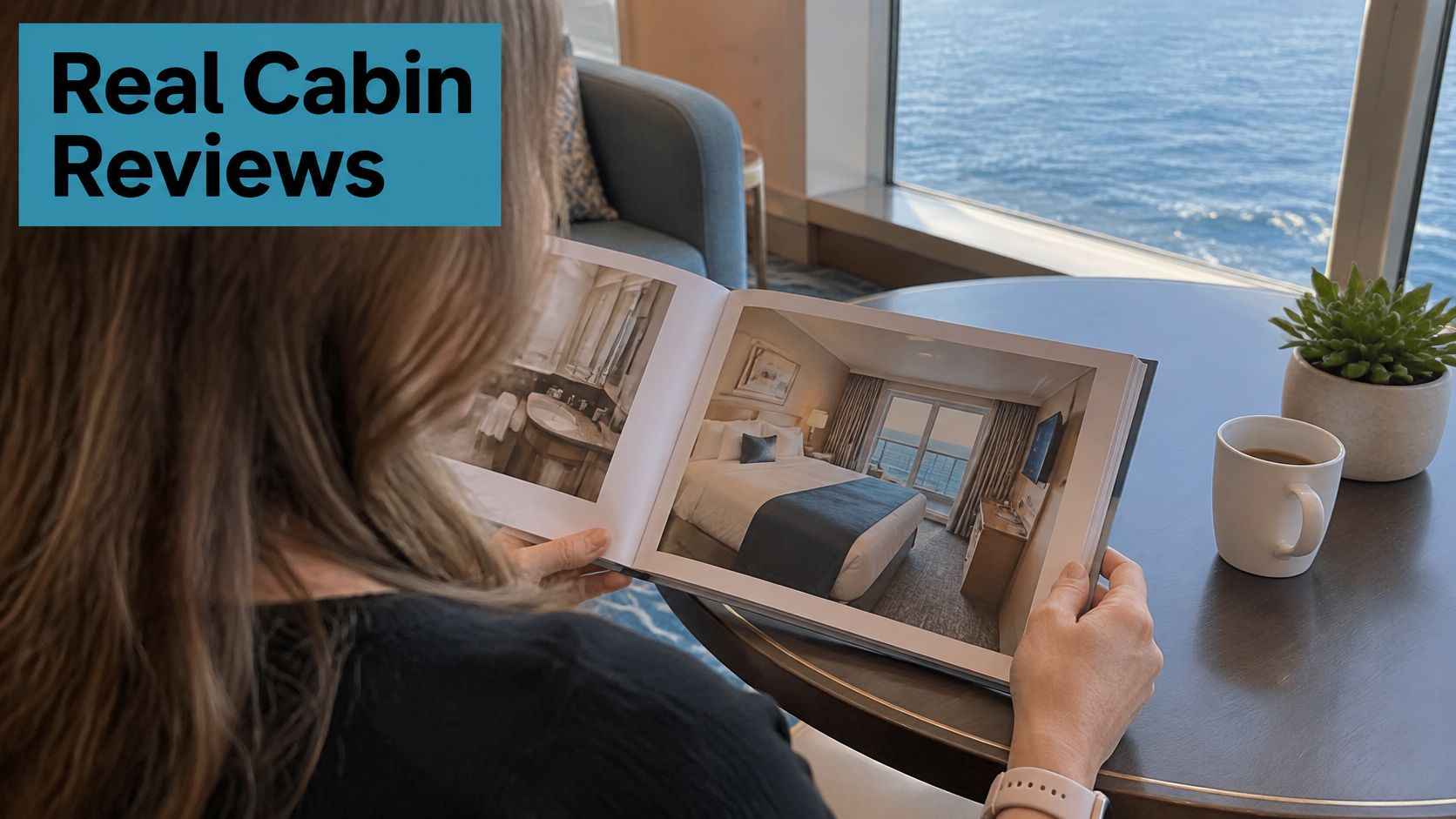
Start with the exact ship and cabin number, not just the cabin category. Cruise Critic's reviews and community discussions are useful places to look for the unglamorous details: drawers that won't open beside the bed, balcony furniture that leaves little walking space, or noise from a nearby service door.
The community's long history makes it useful for comparing accounts rather than relying on a single verdict. TripAdvisor's account of Cruise Critic identifies it as an early consumer cruise site with an established review community, but longevity doesn't make every individual comment reliable.
Look for agreement, not identical ratings
Say you're considering a balcony cabin for breakfast outdoors. A reviewer calling the balcony small tells you little; a photograph showing chairs pressed against the railing tells you much more. Another account describing difficulty opening the door around the furniture strengthens the warning.
Use a focused search:
- Exact identity: Match the ship, cabin number, and category. A similarly numbered room on a sister ship isn't conclusive evidence.
- Sailing context: Favor recent accounts, particularly when refurbishment or maintenance could have changed the room.
- Repeated symptoms: Look for independent descriptions of the same rattle, odor, temperature problem, or storage limitation.
- Location clues: Check references to laundry rooms, crew doors, and elevator lobbies against the official plan.
A review saying the cabin was quiet is useful only within limits. Did the reviewer sleep early, spend evenings elsewhere, or sail without rough weather? Treat missing context as an unanswered question, not proof that a problem doesn't exist.
2. CruiseMapper Ship Deck Plans and Cabin Reviews
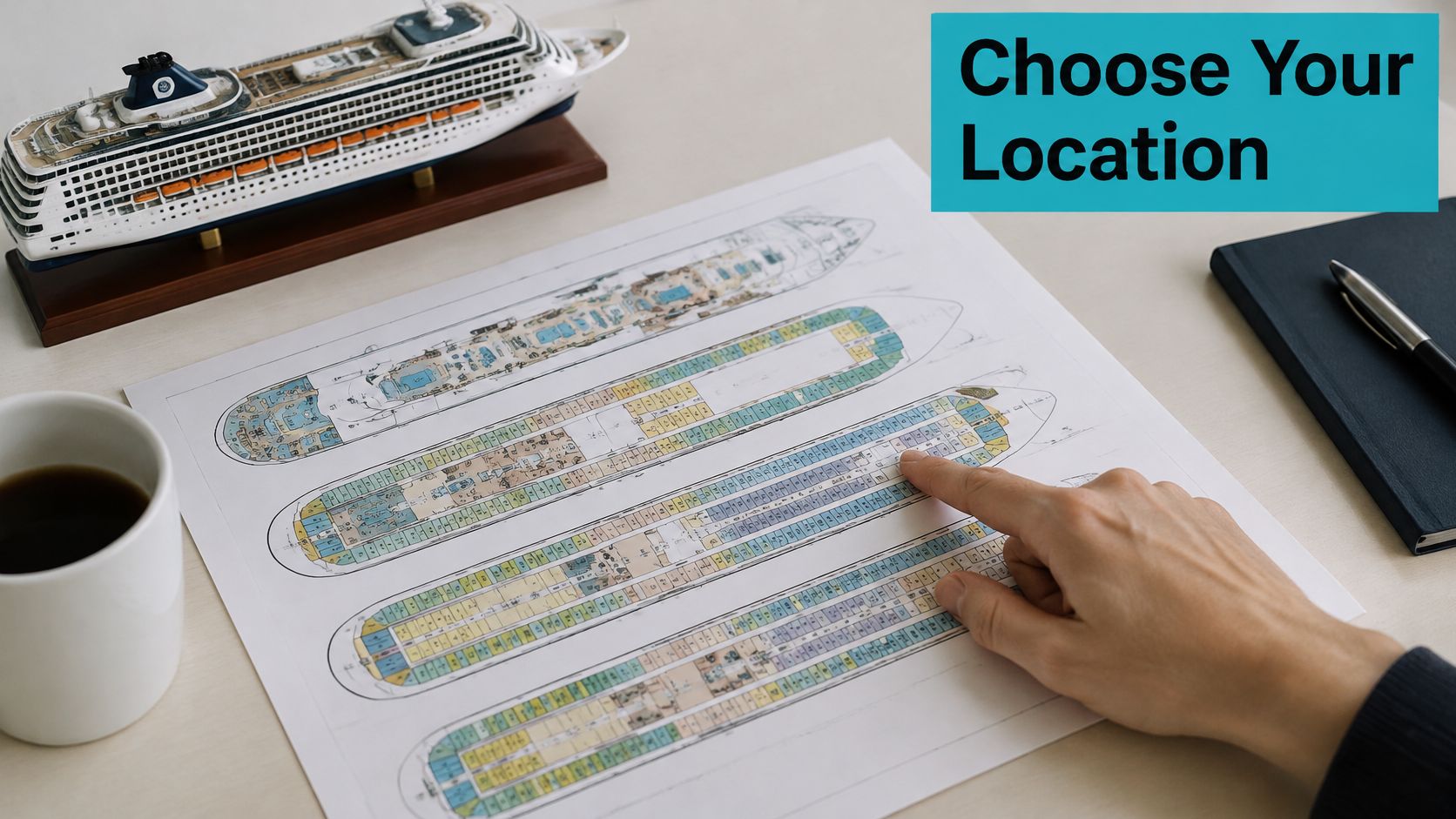
A cabin can look conveniently close to the pool until you notice it's directly beneath the pool furniture. CruiseMapper's deck layouts and cabin information are useful for investigating that sort of location trade-off, especially when a review mentions a venue without explaining where it sits.
Use the site as a navigation aid, then confirm the layout with the cruise line's current official deck plan. Don't assume an older saved diagram reflects the arrangement offered for your sailing.
Check above, below, and along the corridor
Find the cabin, then align neighboring decks using staircases and elevator shafts as reference points. Don't judge vertical position by where a cabin appears on your screen, since diagrams can use different scales or spacing.
- Above: Look for pool seating, buffet preparation areas, sports facilities, and entertainment spaces.
- Below: Check theaters, lounges, restaurants, and other venues whose activity could matter during your sleeping hours.
- Beside: Identify connecting doors, stair lobbies, laundries, service areas, and unexplained blank spaces.
Say you're choosing between similar balcony cabins. The room beneath the buffet offers a short trip to breakfast; the room surrounded by accommodation may be a better starting point for protecting sleep. Neither location guarantees a particular experience, but the plans show which questions deserve attention.
Practical rule: A blank space on a deck plan is an unknown, not evidence of silence.
For mobility, trace the actual walking route rather than estimating straight-line distance. A nearby dining room may require a different elevator bank or a detour around spaces you can't walk through. Check those routes before trading convenience for a supposedly quieter corridor.
3. TripAdvisor Cruise Cabin Reviews
Separate the cabin verdict from the holiday verdict. A traveler may dislike the dining, weather, or embarkation process while describing a comfortable room. Another may love the cruise despite a bathroom that never drained properly.
TripAdvisor's ship reviews can help you identify recurring comments about housekeeping, maintenance, bedding, and storage. Read the accommodation details rather than treating the overall rating as a cabin score.
That distinction has a sound basis: in a peer-reviewed study of North American cruise passengers, cabin cleanliness received the highest ranking among the cleanliness-related factors evaluated. For booking purposes, specific descriptions of room condition deserve more attention than a general statement that the ship was lovely.
Sort complaints by what caused them
Keep a short note for each relevant review:
- Housekeeping: Missed cleaning, replacement towels, bathroom attention, or unresolved requests.
- Maintenance: Leaks, damaged fittings, unreliable temperature control, or persistent drainage problems.
- Layout: Awkward wardrobe access, limited shelves, or furniture blocking a walkway.
- Preference: Firm mattresses, subdued décor, or a cabin that felt too enclosed.
Suppose you're considering an interior category on a Carnival ship. Repeated comments about limited drawer space are worth checking in photographs, especially if you pack folded clothing rather than hanging outfits. A complaint that the room felt dark may describe a feature you already accept.
Don't assume broad category feedback proves anything about a particular cabin's noise exposure. Use TripAdvisor to identify the questions, then use cabin-number accounts and the deck plan to investigate them. If reviewers don't identify their accommodation clearly, give their layout claims less weight.
4. Cabin Location and Deck Reviews
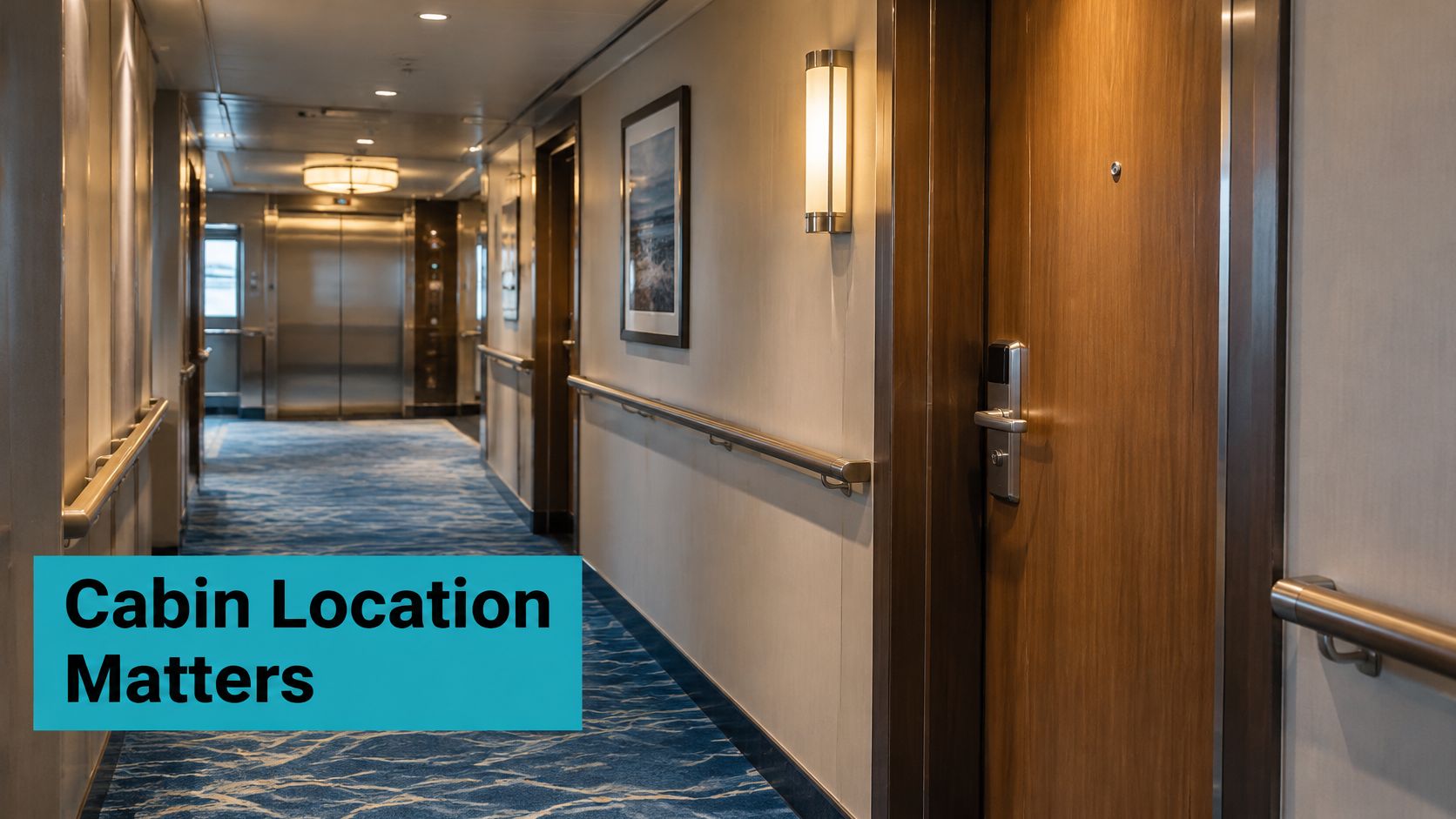
Location reviews are most useful when they describe what happened, when it happened, and how long it lasted. Occasional conversation outside the door is different from bass through the floor each evening or vibration during port maneuvers.
Cruise Critic's guide to cabins to avoid flags location concerns around public venues and operational areas. Use those warnings to investigate a room, not to declare every cabin near an elevator or beneath a restaurant unsuitable.
Match the risk to your routine
For motion sensitivity, lower, midship accommodation is generally the better starting point than the ship's forward or aft extremes. It isn't a promise of motion-free sleep, and a reviewer's calm voyage doesn't predict your sea conditions.
Noise requires a different assessment:
- Early-morning disturbance: Look for pool-chair movement, cleaning activity, and breakfast-area preparation.
- Late-night disturbance: Investigate entertainment venues, busy corridor routes, and nearby gathering spaces.
- Arrival-related vibration: Read for reports tied to docking rather than vague descriptions of engine noise.
- Guest noise: Distinguish a noisy neighbor on a particular sailing from recurring operational activity.
Say you turn in early while your partner sleeps late. A cabin near evening entertainment could affect you; a room beneath outdoor seating could affect your partner. The better choice depends on which disturbance overlaps your actual sleeping hours.
The best location isn't the one with the most enthusiastic reviews. It's the one whose likely disadvantages you can comfortably accept.
Don't automatically reject elevator proximity. A shorter walk can be valuable for someone with fatigue or limited mobility. Check whether the cabin opens directly toward the lobby or sits farther along a separated corridor before deciding.
5. Interior Cabin and Virtual Balcony Reviews
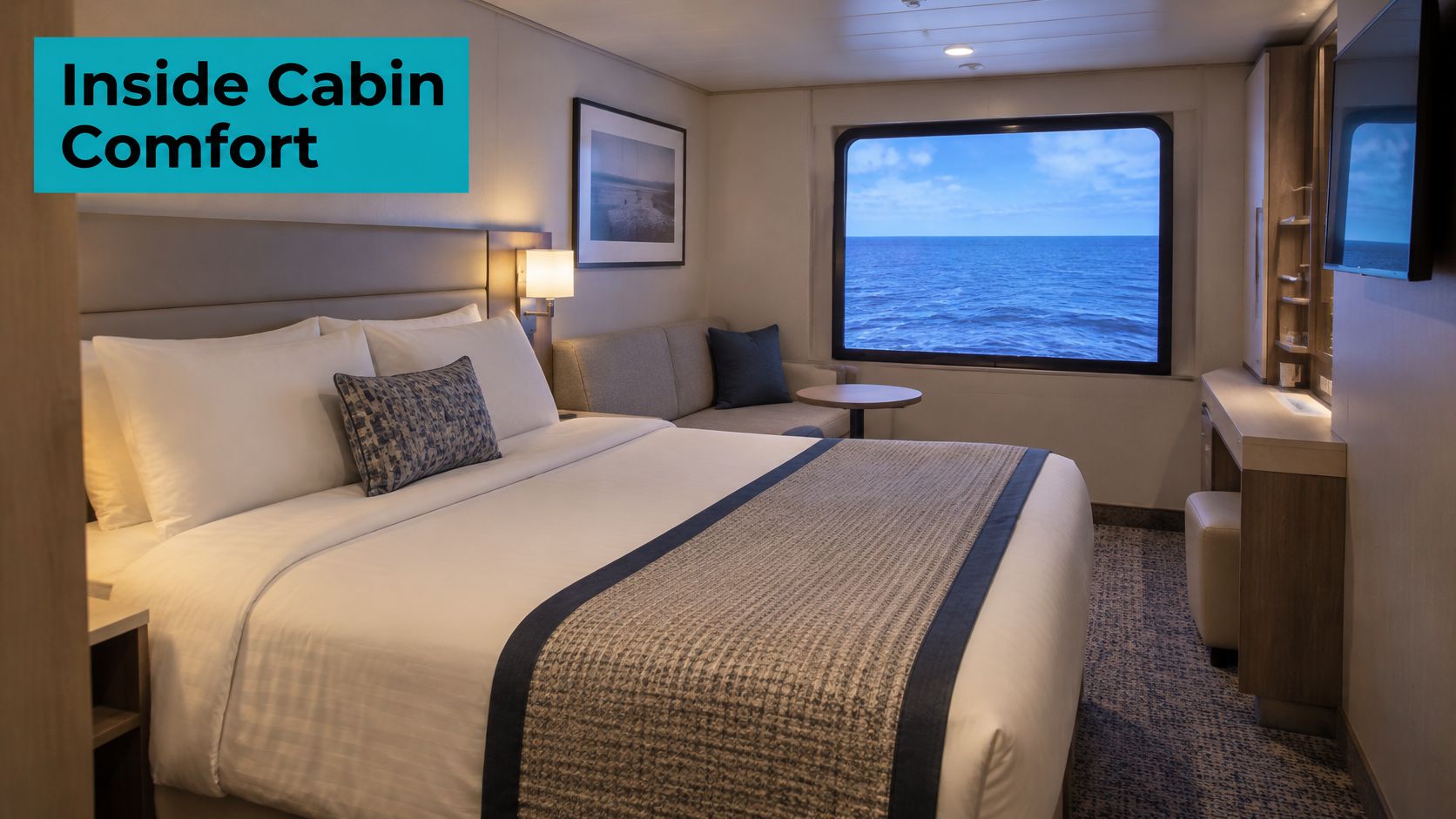
An interior cabin can work well if you use the room mainly to shower, change, and sleep. It's a less convincing choice if you expect to read there through the afternoon or need daylight to feel comfortable.
Don't reduce the decision to window versus no window. A study of cruise passengers' onboard environments found that sensory and environmental conditions, including sound, lighting, temperature, air quality, and layout, were significantly related to experience and satisfaction. Those are useful prompts for reading interior cruise cabin reviews.
Check the room with the lights off
For virtual balcony accommodation, verify the specific feature on the ship you're booking. Ask whether the display uses a live external view, how brightness is controlled, and whether you can turn it off independently.
A screen can provide a visual connection to the outside. It doesn't provide fresh air or natural daylight.
- Lighting: Look for bedside reading lights, bathroom light spill, and switches reachable from bed.
- Ventilation: Read for persistent stuffiness, odors, or temperature settings that didn't respond.
- Storage: Check hanging space, drawers, bedside surfaces, and room for empty luggage.
- Bed access: Look at the walking space with beds arranged the way you'll use them.
Say you're choosing a Royal Caribbean virtual balcony cabin because you like sleeping in darkness but dislike a blank wall during the day. That can be a sensible compromise if reviewers confirm that the screen controls suit you.
Don't choose an elevator-adjacent interior solely for convenience. Apply the same corridor and neighboring-deck checks you'd use for a balcony or suite. Removing the window doesn't remove location-related noise.
6. Balcony Cabin Reviews
The most useful balcony photograph is often taken sitting down, not standing at the railing. It shows whether you'll see the sea from the chair, how much the railing interrupts the view, and whether surrounding structures dominate the space.
Read balcony reviews for usability rather than just size. A deep balcony with awkward furniture or little privacy may suit you less than a smaller, sheltered space with a clear seated view.
Use this cabin video alongside ship-specific photographs, not as proof of the layout you'll receive.
Separate different kinds of obstruction
A lifeboat below the railing might interrupt the downward view without blocking the horizon. Equipment at eye level creates a different compromise, while an overhang can affect sunlight without obstructing the outward view.
Check these details before paying an upgrade:
- Sight lines: Compare seated views, standing views, and the view looking directly down.
- Privacy: Look for overlooking public decks, stepped balconies, and gaps around partitions.
- Exposure: Read descriptions of wind, shade, rain protection, and whether furniture stayed usable underway.
- Door access: Check thresholds, opening clearance, and the route around chairs.
Say you're booking Alaska because you want to watch the scenery privately. Shelter and comfortable seating may matter more than a balcony that looks expansive in a promotional image.
Higher isn't automatically better. A higher deck can change the view, but you still need to investigate overhead venues, exposure, and motion. Compare the actual cabin positions rather than assuming a more expensive room deserves a premium.
Finally, confirm the cruise line's obstruction description for the exact cabin. A reviewer's acceptable compromise might be the feature you most want to avoid.
7. Suite and Luxury Cabin Reviews
A suite should solve a problem you have. That might mean separate sleeping space, a bathroom you can use comfortably, or a living area that remains accessible after someone goes to bed. Extra floor space alone doesn't tell you whether the upgrade works.
Don't let enthusiastic descriptions of service distract you from maintenance and cleanliness. An analysis of luxury-cruise passenger comments identified cleanliness, spaciousness, bed quality, balcony condition, and room facilities as important cabin-satisfaction factors. Premium surroundings still need to function properly.
Separate physical benefits from service benefits
Read suite reviews with different questions in mind. First, does the room provide useful separation, storage, seating, and bathroom access? Then check which additional services belong to the exact category and fare you're considering.
Look closely at phrases such as separate living area. That could mean a room with a closing door or a sofa beyond a partial divider. Photographs taken toward the bedroom are more revealing than a wide-angle image taken from it.
Upgrade test: Pay for the feature you'll use, not the category name you'll enjoy saying.
Suppose you're considering a Celebrity Cruises suite because your partner reads late while you sleep. Verify that the layout provides meaningful light and sound separation before assigning value to that extra space. A larger open room may not fix your problem.
For perks, distinguish embarkation assistance from arrangements for leaving the ship in port. Don't assume that lounge access, dining privileges, drinks, or dedicated staff described in an older review apply to your booking.
Suite location still matters. An impressive forward or aft room can involve trade-offs in motion, walking distance, or exposure that you wouldn't accept in a standard cabin.
8. Family and Connecting Cabin Reviews
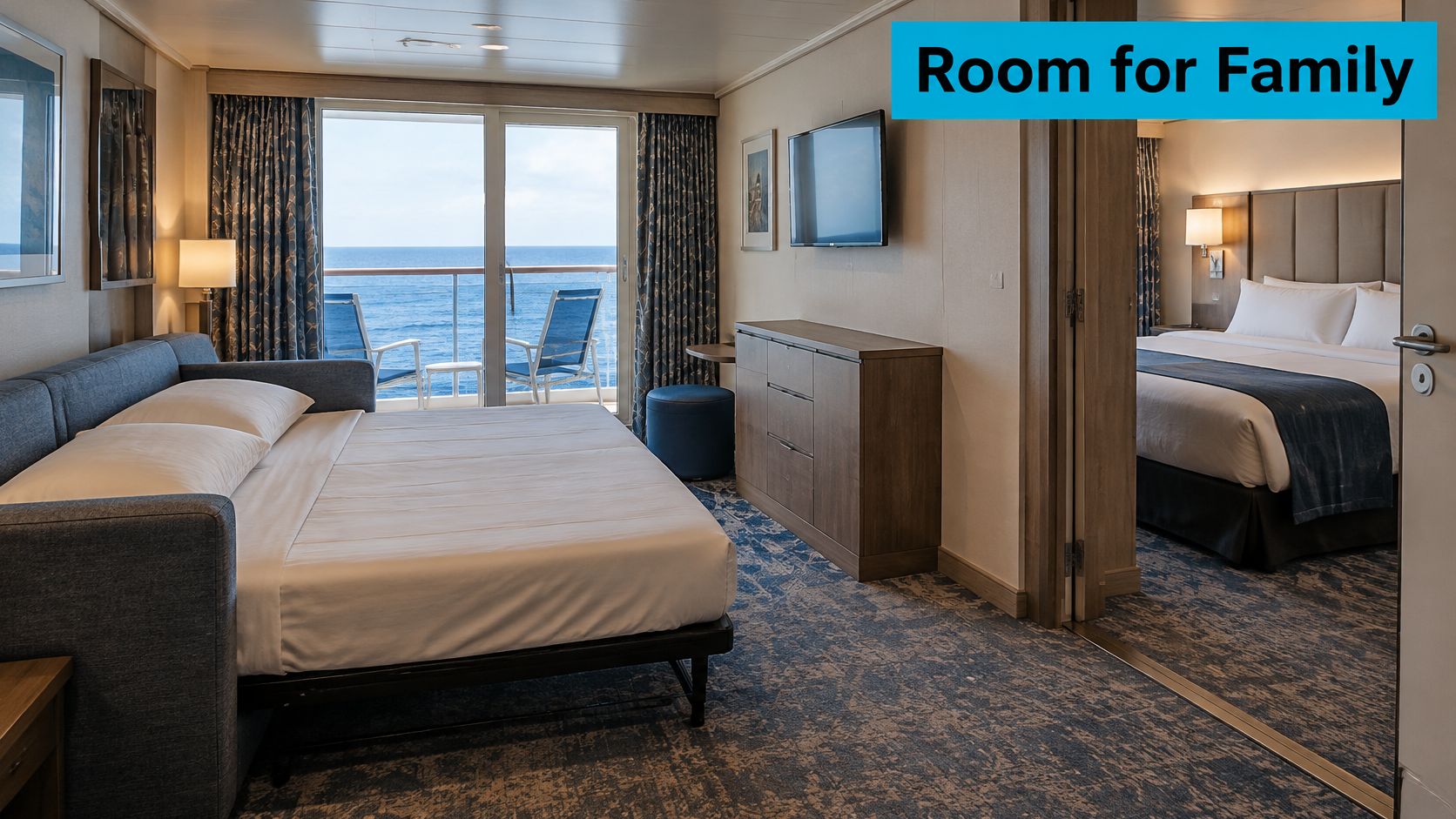
A family cabin needs to work after the extra beds are opened. Daytime photographs can hide the most important compromises: a sofa bed across the walkway, ladders beside the bathroom door, or luggage occupying the only clear floor space.
For connecting accommodation, confirm that the rooms have an internal connecting door. Adjacent cabins aren't necessarily connected, and balcony-divider arrangements aren't a substitute for verifying the internal layout and applicable rules.
Follow the nighttime route
Say you're traveling with teenagers and a grandparent who uses a mobility aid. Separate sleeping areas may help, but the arrangement still needs usable bathroom access, somewhere to store the aid, and a manageable route to elevators and dining.
Seatrade Cruise News' coverage of accommodation preferences highlights travelers' interest in upgraded cabins and spacious areas. For a family, translate that preference into practical questions rather than assuming a family-friendly label guarantees enough usable room.
- Sleeping arrangements: Verify sofa beds, upper berths, bed separation, and the permitted occupancy.
- Nighttime access: Find photographs showing all sleeping spaces prepared, with the bathroom route visible.
- Mobility needs: Request doorway clearances, shower details, thresholds, and space for the specific equipment.
- Daily circulation: Trace stroller or mobility-aid routes to elevators, dining, and the facilities you'll use.
- Privacy: Check whether partitions close and whether connecting doors can remain secured as needed.
An accessible category name isn't enough to establish suitability for a particular wheelchair or scooter. Reviews help identify questions, but equipment-specific dimensions need direct confirmation.
Raise connecting-room and accessibility requirements at the start of your search. Don't select a fare first and assume the right arrangement can be added afterward.
Where to Find Cruise Cabin Reviews and What Each Source Reveals
| Item | Best For | Key Detail Covered | Main Limitation |
|---|---|---|---|
| Cruise Critic Cabin Reviews | Travelers researching a specific cabin | First-hand reviews, photos, and cabin-specific details such as noise and storage | Reviews may be outdated or subjective |
| CruiseMapper Ship Deck Plans and Cabin Reviews | Comparing cabin locations and ships | Interactive deck plans paired with cabin details and user feedback | Plans may not reflect recent changes, and some ships have few reviews |
| TripAdvisor Cruise Cabin Reviews | First-time cruisers seeking broad guest feedback | Reviews, ratings, and photos by ship and cabin category | Reviews may focus on the overall cruise rather than the cabin |
| Cabin Location and Deck Reviews | Travelers prioritizing comfort, quiet, or convenience | How deck level and ship position affect motion, noise, and access | Preferred locations may cost more or sell out early |
| Interior Cabin and Virtual Balcony Reviews | Budget-conscious travelers considering windowless cabins | Reviews cover natural light, virtual balcony screens, and value | Traditional interior cabins lack natural light and may feel confining |
| Balcony Cabin Reviews | Travelers wanting private outdoor space | Reviews assess balcony size, privacy, weather exposure, and obstructed views | Higher cost, with possible view obstructions |
| Suite and Luxury Cabin Reviews | Luxury travelers weighing premium space and perks | Reviews cover suite layouts, upgrades, and included services | Significantly higher cost, and perks vary in value |
| Family and Connecting Cabin Reviews | Families and multigenerational groups | Reviews cover connecting doors, sleeping arrangements, and family layouts | Limited availability and potential noise between rooms |
Turn Cabin Reviews Into a Confident Booking Decision
The strongest booking decision comes from matching your priorities, review evidence, and the current deck plan. None can replace the others. A detailed review without a confirmed location can mislead you, while a promising location doesn't establish the room's current condition.
Start by deciding what would spoil the cabin for you. For a light sleeper, that could be recurring overnight noise; for someone with fatigue, it could be a long walk to the elevator. For a family, it might be losing bathroom access when the beds are open.
Use a short final checklist
- Choose the right cabin type: Decide whether daylight, private outdoor space, separate sleeping areas, or a lower fare matters most.
- Read a broad sample of recent reviews: Favor the exact category and cabin number, and separate repeated observations from isolated preferences.
- Cross-check every candidate: Inspect the current official deck plan above, below, beside, and along the walking route.
- Verify the occupied layout: Check bed setup, storage, bathroom access, balcony furniture, and mobility clearances.
- Confirm the booking details: Resolve the exact position, applicable perks, occupancy, and any uncertainty about cabin assignment before paying.
Be careful when choosing a booking that leaves the cabin assignment to the cruise line. If your decision depends on avoiding a particular venue or securing a specific connecting arrangement, an unassigned location won't provide the same certainty as selecting and confirming a suitable room.
Keep unresolved questions specific. Ask whether the balcony obstruction affects the seated horizon view, not just whether the view is good. Ask whether the bedroom closes off from the living area, not whether the suite is spacious.
At Best Cruise Rates, our travel advisors help with new bookings, pricing questions, and cruise planning guidance. Use that assistance to raise cabin requirements before committing, particularly when the available options involve different locations, layouts, or inclusions.
Don't keep researching indefinitely once the important questions are answered. Choose the cabin whose compromises you understand, then compare the sailing, itinerary, and fare alongside your alternatives. A realistic expectation is more useful than a perfect photograph.
Our online tools let you compare sailings side by side, while our cruise specialists can help with booking and planning questions. Visit Best Cruise Rates to compare itineraries and fares, request a free quote, and discuss the cabin priorities you've identified before you book.
Ready to book your next cruise?
Compare 40+ cruise lines or call our specialists at 1-888-604-0279.