Cruise Ship Comparisons: How to Choose the Right Ship
The most repeated advice on cruise ship comparisons is still the same: book the biggest ship, the longest amenity list, and the lowest advertised fare. I would not book that way. A 4,000-guest ship and a 200-guest ship can share a week in warm water and still be different trips. Pool counts and "starting from" prices do not tell you how crowded the buffet gets, how many hours you spend at sea, or what the week costs once fees and drinks hit the bill.
What works is a scorecard on the exact sailing. Space ratio shows how much enclosed volume each guest shares. Sea days and speed show whether the week is time on board or a port sprint, and they drive fuel use. All-in nightly cost puts a stripped fare next to a more inclusive one on the same unit. A Carbon Intensity Indicator rating, when the line will share it, shows how the ship operated.
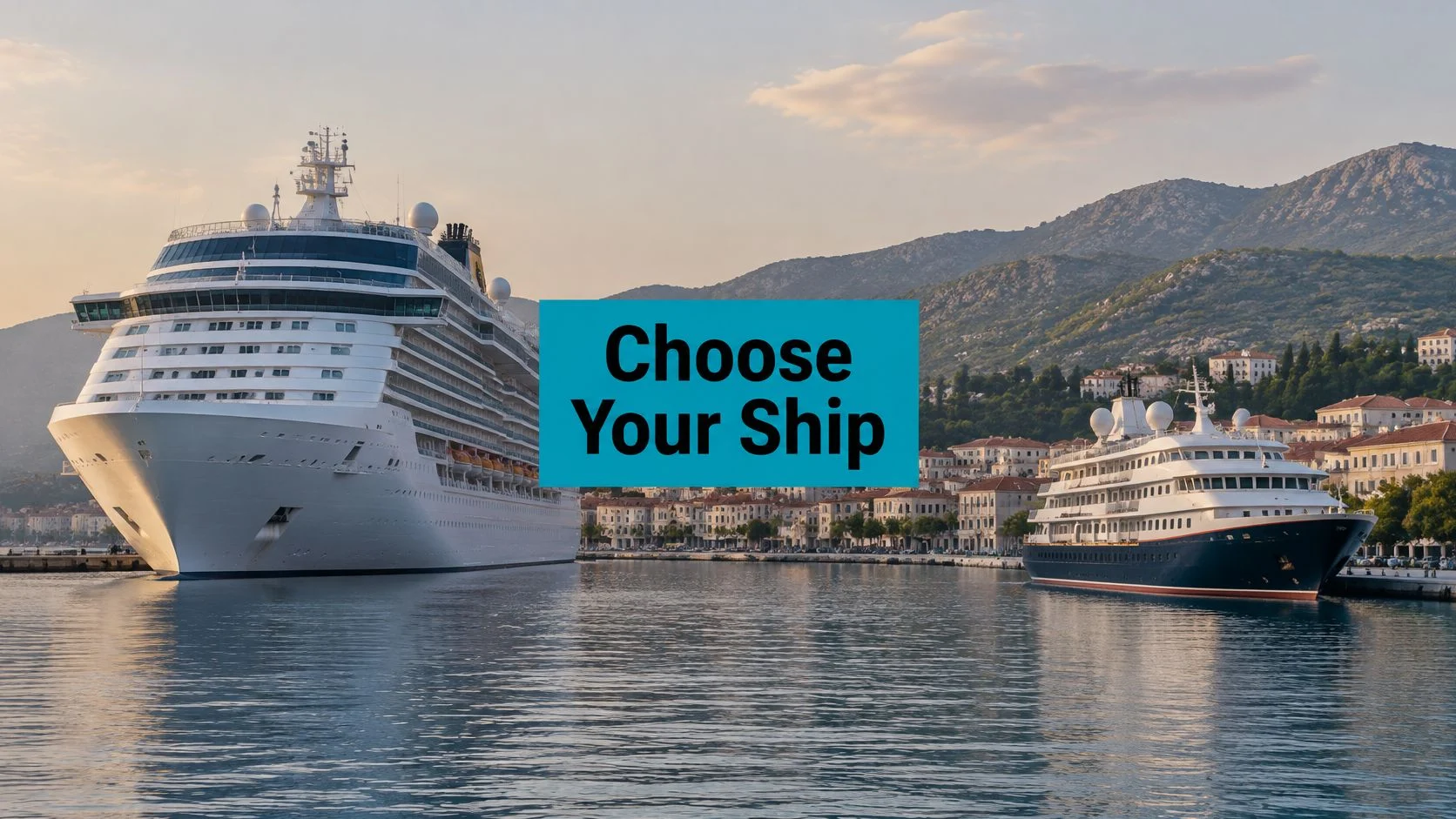
Pick the class first. Then compare only ships that are trying to do the same job.
Table of Contents
- Cruise Ship Classes Compared at a Glance
- Reading Size, Capacity and Space Ratio
- Amenities That Change Your Daily Experience
- Atmosphere and Crowd Feel by Ship Type
- Itineraries, Speed and Verifiable Emissions
- What the Cruise Price Really Includes
- Choose the Ship That Fits Your Trip
Cruise Ship Classes Compared at a Glance
Start with class. A family week in the Bahamas and a weather-dependent polar landing are not versions of one product, so jumping to a single vessel skips the decision that narrows the field.
| Ship class | Atmosphere | Usual itineraries | Price band |
|---|---|---|---|
| Mega ship | Busy, entertainment-led, strong family draw | Caribbean, Bahamas, Mexico, Western Mediterranean | Budget to mid-range |
| Large mainstream | Lively, broad mix of ages | Caribbean, Mediterranean, Alaska, Northern Europe | Budget to mid-range |
| Midsize | Calmer and easier to navigate | Caribbean, Bahamas, Alaska, Europe | Mid-range |
| Boutique small ship | Relaxed, social, less structured | Greek islands, Adriatic, Northern Europe | Mid-range to premium |
| Luxury | Quiet, service-led, dress codes possible | Worldwide, often longer voyages | Premium to luxury |
| Expedition | Lecture-led, outdoor focus | Polar, Arctic, Antarctic, Galapagos | Premium |
| River | Slow pace, shore-based culture | Rhine, Danube, Douro | Mid-range to premium |
Mega ships usually carry roughly 5,000 guests or more at full occupancy. Entertainment venues are large, and family traffic is heavy. You fit this class if you want a show, a slide, or a restaurant choice every hour and you accept lines.
Large mainstream ships, about 2,000 to 4,000 guests, stay lively across ages. They are the usual pick for a Caribbean, Mediterranean, Alaska, or Northern Europe week when you want variety without a full resort scale.
Midsize ships, about 1,000 to 2,000 guests, walk easier and run quieter. Fares typically sit in the mid-range, and the trade-off is fewer headline venues.
Boutique small ships, about 100 to 600 guests, drop the structured day. Greek islands, the Adriatic, and parts of Northern Europe suit people who would rather talk at dinner than chase a show.
Luxury ships, often about 100 to 700 guests, sell space and service. Fares frequently fold in more dining, drinks, and tips. Dress codes can apply, and voyages often run longer.
Expedition ships, about 100 to 250 guests, center on briefings and time outside. Polar, Arctic, Antarctic, and Galapagos landings move with the weather, so a locked port timetable is the wrong expectation.
River ships, about 120 to 200 guests, call at a town most days and sail mostly at night. The Rhine, Danube, and Douro reward people who want culture ashore, not sea days.
The CLIA 2024 member-fleet profile included 303 ocean-going ships with capacity for 635,000 lower berths, operated by 45 cruise-line brands, which is about 2,100 lower berths per ship. Midsize and large ships are the norm.
Practical rule: Pick the class first, then compare ships only inside that class. A 4,000-guest ship and a 200-guest ship answer different trips. Exact nightly fares still move with season and sailing date, so treat the price band as a bracket, not a quote.
Reading Size, Capacity and Space Ratio
Three published numbers sort ships inside a class better than a deck rendering. Gross tonnage measures enclosed volume, not how many people are aboard, so a high tonnage can still hide a crowded pool. Lower berths are the published capacity at two guests per cabin, and that is the base most fleet comparisons use. Space ratio is gross tonnage divided by lower berths. Values near 40 are typical on mainstream ships. Values above 50 usually mean more room per guest. Values under 30 usually mean dense public rooms.
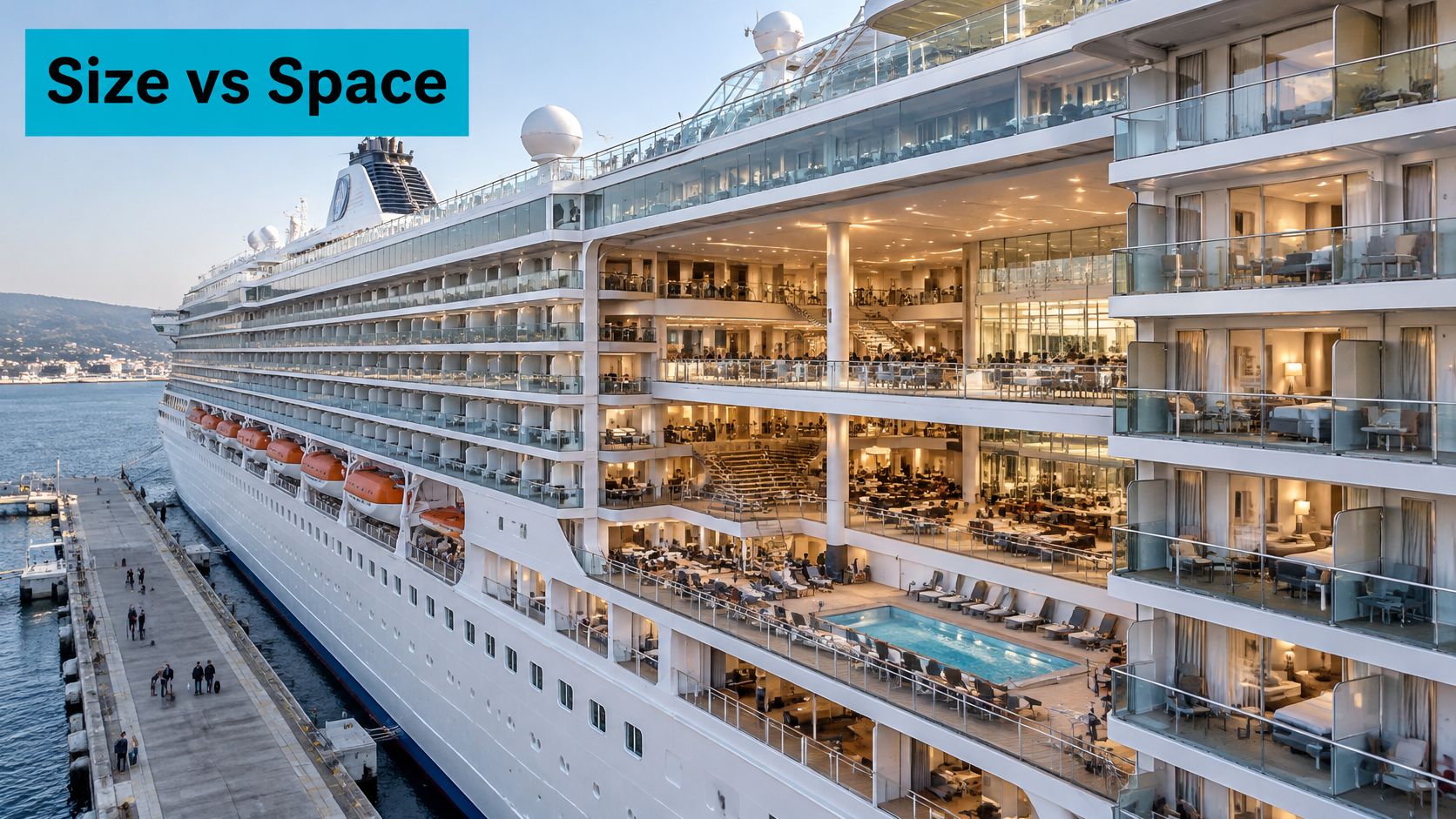
A wide hull at the pier does not tell you which of two sister designs will feel busier once both are full.
Same tonnage, different week
Say two ships are both 90,000 tonnes. One lists 4,500 lower berths, so the ratio is 20. The other lists 3,000 lower berths, so the ratio is 30. The first will feel busier at the pool and the buffet even though the volume matches. I would rank the second ahead for a couple who wants chairs, and the first only if the extra venues are the reason for the trip.
Why the ratio has to stay inside a class
Mainstream capacity has grown for decades while luxury and river ships have stayed small, so a raw tonnage ranking mixes products that should not share a shortlist. CLIA's state of the cruise industry report reports that approximately 1.9 million passengers took ocean cruises worldwide in 1985, compared with 34.6 million in 2024. The same report projected 37.7 million ocean-going passengers for 2025, and it put North America at 20.53 million passengers in 2024, roughly 59% of the global total. Large mainstream fleets sit beside smaller European, Asian, luxury, river, and destination ships. A luxury ratio above 50 is not "better" than a river ship built for 150 guests. It is a different product.
Maximum capacity is the trap. It counts third and fourth berths, so holiday weeks with full cabins run denser than the lower-berth figure suggests. Compute the space ratio from gross tonnage and lower berths for each shortlisted ship, then rank only within the class you already chose.
Amenities That Change Your Daily Experience
Count the venues you will use, not the venues the brochure can name. Two ships with eight restaurants can feel nothing alike if one includes dinner and the other charges for every specialty room.
| Traveler | Amenity to check | What to verify |
|---|---|---|
| Family | Kids' clubs by age band, family cabins | Program ages and whether specialty activities cost extra |
| Retiree | Accessible cabins, lifts, quiet decks | Cabin location relative to lifts and included dining |
| First-time cruiser | Dining options and entertainment | Whether specialty restaurants carry a surcharge |
| Nightlife seeker | Lounges, theaters, late venues | Late-night schedule on your exact sailing dates |
| Pool-focused guest | Main pool, adults-only deck | Number of pools and deck space per guest on that ship |
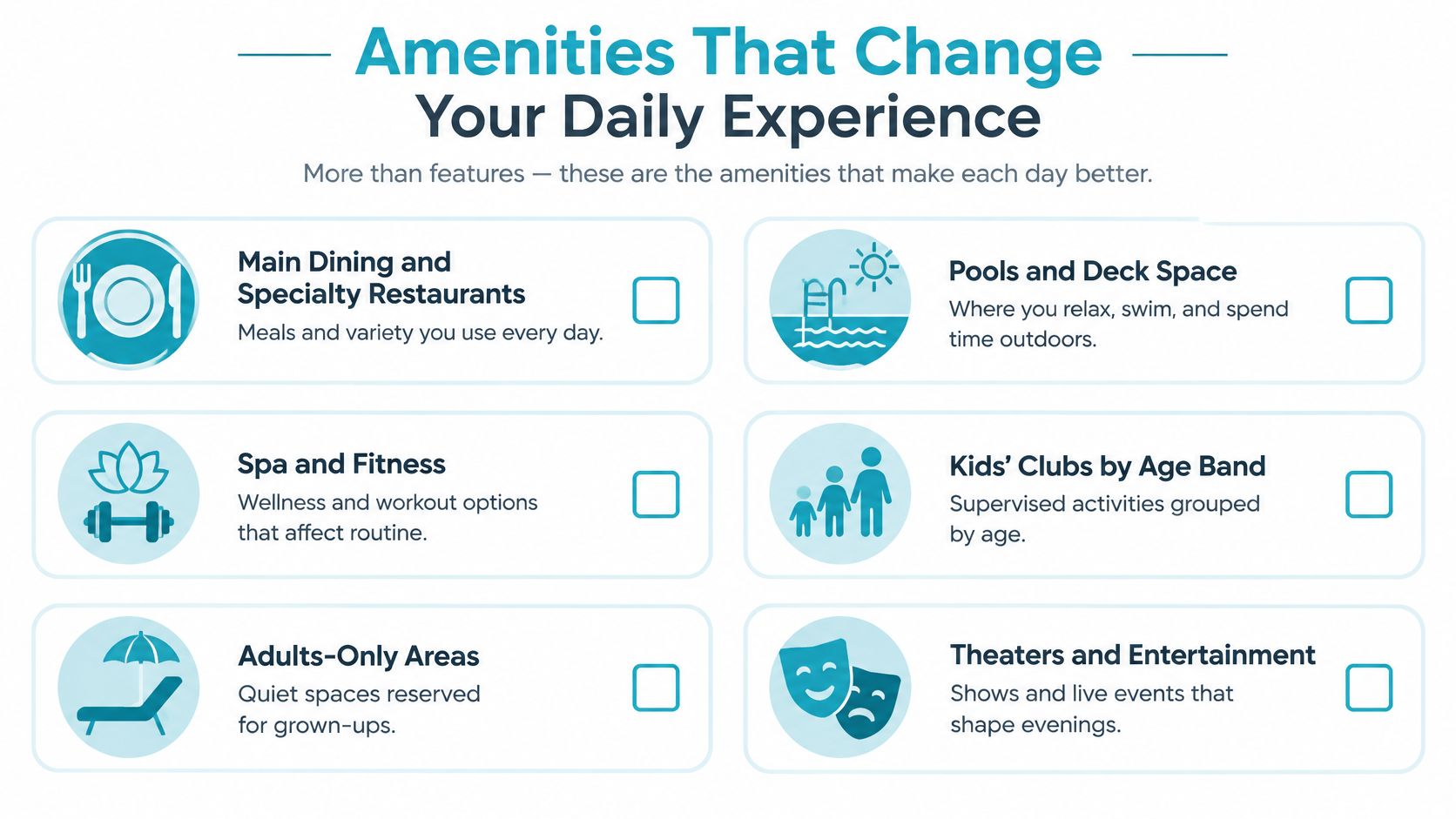
Match the list to the day you will actually have
A family should confirm kids' club age bands, connecting or family cabins, and whether a children's pool exists. A missed band, such as a club that stops at age 11 when you are traveling with a 12-year-old, matters more than a water slide you will use once.
A retiree should check accessible cabins, lift locations, quieter decks, and how much dining is included. A long walk from the cabin to the only included restaurant gets old by night three.
A first-time cruiser should check dining flexibility, what entertainment is included, and how far the theater sits from the cabins. Nightlife seekers need the late schedule on those dates, not last summer's. Pool-focused guests should ask how many pools that hull has and whether an adults-only deck is real space or a roped corner.
Included versus surcharged
Pull the deck plan for the specific ship. Sister ships drop or rename venues, and brochure copy often blends them. Then mark each room you care about as included or extra.
Build a ten-item shortlist from your own routine before you compare:
- Meals: main dining room plus the specialty rooms you will book.
- Included dinners: how many nights you can eat without a cover charge.
- Kids: age bands, hours, and whether special activities cost extra.
- Family cabins: beds, location, and sofa-bed limits.
- Pools: main pool, kids' pool, and adults-only deck on that hull.
- Quiet time: a deck or lounge that is not next to the theater.
- Evenings: theater, lounge, or nothing, based on how late you stay out.
- Wellness: gym access versus spa treatments that bill separately.
- Access: step-free routes, lifts, and cabin door width if you need them.
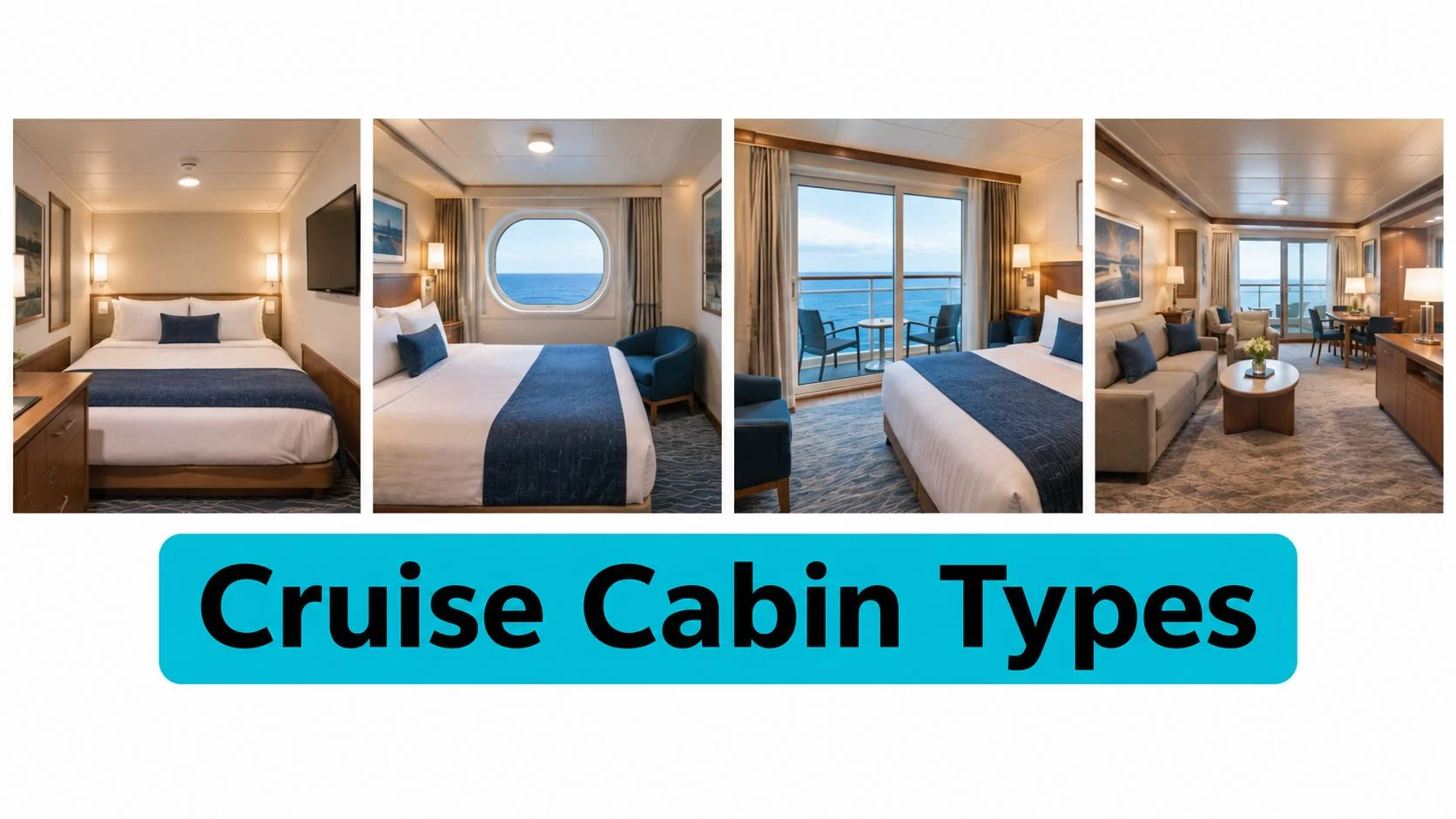
- Cabin type: inside, oceanview, balcony, or suite, priced for the nights you will be in it.
If two shortlists look equal, the ship that includes the dinners and shows you will use is the better daily experience.
Atmosphere and Crowd Feel by Ship Type
Atmosphere is how many people share one public room at the same moment. Guest count is only the start. Four tests tell you whether a sailing will feel festive or jammed.
On a Caribbean port morning, a mega ship's open decks can look almost empty while the ship is technically full. Half the guests are ashore. By early afternoon the main pool is packed for about two hours, loungers are claimed, and the buffet line doubles. That is density, not a bad review.
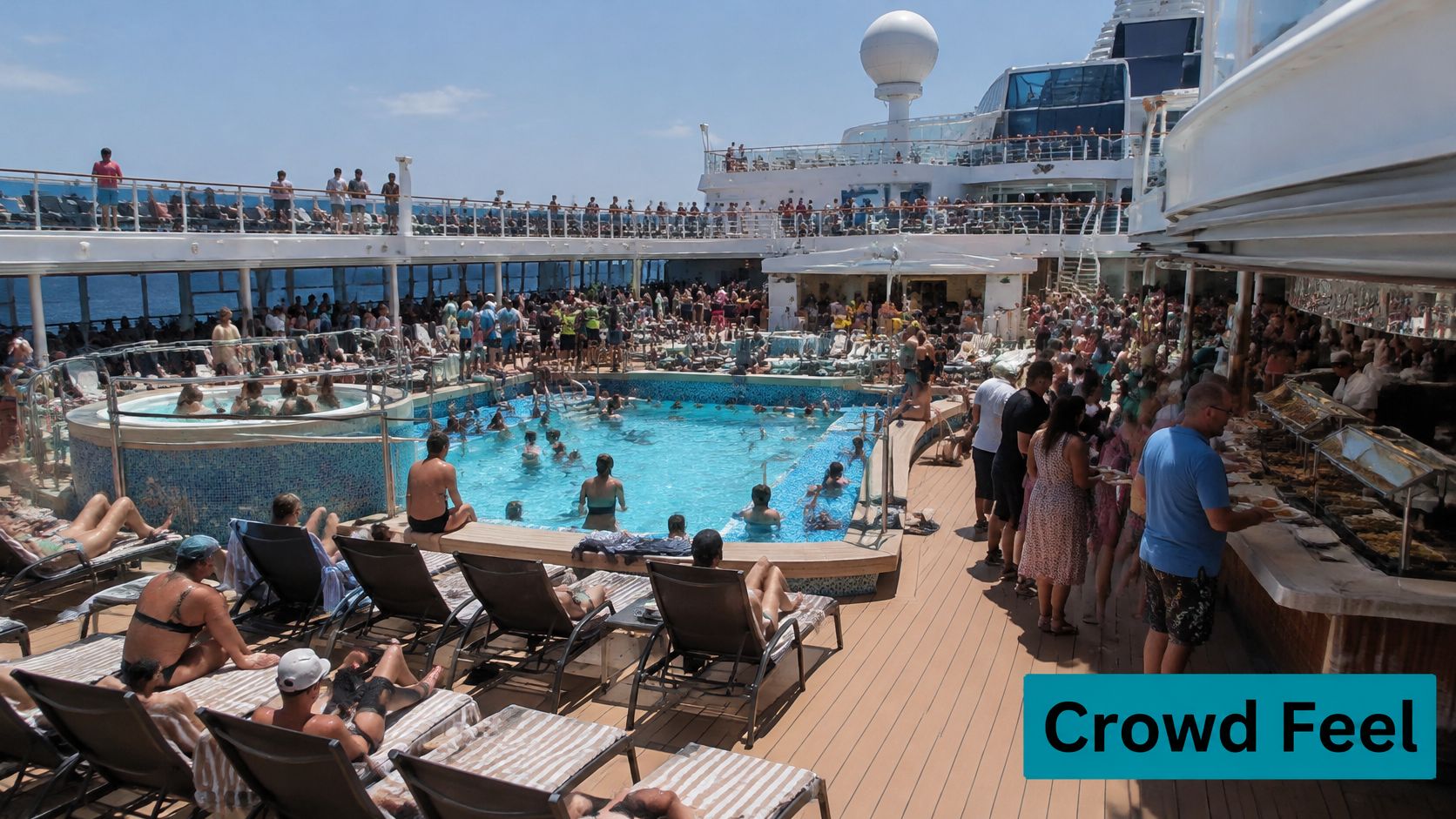
Four tests you can picture
Density is guests per pool, buffet line, and lounge. Use the space ratio you calculated as the starting sort, then read reviews that name a venue and a time of day. "Beautiful ship" does not help. "Could not get a chair at the main pool after 1 p.m." does.
Age mix follows the calendar. School-holiday sailings run family-heavy. Mid-week and adults-oriented departures usually feel quieter. Check your dates against school breaks before you blame the ship.
Tempo is the daily clock. A mega ship runs late entertainment and tight show times. A midsize ship splits social rooms and quieter decks. A small or expedition ship runs on briefings, shared meals, and time outside. If you want to set your own evening, the mega-ship clock will fight you.
Staffing shows up when something breaks. Luxury and expedition ships usually carry more crew per guest, so a cabin issue or a missed tender tends to get a named person faster. Mainstream ships can still serve well, but you are more often in a queue.
A packed pool for two hours and an empty deck at 9 a.m. can be the same ship on the same port day. Judge the hour you will actually be there.
Ask which deck the quiet rooms sit on, and whether that deck is above the nightclub. Recent reviews that mention a specific lounge, pool, or dining room are worth more than a star average.
A sunny pool deck in peak hour makes the density test obvious in a way a deck plan never will.
Itineraries, Speed and Verifiable Emissions
Sea days are time on board. Port-heavy weeks are sightseeing. Speed is the variable most comparison pages skip, and it changes both the day and the fuel bill.
| Itinerary pattern | Typical sea days | Port time | Best for |
|---|---|---|---|
| Caribbean 7-night loop | 1 to 2 | Most days in port | Port-focused first-timers |
| Transatlantic repositioning | Most days at sea | 0 to 1 port days | Travelers who want time on board |
| Alaska Inside Passage 7-night | 1 to 2 | Two or three ports with scenic cruising | Scenery seekers |
| Mediterranean 7-night | 1 to 2 | Five to six port days | Culture and city stops |
| Polar expedition | Several, weather-dependent | Weather-dependent landings | Wildlife and small groups |
| River cruise 7-night | 0 (sailing mostly overnight) | Daily port calls | Culture and a slower pace |
Why two matching weeks are not equal
Fuel demand rises sharply as speed goes up, so a ship pushed near its upper service speed burns far more than a slightly slower twin. A peer-reviewed passenger-ship emissions study found that reducing average speed by 2 knots, approximately 3.7 km/h, could reduce fuel-energy use by almost 20% under the modeled conditions, with about 70% of consumption and associated emissions during navigation and port docking at roughly 10–11% of total daily CO₂-equivalent emissions. Two 7-night Caribbean sailings on the same class can diverge if one stacks three fast sea days and the other keeps two slower ones with longer port stays.
Record published service speed, scheduled nautical miles, number of sea days, and port turnaround time. Those four fields connect the brochure route to time on board and to fuel.
Ratings you can ask for
Do not stop at fuel type. The IMO energy-efficiency regulations and guidelines set CII ratings from A to E, with A the strongest, and require ships of 5,000 gross tonnage or more to calculate EEXI and report annual CII under rules effective from 2023, using about 3.206 tonnes of CO₂ per tonne of diesel or gas oil, 3.151 for light fuel oil, and 3.114 for heavy fuel oil. EEXI is technical efficiency under a reference condition. CII is how the ship operated. The Energy Efficiency Design Index, in grams of CO₂ per capacity-mile, folds in size, capacity, engines, efficiency measures, and reference speed, and a lower value means better designed efficiency.
A large ship can burn more fuel in total and still look stronger per passenger-mile. A small ship can show lower absolute emissions and a worse figure per passenger-mile. Normalize for itinerary length, occupancy, speed, and hotel-load intensity before you call either one cleaner. Use those carbon factors only to audit a fuel figure the line has already reported.
Shore power only helps where that itinerary's ports can take the cable. CLIA's cruise industry reporting says 50% of current and prospective cruise travelers are more committed to considering environmental impacts than three years earlier, and that connecting to onshore power can allow engines to be switched off and reduce emissions by up to 98%, depending on circumstances. A capability sticker without a compatible berth is a marketing line.
Ask the line three things about that ship and that date: the latest CII rating, reported fuel consumption with the propulsion setup, and which ports on this route offer compatible shore power.
What the Cruise Price Really Includes
A headline fare is a starting line, not a week. Compare the items you will pay, then turn them into one nightly number.
| Cost item | Usually in base fare? | How to compare |
|---|---|---|
| Cruise fare | Yes | Compare per person per night at double occupancy |
| Port fees and government taxes | Often added on top | Confirm the all-in total for your party |
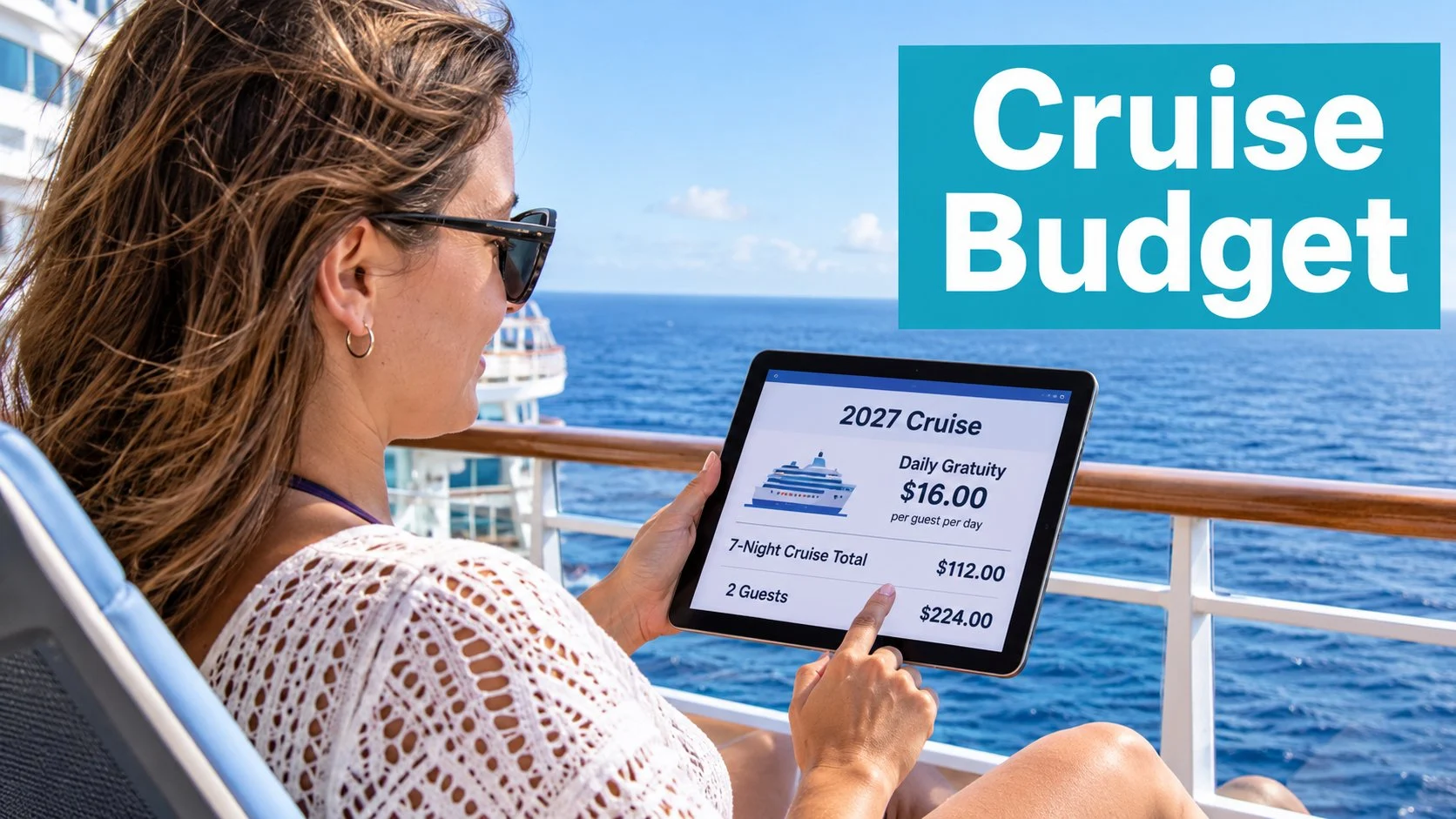
| Gratuities | Often added per day on mainstream lines | Multiply the daily rate by nights and guests |
| Drinks package | No | Compare against your expected daily drink count |
| Wi-Fi and internet | No | Compare tiers for messaging versus streaming needs |
| Shore excursions | No | Compare against booking independently at the port |
| Airfare | Usually no | Check whether the booking includes flights |
| Travel insurance | No | Price depends on fare and trip length |
Five steps to one nightly cost
- Add the cruise fare for your full party at double occupancy. A solo supplement, if it applies, goes in here, not later as a surprise.
- Add port fees and government taxes. They are often printed apart from the fare, and they are not optional.
- Add gratuities for every night and every guest. Many mainstream lines add a daily amount. Many luxury fares already include it, which is why their headline looks higher.
- Add only the extras you will use. Price a drinks package against your real daily drink count, pick the Wi-Fi tier you need for messaging or streaming, and add two or three shore excursions you know you will take.
- Divide the total by nights, then by guests if you want a per-person figure. That is the number you compare.
Say a mainstream quote is a $900 fare, $250 in fees, and about $16 a day in gratuities over seven nights. That is $1,262, or about $180 per person per night, before drinks, Wi-Fi, or tours. An inclusive fare of $1,100 that already covers tips and a basic drink list can be the cheaper week once you add those same items to the first quote.
Airfare is usually separate, and so is travel insurance, which moves with the fare and the length of the trip. Leave both out of the nightly cruise figure, then add them once at the end so every sailing carries the same extras.
The cheapest headline fare is often the most expensive once the total is built. I would not book on the banner price.
Choose the Ship That Fits Your Trip
Score the sailing, not the brand video. Use six criteria, each from 1 to 5: ship class, amenities you will use daily, atmosphere, itinerary and speed, true nightly cost, and verified environmental data. A 5 means that sailing clearly fits this trip. A 1 means it fights the trip. Weight nothing extra unless one criterion is a deal-breaker, such as a missing accessible cabin.
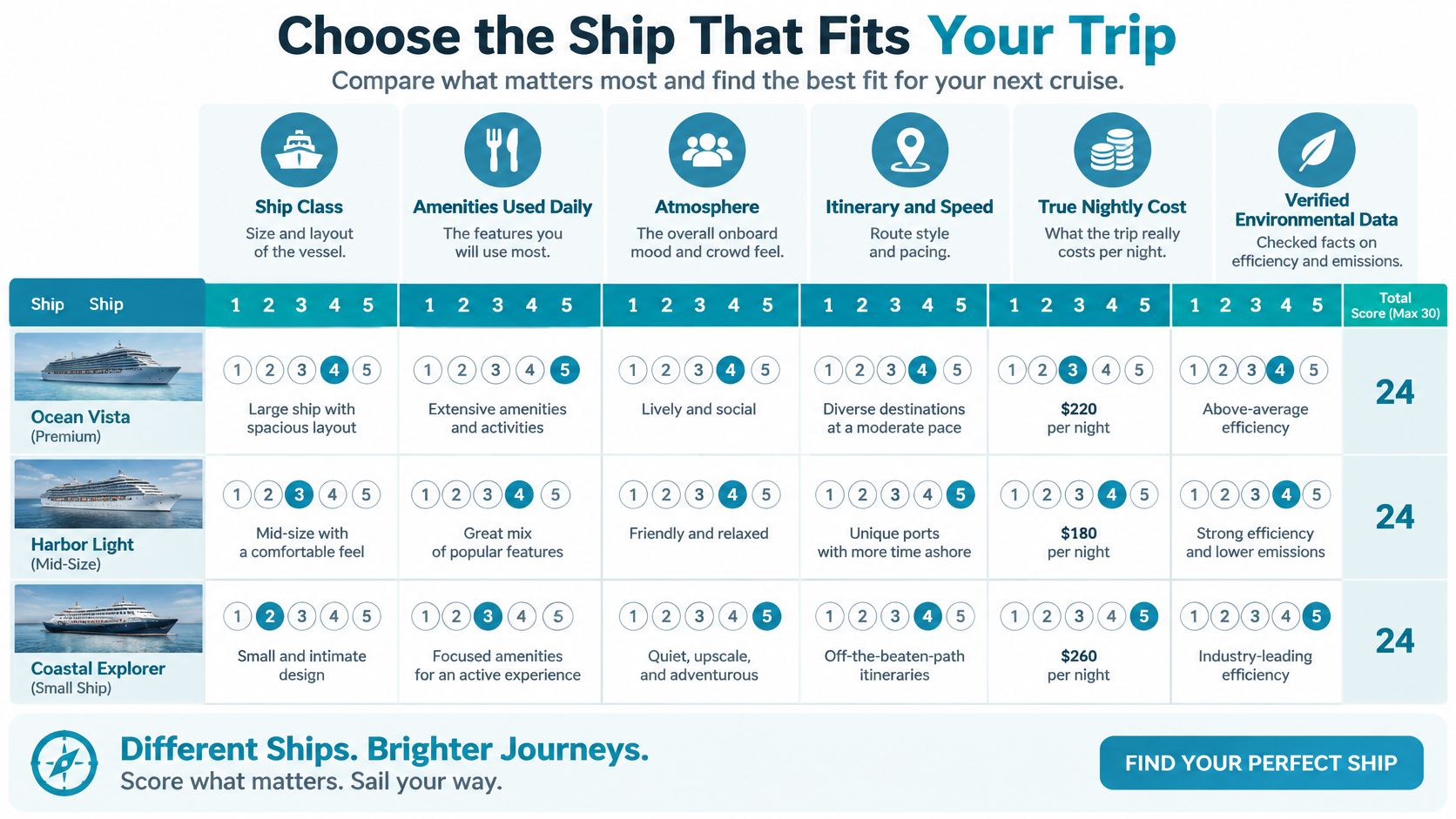
Who usually wins which shortlist
First-time cruisers usually do best on a midsize or large mainstream ship with a port-heavy 7-night route. You see ports, you learn the rhythm, and you are not stuck on a five-day ocean crossing.
Families usually do best on a large ship with real age-banded kids' clubs. Book outside peak school holidays when you can. The ship is the same, the crowd is not.
Retirees usually do best on a midsize or luxury ship with accessible cabins, included dining, and fewer sea days if the point is ports rather than the ship itself.
Luxury travelers usually do best on a luxury or boutique ship with more crew per guest. Pay for inclusions you will use, not for a longer restaurant list.
Wildlife and polar travelers belong on an expedition ship, with plans that can move when ice or wind closes a landing. A fixed "must see this bay at 10 a.m." itinerary is the wrong tool.
Book from the score, not the banner
- Choose the ship class based on the trip, not from a sale banner.
- Shortlist three sailings within that class, on dates you can travel.
- Score each one from 1 to 5 on the six criteria.
- Put the all-in nightly cost next to the score so a cheap misfit cannot win on price alone.
- Book the strongest score. If two tie, take the one with the cleaner cost and the CII rating you could verify.
On each sailing, our compare tool lets you compare up to six sailings side by side for rates, itinerary, ship profiles, and more, and a free cruise quote is available if you would rather have the numbers pulled for you. If you find a lower price than the cruise line after booking but before final payment, in U.S. dollars and advertised anywhere, we will contact the cruise line to re-fare to the best promotion, and additional restrictions may apply.
Best Cruise Rates can line up the class, the itinerary, the all-in nightly cost, and the ship profile for the sailings you are choosing between. Compare up to six options in one place, or ask for a free cruise quote and run the scorecard before you commit. Visit Best Cruise Rates when you are ready to put real departures next to each other.
Ready to book your next cruise?
Compare 40+ cruise lines or call our specialists at 1-888-604-0279.